Walmer Castle and Gardens, Kent
Walmer Castle and Gardens, Kent
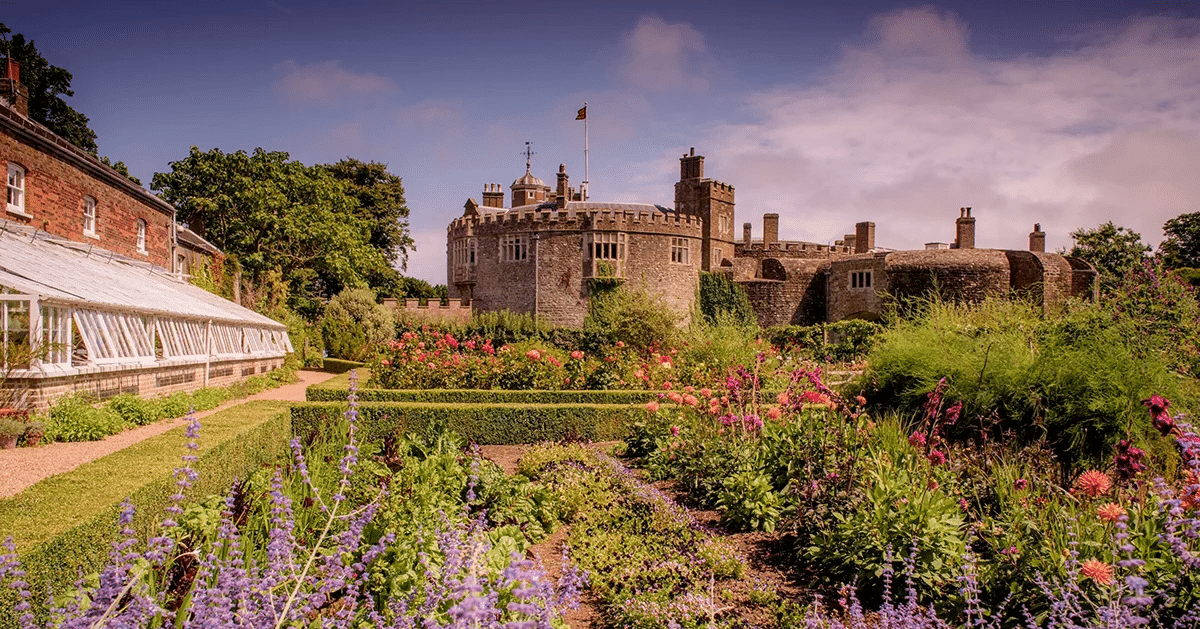
A Tudor artillery fort built to defend England from invasion by France, never put to that particular use, gradually converted over three centuries into an elegant seaside residence for some of the most famous figures in British history. The Duke of Wellington died here in 1852. Rupert Brooke almost certainly finished his most famous poem here in January 1915. The gardens were designed by Penelope Hobhouse. The man whose fall from grace inspired Evelyn Waugh to write Brideshead Revisited lived here for nearly thirty years. It is, for something that started as a gun emplacement, an extraordinarily literary address.
Most of the houses on this Kent shelf sit inland, in valleys, on hills, in the comfortable middle-distance of the Weald. Walmer is different in every particular: it sits on the coast, looking directly at France across a stretch of the Channel where the current runs hard and the wind is honest, on flat ground that made it useful to Henry VIII and makes it unforgettable to anyone who has stood on its ramparts in September with the sea doing what the sea does and Dover a silhouette to the west. It is the coastal member of this collection, and the feeling of it — the salt air, the wide sky, the sense of being at the edge of something rather than the comfortable interior of it — is unlike anything else in this corner of Kent.
It is also, beneath its seaside ease, a place of considerable historical density. What begins as a Tudor gun emplacement ends, by some alchemy of time and occupation, as one of the most storied addresses in England: the official residence of the Lord Warden of the Cinque Ports, a title so ancient and so oddly persistent that it has been held, at one time or another, by a Prime Minister who used it to plan the defence of England against Napoleon, a general who won Waterloo and then retired here to die in a chair, a Prime Minister who couldn’t use it because it was within range of the German guns across the Channel, and a queen who held the title for fifty years and died at the age of a hundred and one.
Why Henry Built It
In 1539, Pope Paul III achieved something that had eluded him for years: he persuaded Francis I of France and the Holy Roman Emperor Charles V to end their long hostility to each other, and he urged both of them to invade England. Henry VIII had outraged the papacy by his divorce from Catherine of Aragon, his seizure of the Church in England and his dissolution of the monasteries, and the Pope considered him fair game for the combined forces of two of the most powerful rulers in Europe.
Henry responded with characteristic decisiveness by building, very quickly, a chain of artillery forts along the vulnerable southern and south-eastern coast. Walmer was one of three built between 1539 and 1540 along a single two-and-three-quarter-mile stretch of the Kent coast, alongside Deal and Sandown. Each was built in the Tudor rose plan — a circular keep surrounded by a ring of semicircular bastions, designed to mount and absorb artillery — and each was garrisoned from 1540. The invasion from France and the Empire never came. The Pope’s treaty collapsed under its own contradictions. Henry’s fortifications stood ready for a threat that did not materialise, which is, if you think about it, the most satisfying possible outcome for a defensive structure.
Walmer saw action eventually, but not from the expected direction: during the English Civil War it was held by Parliamentarian forces, and in the Dutch Wars of the 1650s and 1660s it was used to protect shipping in the Downs, the important anchorage just offshore. A major sea battle between the Dutch and the Spanish was fought in full view of the castle in 1639, which must have been an extraordinary spectacle for those watching from the ramparts. By the end of the seventeenth century, however, Walmer’s military utility was essentially spent, and in 1708 the castle acquired a new identity entirely.
The Lord Warden, and Why It Matters
The Cinque Ports — pronounced, correctly and counterintuitively, “sink ports” — were five major harbours on the south-east coast: Sandwich, Dover, Hythe, New Romney and Hastings. Since before the Norman Conquest they had formed a defensive and trading alliance, providing ships and men to the Crown in return for extraordinary privileges of self-government, and their royal charter of 1155 made the alliance a formal constitutional entity. The Lord Warden was their head: the Keeper of the Coast, the guardian of the Channel’s English side, one of the most powerful regional offices in the medieval and early modern state.
By 1708 the role had lost its military urgency without losing its prestige, and when the 1st Duke of Dorset was appointed that year he found the existing Lord Warden’s residence at Dover Castle unsatisfactory — probably because it was in a semi-ruinous state — and moved into Walmer instead. He adapted and extended the Tudor fort into something approaching habitable comfort, and established the precedent that his successors followed: Lords Warden would live at Walmer, and Walmer would become, gradually, the house that their occupancy made it.
The painting the Duke commissioned to mark his installation still exists, a formal equestrian composition by John Wootton showing the ceremony at Dover. It now hangs in the Great Hall at Knole — one of those quiet connections between the houses on this shelf that become more visible the more of them you visit.
The Lords Warden: A Brief Portrait Gallery
The occupancy of Walmer reads, across three centuries, like a compressed history of British political life: a sequence of powerful, complicated, and occasionally scandalous figures who brought their lives and their furniture and, in some cases, their best ideas to a castle on a cliff above the Channel.
William Pitt the Younger arrived as Lord Warden in 1792, just as Britain was about to face the most serious threat to its security since the Armada. He used Walmer as a base from which to plan the coastal defences against Napoleon, to build and finance the European resistance to France, and to drill the volunteer troops who might be needed if the French actually crossed. Important people came and went constantly: soldiers, politicians, naval officers, strategists. An inventory after his death in 1806 shows most first-floor rooms in the keep were bedrooms. He ran the position, essentially, as a working government outpost.
With him came his niece, Lady Hester Stanhope, who had escaped her father’s harsh household at twenty-seven and installed herself at Walmer as Pitt’s hostess, confidante and nurse until his death in 1806. She helped transform the gardens — the pleasure grounds that Pitt extended and which she shaped during her years here. After his death she left England, travelled widely through Europe and the Middle East, was shipwrecked off Rhodes in 1812 and, having lost her entire wardrobe in the wreck, permanently adopted male Turkish dress for the rest of her life. She settled in a ruined convent in Lebanon and became, in time, one of the most remarkable English women of the century. Her story begins at Walmer.
Lord Liverpool, Pitt’s successor, bought the land on which the pleasure grounds had been made and gifted it to the castle permanently, which is the reason those grounds still exist. Later, Earl Granville — who made Walmer his primary family home from 1865 to 1891 and hosted fashionable parties in its rooms — commissioned George Devey to extend the accommodation and revitalised the gardens with new planting and design. His time at Walmer was not, however, entirely smooth. An inclination for relationships that were illegal at the time attracted growing gossip, and in 1931 his brother-in-law, the Duke of Westminster, outed him publicly, forcing him to leave the country. The writer who immortalised this story was Evelyn Waugh, who fictionalised the fall of William Lygon, 7th Earl Beauchamp in the novel he published in 1945 as Brideshead Revisited. The castle’s guest list includes, by this route, the inspiration for Sebastian Flyte.
Winston Churchill became Lord Warden in 1941, mid-war, and noted to the Minister of Works that he could neither live at Walmer — it was within range of the German artillery along the French coast — nor afford to live there afterwards, and that he hoped the state would take care of it. The Queen Mother, appointed after Churchill and the only woman ever to hold the post, remained Lord Warden until her death in 2002 at the age of 101, having held the role for fifty years. She made only intermittent use of the castle but the garden she commissioned in 1997 — a ninetieth birthday gift from English Heritage, designed by Penelope Hobhouse — is among the finest things at Walmer and is discussed below.
Wellington: The Room at the End
The Duke of Wellington is Walmer’s most significant resident, and the most present. He held the role of Lord Warden for twenty-three years, from 1829 until his death in 1852, and he came to the castle every autumn, treating it as the closest thing he had to a private retreat from the public life that had consumed him since Waterloo. He was not, by most accounts, a relaxed host — the regime at Walmer was spartan by the standards of the day, and he expected his guests to keep military hours — but he valued the castle, the view, the solitude that the Channel provided, and the sense of being, briefly, away from the demands that his celebrity had made inescapable.
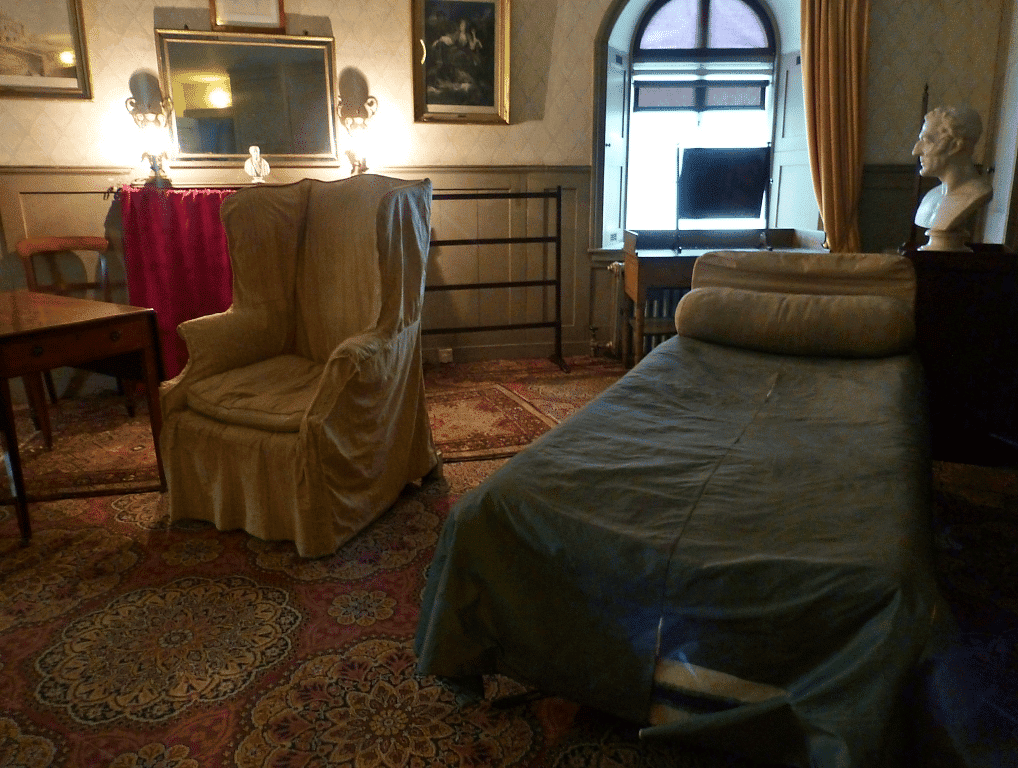
He died on the afternoon of 14 September 1852. His valet found him that morning unable to stir from his small campaign bed — the same folding bed he had used since the Peninsular Wars, the one that the cartoonist William Heath had drawn in 1829 with the caption “Take up your bed and walk.” He was moved to his armchair and made comfortable. He died that afternoon. He was eighty-three.
His body lay at Walmer for two months while preparations for the state funeral were made. In the final two days, around 9,000 people came to stand in the room and look at him. His funeral procession in London drew more than one and a half million people lining the route, the largest funeral crowd the country had ever seen. “Now it will be seen how a nation can mourn,” wrote one observer, and they did.
The room where he died has been restored to its appearance at the time of his death, drawing on a watercolour made shortly afterwards by Thomas Shotter Boys. The campaign bed is there. The armchair is there. The wallpaper has been recreated from the original. The carpet is a reproduction of what was on the floor when his valet found him that morning. Three days after his death, the sculptor George Gammon Adams arrived to make a death mask. That, too, is here. It is one of the most quietly affecting rooms in any English house, partly because it is so small and so plain — a soldier’s room, not a statesman’s, without grandeur or decoration — and partly because the object you are standing in front of is not a portrait or a relic but simply the chair in which a man sat, on an ordinary afternoon in September, and died.
The boots are nearby, and they deserve their paragraph. In the early 1800s Arthur Wellesley, then Viscount Wellington, asked his shoemaker in St James’s Street to make him a new style of boot, easier to wear with trousers than the heavy Hessian design then in fashion. After Waterloo in 1815, these boots became fashionable across England, adopted by everyone who wanted to align themselves with the century’s greatest military victory. The pair at Walmer are his own: soft calfskin, with spurs at the heel, the originals that gave the object its name. The idea that Wellington’s most democratic legacy — the boot everyone pulls on in the rain — is sitting in a glass case on the Kent coast is the kind of detail that deserves stopping in front of.
Rupert Brooke, and the First World War
In January 1915, the poet Rupert Brooke stayed at Walmer Castle at the start of his military service with the Royal Naval Division. He is believed to have finished his most famous sonnet here, in a room above the gardens, in the first days of a war that had not yet declared its full scale to the people who were entering it. The poem is The Soldier: “If I should die, think only this of me: / That there’s some corner of a foreign field / That is forever England.” He was dead of blood poisoning by April, on a hospital ship in the Aegean, four months after he wrote it. He was twenty-seven.
The following summer, the Prime Minister Herbert Asquith convened a meeting at Walmer attended by Winston Churchill, Field Marshals Kitchener and French, and other ministers, to plan the progress of the war. All present, the accounts suggest, were very aware of the great man in whose footsteps they were treading. This particular awareness must have been strange: to plan a war in the rooms of a man who had been the decisive figure in the last great European conflict, whose portrait watched you from the walls, whose campaign bed was down the corridor.
The Gardens
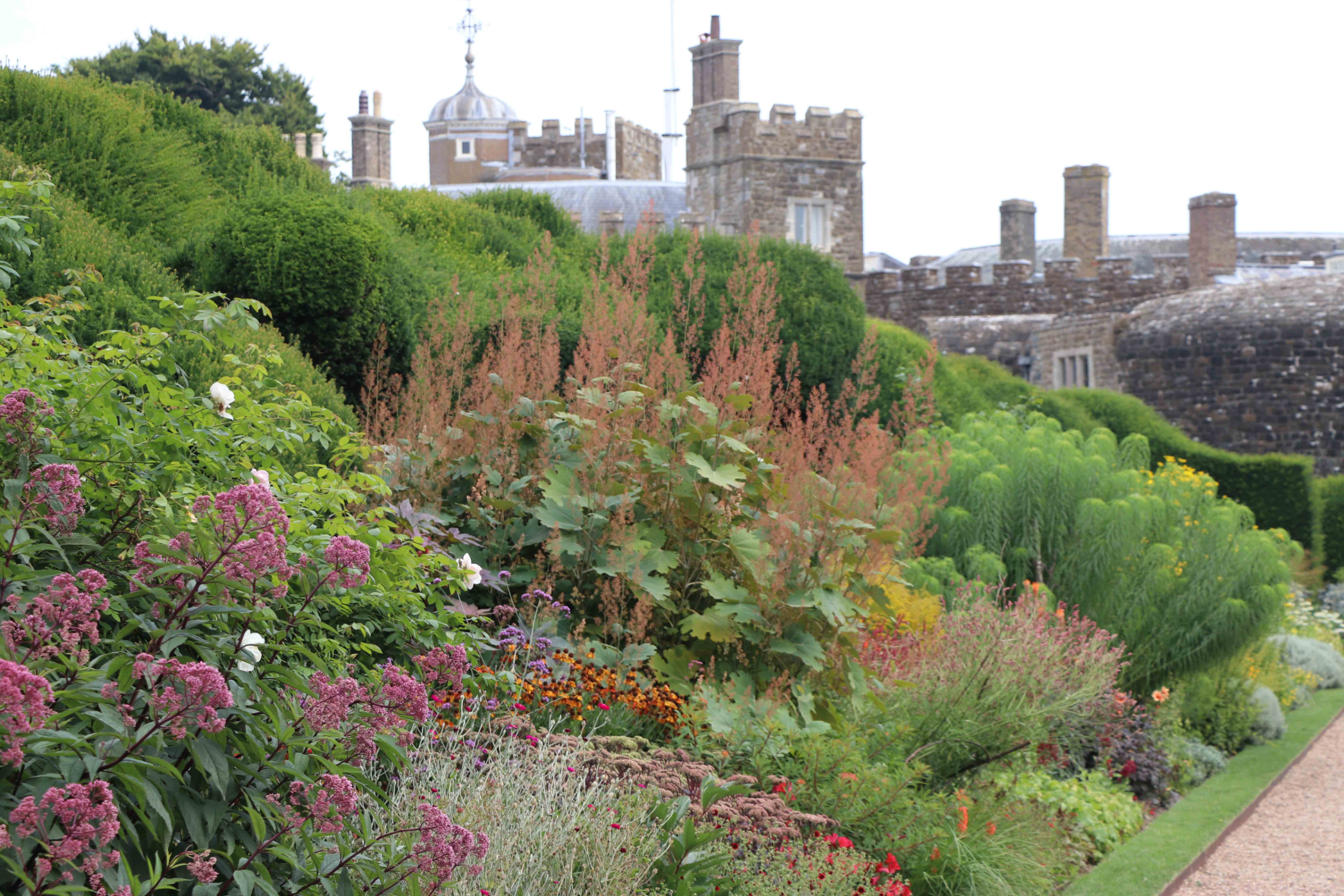
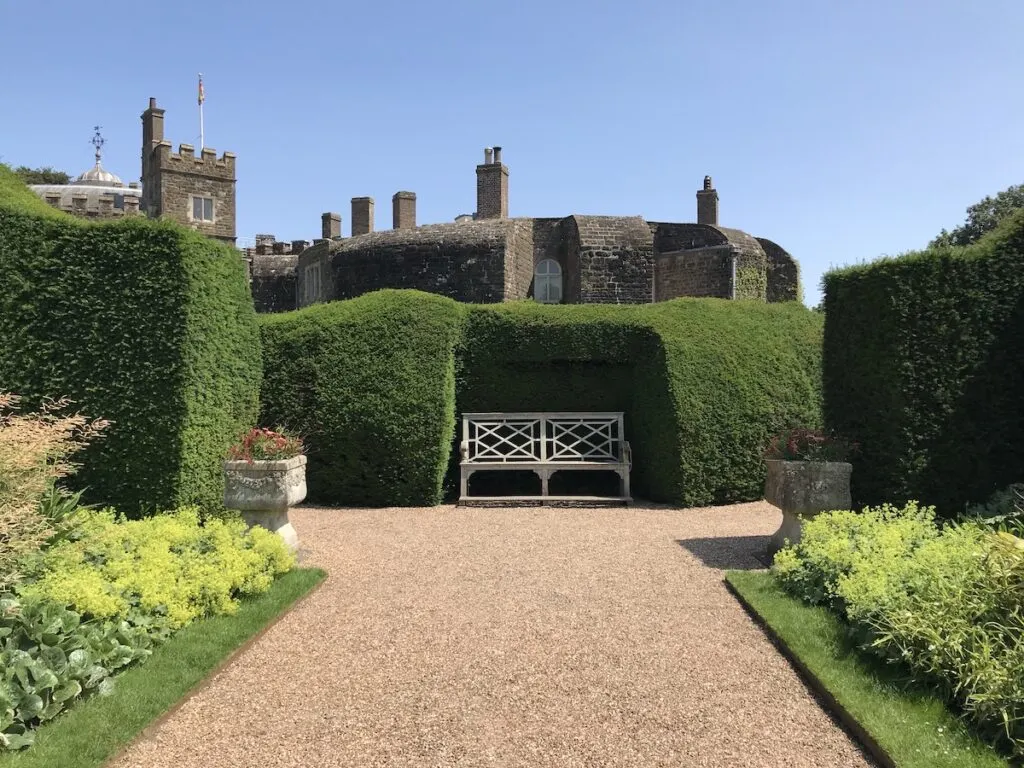
The gardens at Walmer have been made and remade by successive Lords Warden, each adding a layer to the landscape that the next inherited. Pitt extended the grounds and framed them with woodland plantations. Lady Hester Stanhope shaped them during her years as his hostess. Earl Granville revitalised and planted extensively. English Heritage has invested substantially in their most recent restoration, and the result is a garden that earns its eight acres and its award several times over.
The kitchen garden has been growing produce for the castle for nearly three hundred years, first recorded on a plan of 1725, its four quadrants and perimeter paths still essentially as they were laid out under Pitt. The fruit and vegetables grown here still supply the tearoom, which makes the connection between the garden and the cup of tea at the end of the visit a specific, agricultural thing rather than a vague claim about provenance.
The Broadwalk and its yew cloud hedge are among the most distinctive horticultural features on the estate: a broad formal walk lined with mature yew that has been clipped into the billowing, asymmetrical cloud shapes that give it an atmosphere both ancient and entirely contemporary, the topiarist’s art taken seriously rather than decoratively. The wildflower meadows, the shady woodland walks where snowdrops appear in February and the leaf colour turns through the autumn, and the restored Glen Garden — the enclosed and sheltered hollow that English Heritage has recently brought back to productive life — give the grounds a variety of register and season that a single visit rarely exhausts.
The finest single addition to the gardens is the Queen Mother’s Garden, designed by Penelope Hobhouse in 1997 as a gift from English Heritage to mark the then Lord Warden’s ninety-fifth birthday. Hobhouse’s enclosed garden, sheltered within its own walls, mixes the formal and the romantic in the way her best work always does, the planting generous and seasonal, the structure sufficiently clear that the garden holds its character in winter as well as summer. It is worth seeking out specifically rather than stumbling upon.
What to See Inside
The castle’s interior follows the circular route dictated by its plan, moving through rooms that reflect the different periods of its occupation. The Wellington Room is the obvious centrepiece, but the rooms associated with William Pitt — including a print room decorated with the satirical cartoons of his era, including some remarkably irreverent treatment of a Prime Minister who had helped save Europe from Napoleon — give the castle its political dimension alongside the military one. The collections associated with successive Lords Warden were protected from dispersal by an Act of Parliament secured by WH Smith in 1891 — yes, the same WH Smith of the newsagents, who became Lord Warden that year — which means everything you see has been here, protected by statute, ever since.
The views from the ramparts, particularly to the east across the Downs towards Deal and to the west towards Dover, remind you of what the castle was built for and what it has never needed to do: to stop an army coming across that particular strip of water. The water is always there, in every direction you face.
The Setting, and What Else to Find
Walmer sits between the village of Walmer and the town of Deal, and both reward exploration before or after the castle. Deal is one of the most characterful small towns on the Kent coast, its high street running parallel to the shingle beach, its Georgian architecture well-preserved and its independent shops, cafés and restaurants giving it a genuine, specific local life rather than the generic seaside offer. The pier is Victorian and elegant. The fishing boats still work the beach. The Time Ball Tower, built in 1821 to signal noon to ships in the Downs, is a small museum worth an hour. Deal Castle, another of Henry VIII’s chain of artillery forts and managed by English Heritage, is a short walk up the beach, and the combined ticket makes good sense for anyone who wants to understand the full defensive geography of this stretch of coast.
The Practical Details
Walmer Castle is on the B2057 between Deal and Kingsdown, on the coastal road, approximately two miles south of Deal town centre. Deal railway station is the most practical approach by rail, served from London St Pancras via the high-speed line in around one hour and twenty minutes; a taxi from Deal takes five minutes or a pleasant coastal walk twenty. By car, the M2 and A2 give access to the Dover and Deal area, with the castle clearly signposted from the main road.
English Heritage manages the property and admission requires an English Heritage membership or a standard ticket. Members visit free and parking is free. Non-members should check current ticket prices on the website. The Lord Warden’s Tea Room serves food made, where possible, from the kitchen garden’s produce, which closes the loop from the garden to the table with satisfying directness.
The castle and gardens are open year-round, though the castle interior has slightly reduced hours in winter and the gardens keep wider seasonal access; check the English Heritage website before travelling. An apartment within the castle — overlooking the kitchen garden and the cloud hedge — is available to rent for overnight stays, which gives access to the garden at its quietest and the rampart views at dawn without competition from day visitors, which is a particular form of luck.
Walmer Castle and Gardens Kingsdown Road, Walmer, Deal, Kent CT14 7LJ
english-heritage.org.uk/walmer
0370 333 1181
Open year-round (check website for seasonal hours). English Heritage members free. Deal station approximately two miles; London St Pancras via high-speed line approximately 1hr 20 mins.
If You’d Like To Find Out More About Walmer Castle Click This Link
About the Author: Lara S

The Finer Map



Get our latest Delivered
Beautiful recipes, inspiration, guides and news that makes you want to live!