Feature town – Folkestone, by the sea
Folkestone, With Its Edges Showing
Folkestone is not the neatest of Kent’s coastal towns, and it is better for it. There is sea air, Victorian promenade, serious public art, a harbour arm brought back to life, a steep old street full of creative businesses, and just enough roughness left at the edges to stop the whole thing becoming too pleased with itself.
Let us begin with the obvious: Folkestone has had a glow-up. The phrase is unavoidable, although one says it with some reluctance, because towns are not kitchen backsplashes and should not be spoken of as though they have recently discovered limewash. Still, Folkestone has changed. The old harbour has become one of the most interesting seafronts in Kent, the Creative Quarter has given the old town a new nervous system, and public art now appears across the town with the sort of confidence usually reserved for cities with better funding and worse weather.
And yet Folkestone has not been polished smooth. That is its advantage. It still has working-town corners, sudden oddness, slightly tired stretches, bits of seaside grandeur, streets that do not quite know what era they belong to, and views across the Channel that make even the most functional building look momentarily poetic. It is not Whitstable with oysters and weatherboard. It is not Deal with Georgian manners. Folkestone is more restless than that: port town, resort town, art town, railway town, almost-France town. A place in the middle of remaking itself, which is often more interesting than a place that has already decided exactly what it is.
This is a piece about how to use it well: the harbour, the old streets, the promenade, the art, the food, the walks, and the places beyond the town where the coast begins to feel wilder.
A town made by the sea, then remade by the railway
Folkestone’s history is tied to movement. Long before the Harbour Arm served spritzes and street food, ships were using this stretch of coast, though the shifting sands and shingle made the business rather less glamorous than the present-day promenade might suggest. The modern story begins properly in the nineteenth century, when the railway arrived in 1843 and changed the town’s fortunes almost at once.
The South Eastern Railway saw Folkestone as a rival to Dover for cross-Channel traffic, and the harbour branch line, descending steeply from the mainline station to the sea, became one of the town’s defining pieces of engineering. Steam packets ran to Boulogne and Calais, the harbour station sent passengers towards the Continent, and Folkestone became not simply a seaside resort but a place of departure. One came here to take the air, but also to leave England.
That double identity still lingers. On the Leas, the town remembers its more elegant resort life: broad promenade, sea views, pale facades, elderly hotels and the faint echo of people who once dressed properly for a walk. Down at the harbour, it remembers the port: rails, platforms, piers, ferries, warehouses, and the practical business of getting people, luggage and expectation across water.
The Leas Lift belongs to that age too. Opened in 1885, the water-balanced funicular carried visitors between the clifftop promenade and the beach below, saving them from the steep walk and, one imagines, a good deal of Victorian perspiration. It has been closed since 2017, but restoration work is under way, with reopening planned for 2026. When it returns, Folkestone will regain one of those details that makes a town feel more itself.
The harbour awake again
If you only have a few hours in Folkestone, begin at the Harbour Arm. It has the clearest sense of the town’s recent reinvention: old infrastructure, new appetite, sea on both sides and the feeling that someone has worked out what to do with a place that might otherwise have been left to rust and nostalgia.
The arm itself was completed in the early twentieth century as part of Folkestone’s working harbour, but its current life is less about departure and more about lingering. It is now a promenade out to sea, lined with independent food and drink businesses, bars, small shops, music, events and the kind of seating that makes an English person look optimistically at the sky and say, “I think it might hold.”
There are worse ways to spend an afternoon than walking out along it with something in hand. The view back towards the town is instructive: the cliffs, the old station, the new development, the beach, the hotels on the Leas, the gulls doing exactly what gulls do and showing no remorse for it. On a clear day the French coast appears across the Channel, which always gives Folkestone a little extra charge. The town looks English, but the horizon keeps interrupting.
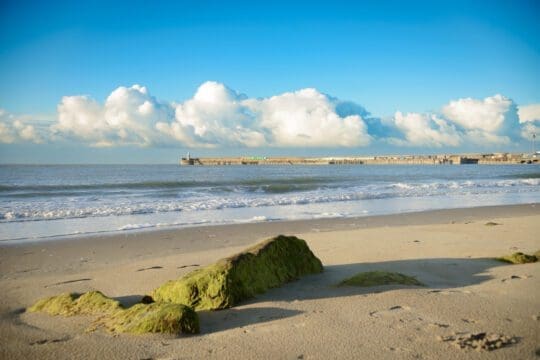
Beside the harbour is Sunny Sands, a small sandy beach tucked into the harbour’s curve. It is popular in summer, naturally, because sand is a rare commodity on this part of the Kent coast and everyone behaves accordingly. Cornelia Parker’s Folkestone Mermaid sits above it, a life-cast bronze figure made for the 2011 Triennial and modelled not on an idealised mythic creature but on a real Folkestone woman. That feels right for the town. Folkestone’s best art does not simply decorate the place; it talks back to it.
The Creative Quarter and the old uphill streets
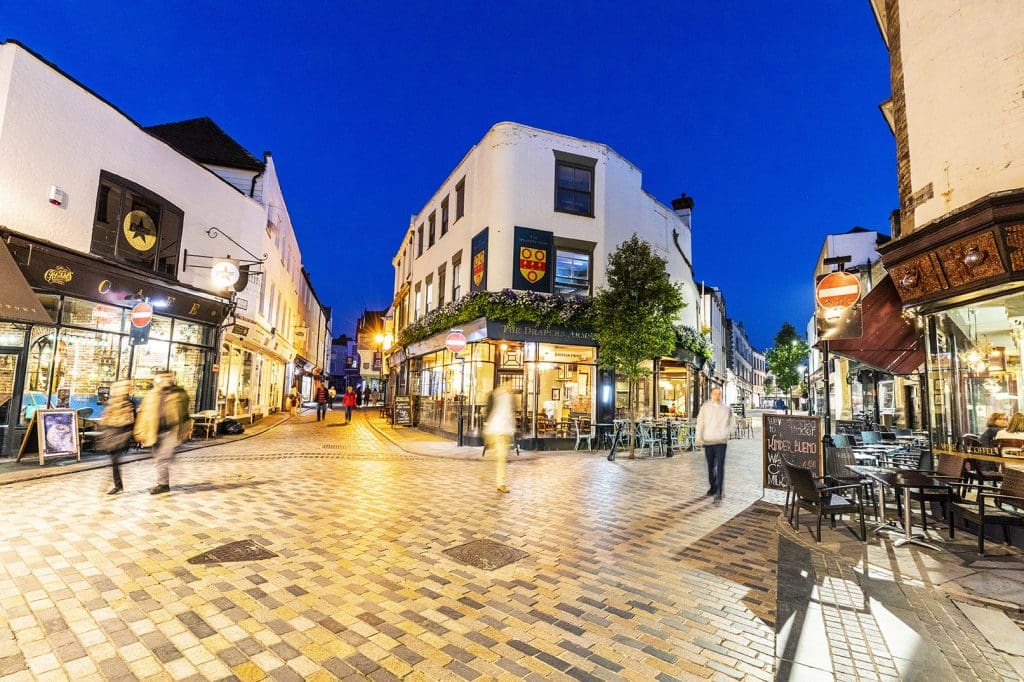
Walk inland from the harbour and the Old High Street rises steeply into the Creative Quarter, a bright, uneven, enjoyable street of galleries, cafés, small shops, studios and independent businesses. It is not polished in the uniform way of a regenerated shopping district, which is a mercy. There are colours, windows, signs, slopes, corners, and enough creative activity to make the climb feel like part of the point rather than a punishment for lunch.
Creative Folkestone describes the area as the town’s cultural heart, and the scale is not token. The wider quarter includes studios, offices, shops and creative businesses, with artists, makers, designers, filmmakers, musicians and small independents forming the kind of ecosystem that can make a town feel alive beyond visitor hours. You feel it most on the Old High Street, where the buildings still carry enough age and irregularity to make the new uses feel rooted rather than dropped in from a lifestyle moodboard.
This is the place to browse slowly. There are cards, prints, clothes, objects, galleries, cafés and the pleasure of discovering a shop that has not been designed by committee. It is also where Folkestone most clearly avoids the great danger of the modern coastal revival, which is becoming all branding and no actual life. The Creative Quarter works because there are still real businesses and real artists here, not merely the promise of creativity printed on a hoarding.
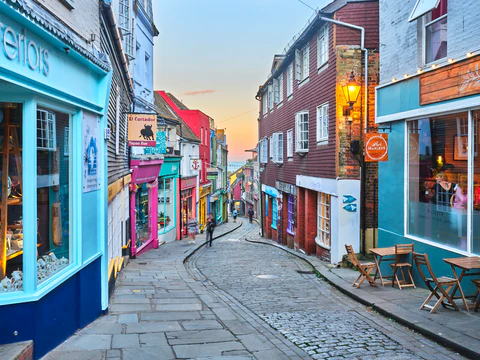
Image courteousy of Creative Folkestone
Art in the open air
Folkestone’s public art is one of the reasons the town deserves more than a seaside-food-and-view visit. The Folkestone Triennial began in 2008, commissioning artists to respond to the town’s landscape, history and present life, and several works have remained as part of Folkestone Artworks, described by Creative Folkestone as the UK’s largest urban outdoor exhibition of contemporary art.
This matters because it changes the way you walk. Art appears on beaches, streets, walls, benches and edges of the town, not locked away waiting for appropriate lighting and a gift shop. Cornelia Parker’s Folkestone Mermaid is the most photographed, partly because it has the instant appeal of being by the sea, but Tracey Emin’s Baby Things is the one that may stay with you longer. Small bronze baby clothes are tucked into the town in unexpected places: under benches, by railings, lying near kerbs. They are easy to miss, and then suddenly not easy to forget.
There is an honesty to this that suits Folkestone. The art is not all decorative. Some of it is playful, some subtle, some strange, some solemn. It asks you to pay attention to what is already there: the beach, the railway, the harbour, the cliffs, the social history, the people who live here as well as those who come for the weekend.
It is worth downloading a map or following one of the suggested routes if you want to make an afternoon of it. But it is also enough to let the works interrupt you as you go. Folkestone is good at interruption.
The Leas, the lift & the lower park
The Leas is Folkestone in its grander mood: a clifftop promenade running above the Channel, with long views, lawns, hotels, apartments and the remains of the town’s fashionable resort life. It was developed in the nineteenth century as part of Folkestone’s attempt to attract visitors of a certain polish, and it still knows how to behave when the light is good.
Walk it slowly. On a clear day, France is visible across the water, and the view has a way of making the town’s contradictions feel less like problems and more like texture. Behind you are buildings in various states of confidence; below is the beach; ahead is the curve of the coast. The restored Leas Lift, when it returns, will make the relationship between the upper town and the shore feel complete again.
Below the cliffs, Lower Leas Coastal Park stretches between Folkestone and Sandgate, a long undercliff park with planting, paths, sea air and its own strange microclimate. It is one of the best family-friendly parts of the town, though its play area has been undergoing refurbishment, so check before promising anything too enthusiastically to small people. The park gives Folkestone softness: green space under the cliff, views out to sea and enough room to drift without needing to buy anything.
The Zig Zag Path is another Folkestone pleasure, cutting down through artificial grottos and Pulhamite rockwork from the Leas towards the shore. It is eccentric, faintly theatrical and entirely useful, which is a combination more towns should attempt.
The wilder edge: the Warren
For all Folkestone’s restaurants, bars and art, the town’s most dramatic outing may be east rather than central. Folkestone Warren lies beyond the harbour, beneath the cliffs towards Dover, a landscape of landslips, chalk, scrub, woodland, sea and railway line that feels much further from town than it is.
The Warren is protected as a Site of Special Scientific Interest and a Local Nature Reserve, important for wildlife and geology, and it has a properly untamed quality. This is not a promenade walk with a neat ice cream at the end. Paths can be steep, conditions change, and access may be affected by coastal works, erosion and weather. It is a place to check before setting out, wear sensible shoes for, and not treat like a decorative backdrop to poor planning.
But on the right day, it is glorious. The white cliffs, the Channel, the vegetation, the sense of the land having slipped and settled into strange shapes. It is the opposite of the Harbour Arm’s sociable reinvention: quiet, unstable, beautiful, and not particularly interested in whether you have booked lunch.
If you want an easier extension with a memorial weight to it, the Battle of Britain Memorial at Capel-le-Ferne sits on the cliffs between Folkestone and Dover. It is a moving site, with its seated pilot figure looking out towards the Channel and the sky that gave the place its meaning. It works well as part of a wider coastal day, especially if you are driving.
Where to eat
Folkestone’s food scene has changed quickly, which means it rewards checking rather than assuming. Some good places have opened, moved, closed or evolved, and a town in transition rarely keeps its menus still for long.
Rocksalt remains the obvious harbour table, cantilevered over the water with big Channel views and a seasonal, local, seafood-led approach. It is the restaurant people know, and there is a reason for that. It gives the harbour a sense of occasion, particularly if the light is behaving and you have booked at a civilised time rather than arriving hungry and hopeful.
Little Rock, from the same wider harbour world, is the more relaxed beachside fish restaurant, sitting down by the harbour station side of the seafront. It is the easier, saltier option: seafood, beach air, less ceremony, more immediate pleasure. Between that, the Pilot Beach Bar, the Lighthouse Champagne Bar and the food vendors along the Harbour Arm and Goods Yard, you can shape a very pleasant seaside afternoon without ever turning it into a formal meal.
In the Creative Quarter, Marleys is the friendly independent bistro to know, founded by Mark and Charly in 2018 and now serving brunch, lunch and dinner with a relaxed neighbourhood feel. It is a useful address because it suits the town properly: casual, warm, food-led and set where you are likely to be wandering anyway.
Luben is the wood-fired pizza option, opened in 2016, good for families, groups and anyone who has reached that point in a day out where sourdough pizza feels less like a choice and more like civic infrastructure. There are moments when originality is overrated and a good pizza in the right place is exactly the thing.
For a serious dinner beyond Folkestone itself, Hide and Fox at Saltwood near Hythe is the one to book well ahead. It holds two Michelin stars and offers modern British tasting menus in a small, calm village setting. It is not a casual add-on to a harbour wander, but it is close enough to make Folkestone part of a very good food weekend, especially if you are staying on the coast.
It is also worth saying that Folkestone’s food scene is not a single neat story. It has destination dining, beach bars, independent cafés, changing pop-ups, harbour vendors and a few places that are better in theory than in execution, as all food towns do. The safest plan is to choose the mood first: Rocksalt for a harbour occasion, Little Rock for relaxed seafood, Marleys for independent bistro warmth, Luben for pizza, the Harbour Arm for grazing, and Hide and Fox if the day has ambitions beyond Folkestone’s postcode.
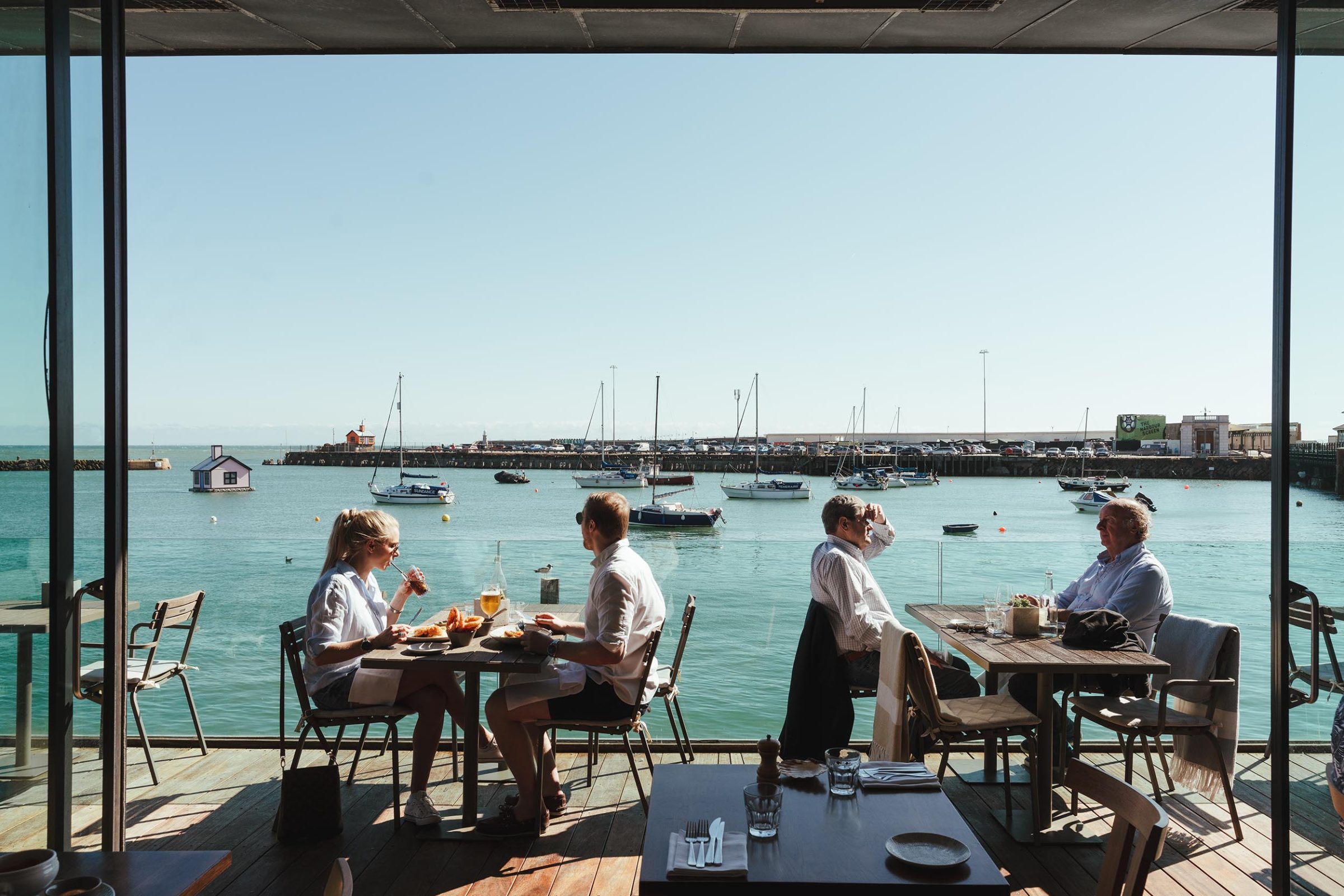
Dining view from inside the Rocksalt by the harbour. Image courtesy of The Rocksalt Restaurant
How to use it
Folkestone is easy from London, which is one of its great advantages. High-speed trains from St Pancras to Folkestone Central take roughly 55 minutes, and the walk down towards the Creative Quarter and harbour is manageable, though not entirely flat. The clue is in the cliff. Wear shoes that will not make you resent the town.
If you are coming for the first time, make the day simple. Arrive at Folkestone Central, walk down through the town towards the Creative Quarter, take the Old High Street slowly, then carry on to the harbour and Harbour Arm. Eat something with a view. Walk to Sunny Sands and the Mermaid. If the weather is good, continue along the seafront or up to the Leas; if you want green space, go through Lower Leas Coastal Park; if you want a wilder walk and have checked access, head towards the Warren.
For families, Sunny Sands, the Harbour Arm, Lower Leas Coastal Park and pizza or relaxed seafood make the easiest day. For couples, the Creative Quarter, art trail, Harbour Arm drinks and Rocksalt or Little Rock do the work nicely. For culture, follow the public artworks and allow the town to look stranger than a standard seaside itinerary would suggest. For walkers, the Leas and Warren are the proper draw, with Capel-le-Ferne and the cliffs beyond if you want the day to open out.
Spring to early autumn is the easiest season, particularly for the Harbour Arm, beaches and outdoor art. Summer brings the most life and the most people, which is how seaside towns behave when given sunshine. Winter can be excellent for a sharper, quieter version of Folkestone: cold sea, low light, hot coffee, galleries, lunch and a brisk walk that makes you feel briefly virtuous.
So no, Folkestone is not the neatest town on the Kent coast. It is not trying to be. Its charm is in the join between old port and new art, Victorian promenade and shipping container bar, sandy beach and steep backstreet, serious restaurant and gull-noisy harbour. It has edges, and it has ideas. Sometimes that is much better than polish.
About the Author: Lara S

The Finer Map



Get our latest Delivered
Beautiful recipes, inspiration, guides and news that makes you want to live!