Town feature – Ashford in Kent
Ashford, and Kent Beyond It
It will never win a prettiest-town competition (Although it boasts plenty of charming spots!), and it is not trying to. But Ashford is among the best-placed towns in the South East: thirty-eight minutes from London, a good table or two, and on the doorstep of some of the loveliest countryside in England.
Let us be honest with one another, because that is rather how this magazine prefers to work. Ashford is not a beauty. It will not stop you in the street the way Rye does, or Sandwich, or a good bend of the Stour valley. It is a working town, made and remade by the railway, with a large shopping outlet, a busy station and the comfortable, faintly anonymous feel of a place that has always been more interested in getting people somewhere than in being the somewhere itself.
And yet. There is a kind of usefulness that is easy to undervalue, and Ashford has it in quantity. It sits at the southern edge of the North Downs with the whole Garden of England laid out around it, it is tied to London by a train so quick it changes the arithmetic of a day, and it has, quietly, a few genuinely good things to do once you arrive. This is a piece about all of it: the town, where to eat and walk, and the considerable county beyond.
A view of Ashford’s Upper High Street in 1970. Picture by: Steve Salter
A town the railway made
The town’s story is more interesting than its high street lets on. There has been a market here since the thirteenth century, when Henry III granted Ashford its charter, and the name is older still: Old English for a ford by a clump of ash trees, a reminder that all of this began as a crossing of the Great Stour. For some six hundred years it was a quiet agricultural town, trading the livestock that came up off Romney Marsh. A regular market is held here to this day. Then, in the 1840s, the railway arrived and rewrote everything.
In 1847 the South Eastern Railway chose Ashford for its locomotive works, and a market town of a few thousand became an industrial one almost overnight. A whole village, Newtown, was built to house the workers: one of the earliest planned railway estates in England, with its own school, church and green. Five lines eventually met here. The works turned out engines and carriages until 1982, and though the heavy industry is long gone, the railway is still the making of the place. The international station that once sent trains under the Channel to Paris and Brussels now runs high-speed services to St Pancras in thirty-eight minutes. It is the single best reason to consider Ashford at all. You can be deep in the Kent countryside by late morning and back in central London in time for dinner.
The town keeps one genuine curiosity from its past. In St George’s Square stands a First World War tank, presented to Ashford in 1919 in thanks for the town’s wartime savings, and quietly remarkable for having survived when nearly every other presentation tank was cut up for scrap decades ago. It is not handsome. It is, though, exactly the kind of odd, real, local thing a good wander turns up, and worth the minute it asks of you.

A steam train arriving in Ashford station in 1957
There's been a station here since 1842. Image: Ben Brooksbank via creative commons
A table worth booking and an easy afternoon
For dinner, the town’s most ambitious table sits a little out of the centre, on the Canterbury road through Kennington. Stubbs occupies what used to be the Croft Hotel, a tired roadside place transformed, after a reported five million pounds and a good deal of nerve, into something rather more interesting. It runs from a cricket-themed Champagne and oyster bar through a bistro to a clubby steak restaurant dressed in the manner of a Victorian London gentlemen’s club, all candlelight and hand-picked pictures. The kitchen does Jersey rock oysters, properly hung steak, lobster and a serious list of English sparkling from the Kentish vineyards just up the road. It is a touch theatrical, and all the better for it, equally at home for a long unhurried lunch or a proper celebration. Book ahead, especially at weekends.
Editor’s Note“I can vouch for this one. We went for the steak and chips, with a side of creamy mushrooms that I would happily have ordered three of, and left already deciding when we could go back. The steak was properly cooked and properly rested, the chips were the good sort, and the mushrooms were exactly as indulgent as they sound. Highly recommended.”
And for all that the countryside is the real draw, the Designer Outlet deserves its place in the day, particularly when the rain comes in off the Marsh or you have teenagers to keep happy. It sits right beside the station, a five-minute walk, under a tented roof from Richard Rogers’s practice, with a hundred or so brands at outlet prices and parking that is free after five. It is covered, easy and genuinely good at what it does, which is no small mercy on a grey afternoon. If outlet shopping leaves you cold you will miss nothing the rest of Kent does not do better, but it is honest to say that for a great many visitors it is the reason they came.
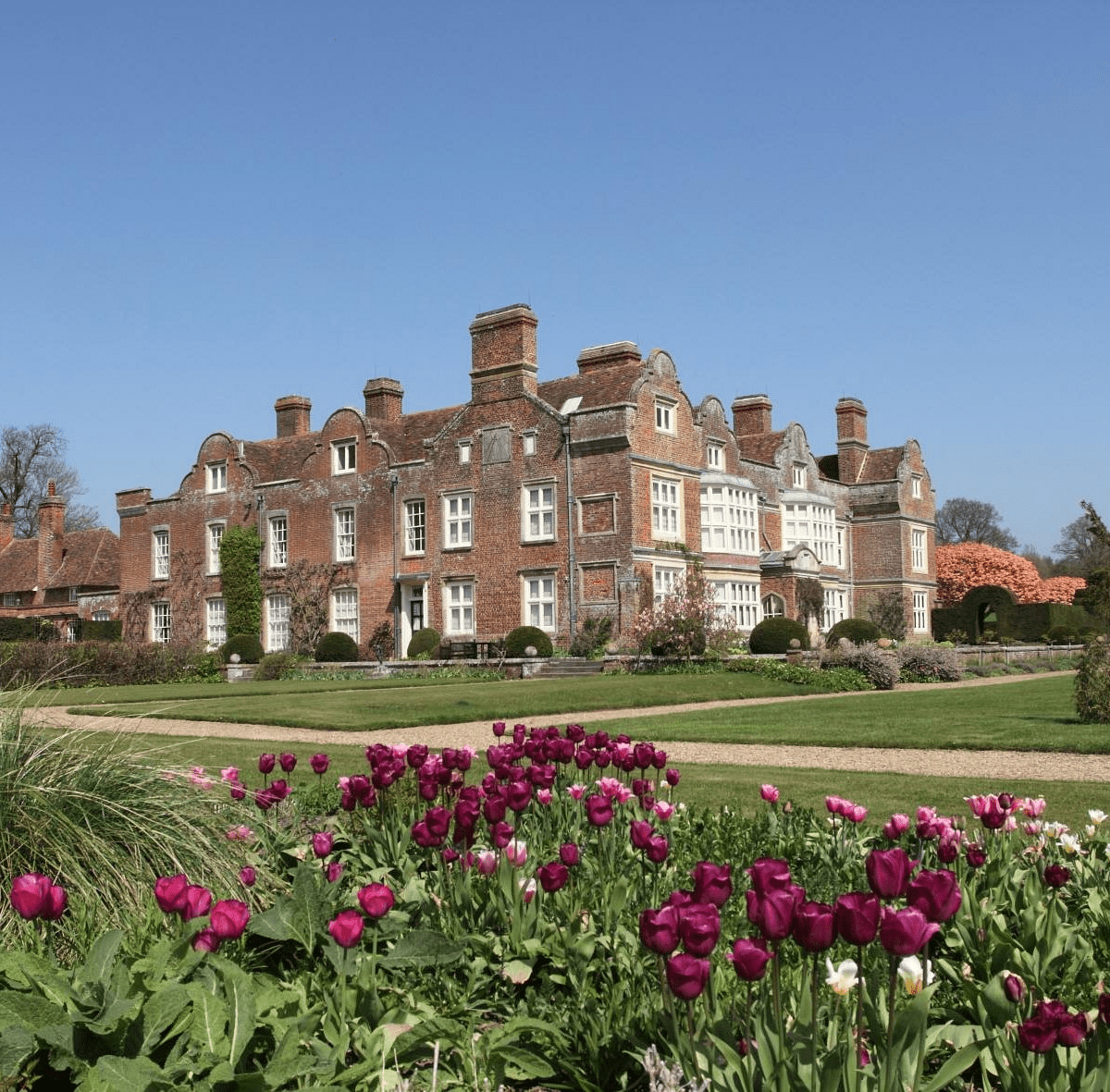
The town’s loveliest set-piece, though, sits a couple of miles out at Godinton. The house is a mellow red-brick Jacobean place built around a medieval great hall, with some six hundred years of history and a celebrated staircase carved from chestnut, but it is the gardens that earn the visit. Twelve acres of them, formal and unhurried, wrapped in old parkland and holding one of the longest yew hedges in England, alongside a walled garden thick with delphiniums, an Italian garden with a quiet fountain, and a rose garden that comes into its own in June. It is run privately rather than by the National Trust, which keeps it pleasantly untrodden, and there is a tearoom for afterwards, as there should be. The gardens open from spring to mid-autumn, the house on Fridays and Saturdays.

If you find yourself in Ashford and want to give this lovely experience a try, consider booking ahead of arriving. https://stubbsrestaurants.com/
What there is in the town
Ashford’s loveliest thing sits a couple of miles out, at Godinton. The house is a mellow red-brick Jacobean place built around a medieval great hall, with roughly six hundred years of history and a celebrated staircase carved from chestnut. But it is the gardens that earn the visit. Twelve acres of them, formal and unhurried, wrapped in old parkland and holding one of the longest yew hedges in England, a great dark green wall of it, alongside a walled garden thick with delphiniums, an Italian garden with a quiet fountain, and a rose garden that comes into its own in June. It is run privately, by a trust rather than the National Trust, which means it is less trodden than the headline gardens and all the better for it. The gardens open from spring to mid-autumn, the house on Fridays and Saturdays, and there is a tearoom afterwards, as there should be.
Back in the centre, St Mary’s parish church holds the old town together: thirteenth-century, enlarged in the fifteenth, a handsome survival among the shopfronts. Out at Willesborough, a white smock windmill of 1869 has been restored and opens through the warmer months. For an hour in the open there is Victoria Park, laid out in 1886, and the water and paths of Conningbrook Lakes on the town’s edge.
And then there is the Designer Outlet, which we may as well meet head-on, because three and a half million people a year visit it and they are not all mistaken. It is a large discount shopping village beside the station, under a tented roof from Richard Rogers’s practice, with parking free after five. If an afternoon of outlet shopping appeals, this is a good one. If it does not, you will be missing nothing the rest of Kent does not do better. Either way it is honest to mention it, because for a great many visitors it is the reason they came in the first place.
Up onto the downs
The real argument for Ashford, though, begins where the town runs out. A few miles north-east the land lifts into the Wye Downs, and the whole character of the place changes. The village of Wye sits at their foot, and above it the chalk has been cut into the Wye Crown, carved into the hillside in 1902 by students of the old agricultural college to mark the coronation of Edward VII, and kept clear and visible from miles around ever since. Climb up onto the down and you come to the Devil’s Kneading Trough, a steep dry valley scooped from the chalk, where the view opens all at once and completely across Romney Marsh and the Weald to the distant sea. It is one of the great views of the South East. It is free, and most people have never heard of it. This is the Kent Downs National Landscape, threaded by the North Downs Way, and a morning’s walking here is the first thing I would send any newcomer to do.
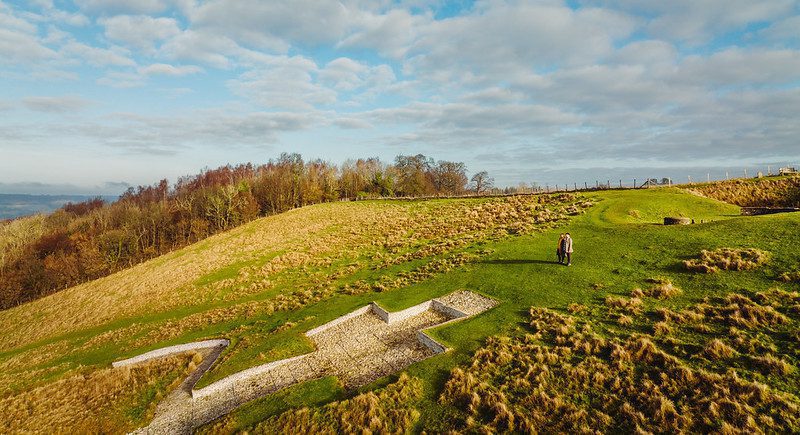
image courtesy of the Kent Downs – https://kentdowns.org.uk/activities/wye-national-nature-reserve/
Walks from the door
This is where Ashford quietly excels, because good walking begins within a few minutes’ drive in almost every direction, and it costs nothing.
Head north towards Challock and you reach King’s Wood, one of the largest blocks of ancient woodland in the South East: fifteen hundred acres of old royal hunting forest where a herd of fallow deer still runs wild among the sweet chestnut and beech. In May the floor turns solid blue with bluebells, among the finest displays in East Kent, and a sculpture trail, commissioned from artists over the past thirty years, threads the trees the year round. The car park is free, the paths are many, and you can make of it a gentle hour or a proper morning.
Closer to home, the village of Westwell sits beneath the downs just north-west of the town, where the old Pilgrims’ Way, shadowed here by the North Downs Way, gives easy, history-soaked walking along the foot of the chalk. It is a quieter, more local sort of outing, the kind of walk you take on a Sunday with no particular destination, with the still water of nearby Eastwell Lake to aim for if you want a loop.
But the one I would send you to first lies a few miles north-east, up on the Wye Downs. Above the village of Wye the chalk has been cut into the Wye Crown, carved into the hillside in 1902 by students of the old agricultural college to mark the coronation of Edward VII, and kept clear ever since. Climb up onto the down and you come to the Devil’s Kneading Trough, a steep dry valley scooped from the chalk, where the view opens all at once and completely over Romney Marsh and the Weald to the distant sea. It is one of the great views of the South East. It is free, and most people have never heard of it.
The wider Weald, and the sea beyond
Give Ashford a second and third day and the county keeps giving. Ten miles or so to the south-west lies Tenterden, a proper Wealden market town of white weather-boarded houses and a broad, generous high street. From its station runs the Kent & East Sussex Railway, a heritage steam line first opened in 1900 as one of Britain’s earliest light railways and lovingly preserved since the 1970s. Its restored steam trains run ten and a half miles through the High Weald to Bodiam, where the track ends in the shadow of a perfectly moated National Trust castle. It is a wholly magical way to spend a few hours, and it reduces small children to silence, which is a recommendation in itself.
Just outside Tenterden is Chapel Down, among the names leading England’s quietly serious wine revival, where you can walk the vines and taste the sparkling that now unsettles Champagne in more blind tastings than the French would care to admit. These hills, it turns out, are very good at this. A little further and you reach Sissinghurst, the garden Vita Sackville-West and Harold Nicolson made famous, its white garden among the most photographed in the country and, in early summer, deservedly so. Leeds Castle and its great moat lie a short drive north; the wild-animal reserve at Port Lympne sits towards the coast; and beyond all of it are Romney Marsh, the cobbled hill-town of Rye just over the Sussex border, and the long pale sands at Camber. None of it is far. That, in the end, is the whole point of Ashford.
How to use it
The practicalities are mercifully few. The fast train from St Pancras does the heavy lifting, and once you are here a car earns its keep for the countryside, though Wye, Tenterden and the coast can all be reached by train or a connecting bus if you would rather not drive. Spring and early summer are loveliest, for the gardens and the Downs alike. Godinton and the steam railway keep roughly to an April-to-October season, so a winter visit wants a little more forethought, and the smaller places run seasonal hours worth checking before you set out.
So no, Ashford will not sweep you off your feet at the platform. It was never built to. It is the door rather than the room, and the rooms it opens onto, the Downs, the Weald, the vineyards, the steam threading through the trees, are some of the finest in England. Sometimes the cleverest place to begin is the one nobody thinks to write about.
About the Author: Lara S

The Finer Map



Get our latest Delivered
Beautiful recipes, inspiration, guides and news that makes you want to live!