Scotney Castle, Kent
Scotney Castle, Kent
In the 1830s a man stood on a Kentish hillside, looked down at a damp and crumbling medieval castle in the valley below, and made a decision that most people would not have considered: rather than restore it or demolish it, he would ruin it further, deliberately, artfully, as an act of landscape design. The result is one of the most visually satisfying estates in England, and one of the few places in the country where a ruined tower, a Victorian country house, an overgrown quarry and a hidden dinosaur footprint all belong to the same picture.
There are easier ways to make a garden. You could plant things, for a start. You could commission a parterre, or a ha-ha, or a kitchen garden with a good espaliered wall, the kinds of improvements that have been making English country estates more beautiful and more pleasant since the sixteenth century. What you probably would not do, unless you were Edward Hussey III in 1837 with a very particular aesthetic philosophy and considerable nerve, is look at the decaying medieval castle on your own land, the one you are planning to move out of anyway, and decide to knock more of it down, selectively and carefully, in order to make it look better from a distance.
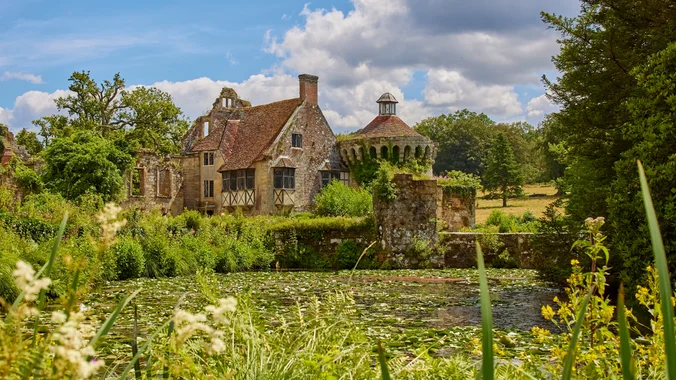
This is, precisely, what Hussey did. And the result — a moated tower rising from a wooded valley, half-demolished into picturesque ruin, reflected in a moat, surrounded by rhododendrons and azaleas and the bones of ancient stonework, viewed from above through the bay window of the house he built to look at it — is one of the most purely satisfying pieces of landscape design in the country. Scotney is not a beautiful accident. It is a beautiful intention, carried through with the confidence of a man who had read his theory and trusted his eye.
The Castle Before the Ruin
The site has been occupied since before the Norman Conquest, listed in the Domesday Book of 1086 as the property of Bishop Odo of Bayeux, the Conqueror’s own half-brother. The name derives from the de Scoteni family who acquired the estate in the twelfth century. But what you see now at the bottom of the valley is primarily the work of Roger Ashburnham, who built a quadrangular castle here around 1378, four corner towers surrounding a central courtyard, ringed by a wide moat fed by the River Bewl. It was built in response to the very real threat of French coastal raids in the decades following the Black Death, when the south-east of England was nervous and armed. Of Ashburnham’s original four towers, only one survives to any height: the Ashburnham Tower, topped with its distinctive conical tiled cupola added in the eighteenth century by the Darell family, and looking now so completely like a fairy-tale castle illustration that the effect is slightly surreal.
The Darell family inherited the castle in 1418 and stayed for three and a half centuries, adding a Tudor south wing to the surviving tower and becoming, gradually, one of the Catholic families in the Weald who found themselves in an increasingly dangerous position as the Reformation reshaped the country around them. In 1591 the castle’s priest hole had its only recorded moment of use. When the authorities arrived at Scotney searching for illegal Catholic clergy, Father Richard Blount was concealed inside it. The secret space was not discovered; the priest survived. The hole is still there. Of all the things to find in a ruined medieval castle, the knowledge that a man once pressed himself into that particular darkness and held his breath is perhaps the one that lingers longest.

The Deliberate Ruin
Edward Hussey III inherited the estate in the 1820s, and his instinct was not to repair the old castle but to reimagine it. He had been captured by the Picturesque movement, the aesthetic philosophy developed in the 1780s by writers and landscape gardeners who argued that designed landscapes should work like paintings: incorporating natural topography, embracing the dramatic, including suitable ruins and rocky outcrops, blurring the boundary between the made and the found. William Gilpin, whose uncle had articulated the Picturesque theory in its most influential form, was engaged as landscape designer. Anthony Salvin, one of the most accomplished Victorian architects, was brought in to design the new house on the hill above the valley.
The plan they devised together was unified and precise, and it required a particular kind of willingness to think at the scale of the whole landscape rather than its individual parts. Salvin built the new house from sandstone quarried from the hillside between the house and the old castle — a quarrying operation that left a rocky hollow, which Gilpin then incorporated into the design as the Quarry Garden, its exposed walls planted with azaleas and acers and traversed by winding paths. Stone salvaged from the old castle’s demolition was used to build fireplaces and features in the new house. And the old castle itself was partially demolished: the seventeenth-century east wing brought down, leaving the Tudor south wing and the Ashburnham Tower as the romantic silhouette that remained. Each window of the new house was positioned to frame a view of the ruin below. Most notably the great bay window of the Library, which looks down the slope of the garden, past the quarry and through the trees to the moated tower beyond, composing the scene like a painting hung on a wall.
The family motto of the Husseys is Vix ea nostra voco: I scarcely call these things my own. It is a more philosophically interesting sentiment than most family mottoes, and it sits rather well at Scotney, where what the family built was always intended to be something beyond mere ownership: a vision, an argument about beauty, a piece of landscape that was meant to be looked at and felt rather than simply possessed.
What the Quarry Gave Up
One further thing emerged from the hillside when Hussey’s workmen were digging for sandstone in the 1830s. Among the Wealden rock they found a hundred-million-year-old impression in the stone: the footprint of an iguanodon, pressed into what was then the bed of a Cretaceous sea and preserved through the intervening millennia until a Victorian landowner’s building project exposed it. It remains in the Quarry Garden today. It is a very strange and rather wonderful thing to encounter on a descent through rhododendrons: evidence that the valley you are walking through was, at an incomprehensibly earlier time, a prehistoric coastline.
The Victorian House
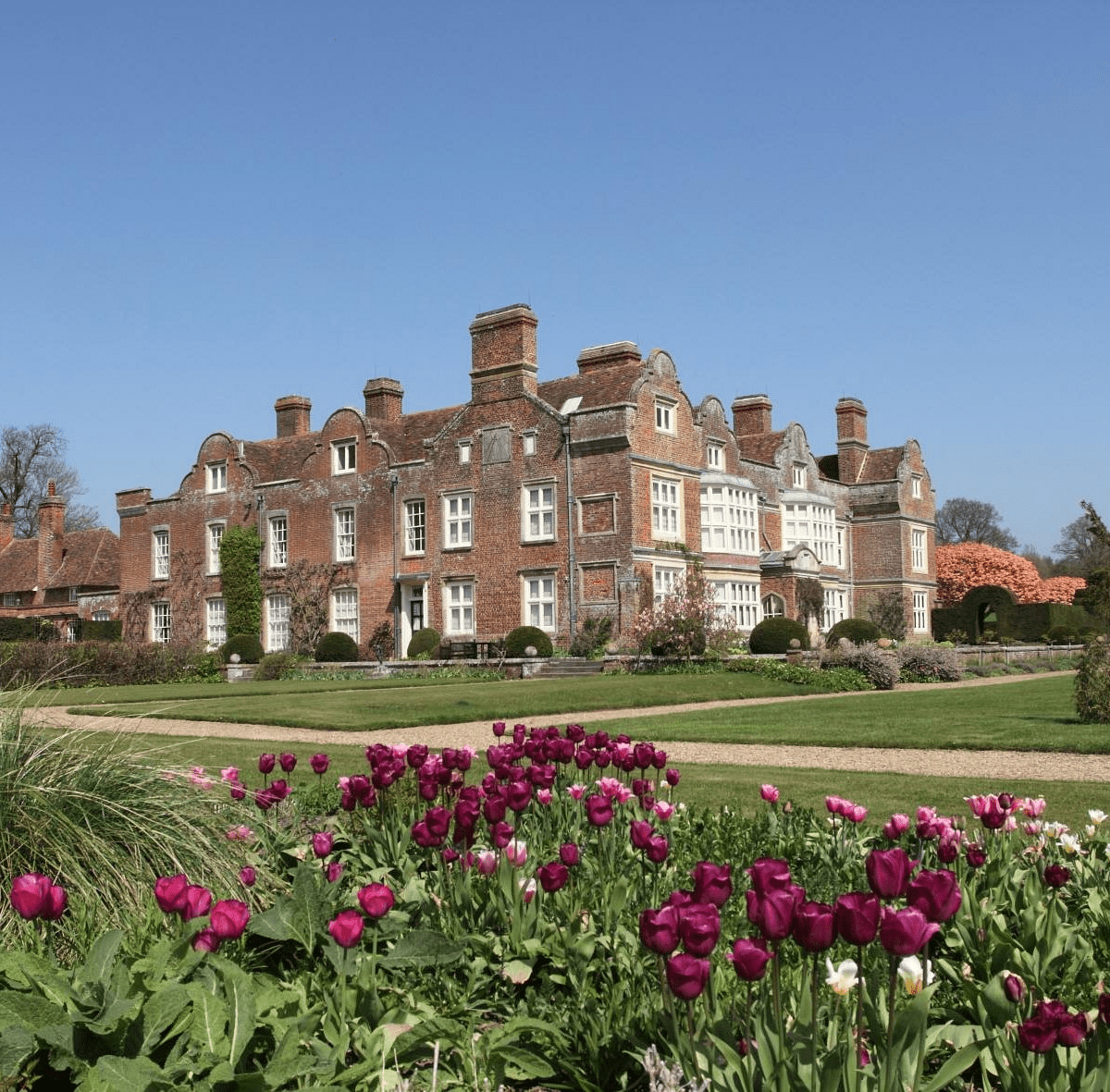
At the top of the slope, the house Anthony Salvin built between 1835 and 1843 is a model of restraint by Victorian standards: Tudor Revival in style, built from the same golden sandstone as the ruin below, its windows carefully positioned to make the landscape visible from within at every turn. It is early for the style and unusually underdressed for the era, which is partly what makes it feel so liveable — more a comfortable family home than a statement of architectural ambition, which was exactly what the Husseys wanted.
Three generations lived here in relative contentment. The last private resident was Christopher Hussey, who died in 1970 — not the least remarkable occupant of the house, given that he spent his professional life as a writer and critic for Country Life and became, in the process, one of the most influential voices on English architecture and landscape of the twentieth century. His books on the Picturesque are still the standard works on the subject. That the man who wrote most authoritatively about the Picturesque aesthetic happened to live inside one of its finest surviving examples is either a very satisfying coincidence or a very satisfying inevitability, depending on your view of how such things tend to work out.
His wife Betty continued living at Scotney after his death until 2006, when she died and the house passed fully to the National Trust’s care. For much of the 1970s and 1980s she shared the estate, at least on weekends, with a tenant in one of the converted flats: the Prime Minister Margaret Thatcher, who rented the Belfry apartment as a retreat from Westminster. When Denis Thatcher was made a baronet in 1990, his territorial designation was gazetted as Scotney in the County of Kent, which means that Scotney Castle is, among its many other distinctions, technically part of the Thatcher family title.
The Garden in Every Season
The garden descends from the house to the moat in a series of planted terraces and wooded slopes, and it is one of those rare gardens that earns the word spectacular in multiple seasons simultaneously, each one for entirely different reasons.
In late spring the rhododendrons, azaleas and kalmia come into colour on the slopes below the house, cascading down towards the moat in sweeps of pink, white and crimson, the scale of the planting matching the scale of the landscape in a way that feels generous rather than overwhelming. Spring also brings rare green-winged orchids to the mansion terraces, and the Quarry Garden at this time, with its winding paths and sudden glimpses of the old castle through the trees, is at its most thickly beautiful.
Summer brings the wisteria and roses to the old castle itself, climbing over the surviving stonework in a way that manages to be genuinely romantic rather than merely decorative. Herb beds around the fourteenth-century Venetian wellhead in the castle courtyard, and herbaceous borders along the moat, give the ruin an inhabited, kitchen-garden quality that sets off the stonework in exactly the way Hussey intended.
Autumn is many people’s favourite. The acers in the Quarry Garden turn to fire, the ruin emerges from the summer’s green into a starker, more architectural silhouette, and the mist that rises from the moat on still mornings produces the view that Lord Conway had in mind when he called Scotney the loveliest castle in the world. He was visiting in autumn.
Winter shows you the bones: the structure of the landscape without its seasonal clothing, which is the truest test of how well any designed garden holds together. At Scotney, in frost or bare branches or low December light, the answer is very well indeed. The moated tower does not need flowers to justify its reflection.
Beyond the garden proper, the estate extends to seven hundred and eighty acres of Wealden parkland and ancient woodland, threaded with waymarked walks that go well beyond what most visitors explore. The wider landscape was shaped by centuries of hop-growing and iron-smelting — the Weald was once one of the most important iron-producing regions in England — and evidence of the former hop gardens is visible to an observant eye in the remnants of oast-shaped structures around the estate.
What Else To Find
The heather-thatched icehouse, the Victorian boathouse on the moat, the chalybeate spring, the giant sequoias, the one-acre octagonal walled garden with its fan-trained fruit trees and its ancient crab apple — each of these rewards a visitor who does not rush the descent to the ruin and back but takes the estate at the pace it was designed for. The walled garden alone, built around 1840 to supply the household with fruit and vegetables, is a quietly beautiful space in every season, the unusual octagonal plan maximising growing space in a way that functions equally well as an aesthetic decision.
The house itself, open to ticketed tours, holds the accumulated collections of three generations of the Hussey family — paintings, textiles, furniture and curiosities gathered over two centuries of comfortable, acquisitive family life. A second-hand bookshop at the visitor entrance is worth visiting before you leave.
For those who want to stay overnight within touching distance of Scotney, Sissinghurst Castle Farmhouse — the farmhouse within the grounds of Sissinghurst Castle Garden a few miles away — is available to book through the National Trust, which is a rare and rather extraordinary option: two of the finest gardens in Kent, available to a single slow weekend in the Weald.
The Practical Details
Scotney Castle is one mile south of Lamberhurst, off the A21 near the Kent-Sussex border, approximately an hour from London and within easy reach of Tunbridge Wells. The nearest rail connections are Wadhurst, served from London Charing Cross, with a taxi for the final few miles. The property gates open at 10am; the Old Castle is open for ticketed tours on specific days and requires advance booking, as it is a fragile structure and numbers are managed carefully. National Trust members visit and park free; non-members should book parking in advance, with day tickets available until 9am on the day of the visit.
The National Trust began a major Lottery-funded restoration programme of the Picturesque landscape in 2026, which is worth checking in advance as some areas of the garden may be subject to work at different times. The long-term aim is to restore the design to Hussey’s original vision, which makes this a particularly good moment to visit: the castle mid-restoration is still the castle, and the programme of work reveals rather than conceals the thinking behind what Hussey made.
Allow a generous half-day for the garden and grounds alone; a full day if the house tour, the walled garden and the wider estate walks are on the itinerary. Bring good boots and the willingness to walk further than the brochure suggests is necessary. The best things at Scotney, as with the best things in most Picturesque landscapes, are found by going a little further than the main path.
Scotney Castle
Lamberhurst, Tunbridge Wells, Kent TN3 8JN
nationaltrust.org.uk/scotney-castle
01892 893 820
Open year-round (check website for seasonal hours and Old Castle tour availability). National Trust members free. Book parking in advance.
About the Author: Lara S

The Finer Map



Get our latest Delivered
Beautiful recipes, inspiration, guides and news that makes you want to live!