Leeds Castle, Kent
Leeds Castle, Kent
It has been called the loveliest castle in the world so many times that the phrase has rather lost its purchase. Forget the marketing line. What Leeds Castle actually is, when you look at it properly, is something considerably more interesting: a fortress that became a palace that became a royal retreat that became a society hostess’s plaything that became, briefly, a secret weapons laboratory, and is now one of the most layered heritage sites in England. The moat reflects beautifully. That is the least of it.
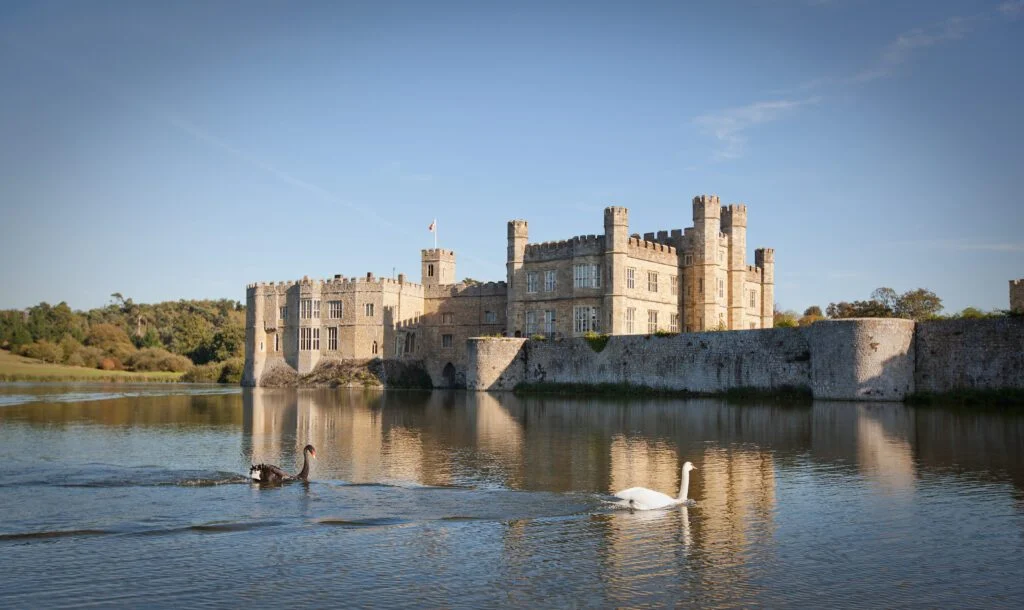
The quote hangs over Leeds Castle like a slightly too-comfortable blazer. Lord Conway, the historian and politician, wrote it in Country Life magazine in 1913 — “on an autumnal evening, when the bracken is golden and a faint blue mist among the trees, the loveliest castle in the whole world” — and it has been repeated in every brochure, every press release and every travel piece about the place ever since. It is not wrong, exactly. Standing on the causeway in the September light with the golden limestone rising from its lake and the Wealden parkland stretching beyond, the effect is genuinely and rather operatically beautiful. But “the loveliest castle in the world” has been said so many times that it slides off the eye without lodging, which is a shame, because the real story of Leeds Castle is considerably more surprising than any landscape description.
That story involves six medieval queens, a diplomatic incident that nearly started a war, a woman who spent two million dollars on interior decoration, a conference room where Middle Eastern peace was brokered, what is almost certainly the world’s only museum dedicated entirely to dog collars, and, since 2026, an artificial intelligence avatar of a medieval queen who will answer your questions about the thirteenth century in real time. The moat reflects beautifully. It is nowhere near the most interesting thing here.
Built on a Saxon Marsh, Made by Queens
The site has been occupied, in one form or another, since 857, when a Saxon lord called Led built a wooden structure on two small islands in the River Len. Robert de Crevecoeur rebuilt it in stone in 1119, and the castle that emerged was always, by the standards of medieval English fortifications, unusually oriented towards comfort and beauty rather than pure defence. It looks, still, more like a fortified manor than a military stronghold: the keep low and wide, built of warm golden limestone, its shape following the contours of its small island rather than rising aggressively above them. This was not weakness but design. Leeds Castle was always a residence first and a fortification second, and it was precisely this quality — the particular grace of it — that made it so attractive to the queens of England.
The first was Eleanor of Castile, beloved wife of Edward I. In 1278 she acquired the castle by purchasing the debt bond of its owner, William de Leyburn, who had borrowed heavily and could not repay — a transaction that Edward himself had helped engineer by imposing heavy taxes on Jewish moneylenders and thereby forcing the sale. Eleanor developed and extended it, adding the revetment wall that still rings the larger island, building a bathhouse at a time when such things were almost unknown in English castles, and giving the keep its name: the Gloriette, from the Spanish term for a garden pavilion, her native language leaving its mark on the stones. Edward wrote of her death in 1290, “in life I loved her dearly, nor can I cease to love her in death,” and the Eleanor Crosses he erected along the route of her funeral procession are among the most tender monuments in English history.
She began a tradition that would persist for the better part of three centuries. After Eleanor came Isabella, wife of Edward II — and with Isabella came the incident that makes Leeds Castle an unexpected trigger point in English political history. In 1321, Isabella arrived at the castle seeking lodging while the constable was absent, and the constable’s wife, Margaret de Badlesmere, refused her entry. When Isabella attempted to force admittance, Lady Badlesmere instructed her archers to shoot at the Queen’s party. Six members of the royal household were killed. Edward II laid siege to the castle and took it by force; Lady Badlesmere was imprisoned in the Tower. The episode deepened a political crisis that contributed directly to the Despenser War and, eventually, to Edward II’s deposition and death. A single act of refusing a queen lodging had, in this oblique way, helped to bring down a king.
The queens kept coming. Philippa of Hainault, wife of Edward III. Joan of Navarre, wife of Henry IV — charged, improbably, with attempting to kill her stepson Henry V by witchcraft, imprisoned here briefly before Henry V relented and restored her property. Anne of Bohemia, wife of Richard II, for whom the French historian Froissart described the castle in 1395 as “the beautiful Palace in Kent called Leeds Castle.” Catherine de Valois, widow of Henry V, youngest daughter of a mad French king and grandmother, through her second marriage, of the first Tudor monarch. And finally, most famously, Catherine of Aragon, first wife of Henry VIII.

Henry, Catherine and the Field of the Cloth of Gold
Henry VIII transformed Leeds Castle between 1517 and 1523, converting a medieval fortification into something closer to a royal palace of the Tudor style. He added an upper floor to the Gloriette, reserved exclusively for Catherine, and decorated her apartments with fireplaces bearing the royal arms intertwined with Spanish motifs and lovers’ knots — a visible gesture of dynastic affection that makes the subsequent history of the marriage rather painful in retrospect. The Maiden’s Tower, built to house Catherine’s ladies-in-waiting, held accommodation for more than a thousand of her personal staff. Among those ladies, at some point, was Anne Boleyn of nearby Hever Castle, who would, in due course, become the reason Henry found a new use for Leeds.
In 1520, the royal party stopped at Leeds Castle on their way from London to Dover, and from Dover across the Channel to the Field of the Cloth of Gold: the extraordinary summit between Henry VIII and Francis I of France, three and a half thousand people in the English entourage, a fortnight of golden tents and jousting and feasting that aimed to demonstrate Anglo-French friendship and succeeded mainly in demonstrating Anglo-French rivalry. The painting commemorating the meeting hangs at Leeds Castle still. Venison from the Leeds estate was supplied for the summit. Henry would have slept under this roof the night before one of the most extravagant diplomatic spectacles in European history.
When the marriage to Catherine collapsed and Henry moved on, Leeds passed out of royal hands and into a long descent through private ownership, declining into a pleasant but unremarkable Kentish estate. The English Civil War was survived — the owners had sided with Parliament, prudently — and the castle spent the following centuries in decent but uninspired maintenance until the morning in 1926 when Olive Wilson Filmer, the Hon. Lady Baillie, drove down from London and decided to buy it.
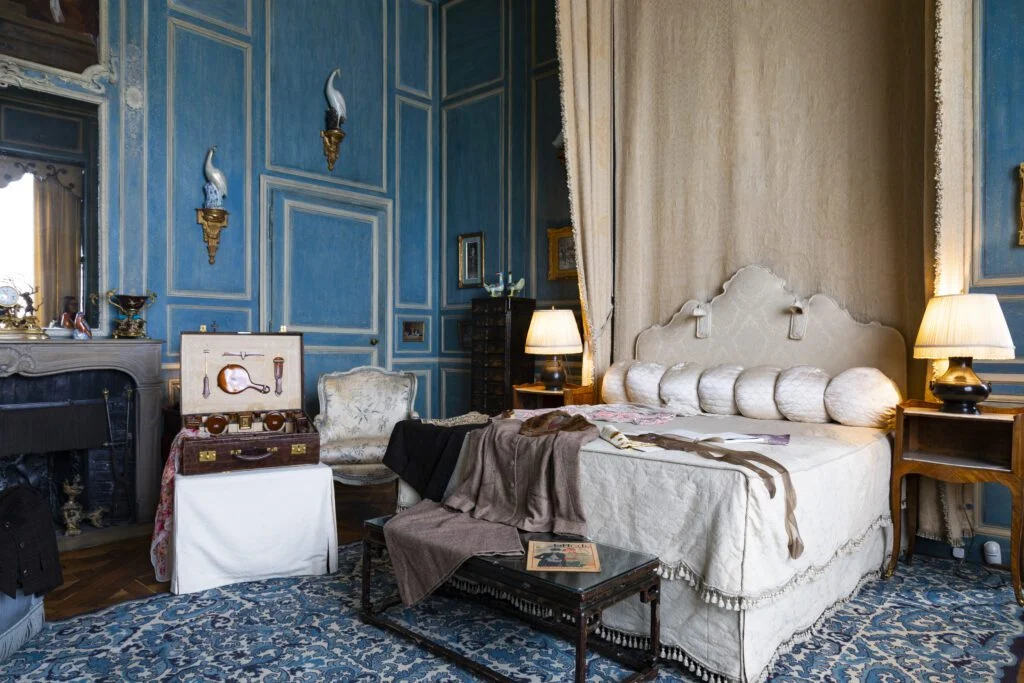
Lady Baillie’s Castle
Olive Baillie was, by any contemporary account, a woman of formidable taste, great wealth and considerable determination. The daughter of an Anglo-American marriage — her mother Pauline was a Whitney, one of the richest families in America — she bought Leeds Castle for £180,000, a sum that purchased a castle in decent structural repair but in need of the kind of attention that only serious money and serious commitment can provide. She gave it both, spending the equivalent of two million dollars over the following decades to transform it into what it is today.
Her method was to retain the finest available. First the French architect Armand-Albert Rateau, who oversaw exterior alterations and added a sixteenth-century-style carved-oak staircase of such confidence that most visitors assume it to be genuinely Tudor. Then Stéphane Boudin, the Paris decorator who also worked for the Kennedys and the Duke and Duchess of Windsor, and whose blue master bedroom for Lady Baillie — wire-brushed, limed, glazed and finished with beeswax to give it an apparent antiquity — is considered one of the finest examples of his work. The rooms she created are of a piece with Boudin’s best: a particular quality of French refinement applied to an English medieval shell, producing something that is neither quite French nor quite English but entirely itself.
Leeds became, in the thirties, one of the great house-party destinations of its era. Politicians, royalty, film stars and ambassadors came and went. During the Second World War the castle became a military hospital for badly burned RAF pilots, and then a facility for secret weapons development including, according to some accounts, advanced flame-throwers. Lady Baillie returned after the war and continued her programme of restoration until her death in 1974, when she left the castle to the Leeds Castle Foundation, the charitable trust that has operated it ever since. Without public funding, the foundation maintains the estate entirely on visitor revenue and corporate use — a fact worth appreciating as you walk the grounds.
In 1978, a different kind of history was made in the castle’s conference room. The Foreign Ministers of Egypt, Israel and the United States — Muhammad Ibrahim Kamel, Moshe Dayan and Cyrus Vance — gathered here for the talks that prepared the ground for the Camp David Accords, the framework for peace between Egypt and Israel that was signed the following year. The room where it happened is still there, Lady Baillie’s portrait on the wall above the table. It is a quiet room with an extraordinary footnote.
What to See
The castle interior takes you through several centuries simultaneously, which is the challenge and the pleasure of it. The Gloriette houses the rooms most directly associated with the medieval queens: the Queen’s Gallery with its Tudor fireplaces, the chapel in approximately the location of Eleanor’s original, the heraldic room where family trees help untangle the ownership. Lady Baillie’s rooms — the blue bedroom, the Art Deco dressing room — are in the New Castle, restored to their 1936 Boudin interiors and reopened to the public after recent restoration work.
The new exhibition for 2026, Pilgrimage of Love: Eleanor of Castile, is worth knowing about before you visit. It features a life-sized AI avatar of Eleanor herself, based on historical research, which visitors can question directly about her life, her marriage to Edward I and her time at the castle. It is, as far as anyone has established, a world first: a medieval queen rendered in artificial intelligence, ready to answer for herself. Whether you find this wonderful or slightly uncanny may depend on your relationship with technology, but it is unquestionably a more interesting way of encountering a thirteenth-century queen than a wall-mounted panel of text.
The Dog Collar Museum, in the gate tower, is one of those institutions that sounds like a bad joke and turns out to be a genuine delight. The collection, donated to the foundation in 1977 by Gertrude Hunt, wife of the historian John Hunt, spans more than five centuries of collar-making, from iron spike collars designed to protect hunting dogs from wolves in fifteenth-century Germany to Georgian silver collars engraved with the names of their owners’ estates. Some are extraordinarily beautiful objects. It is, very likely, the only museum of its kind in the world, and it has no business being as interesting as it is.
The Grounds And The Gardens
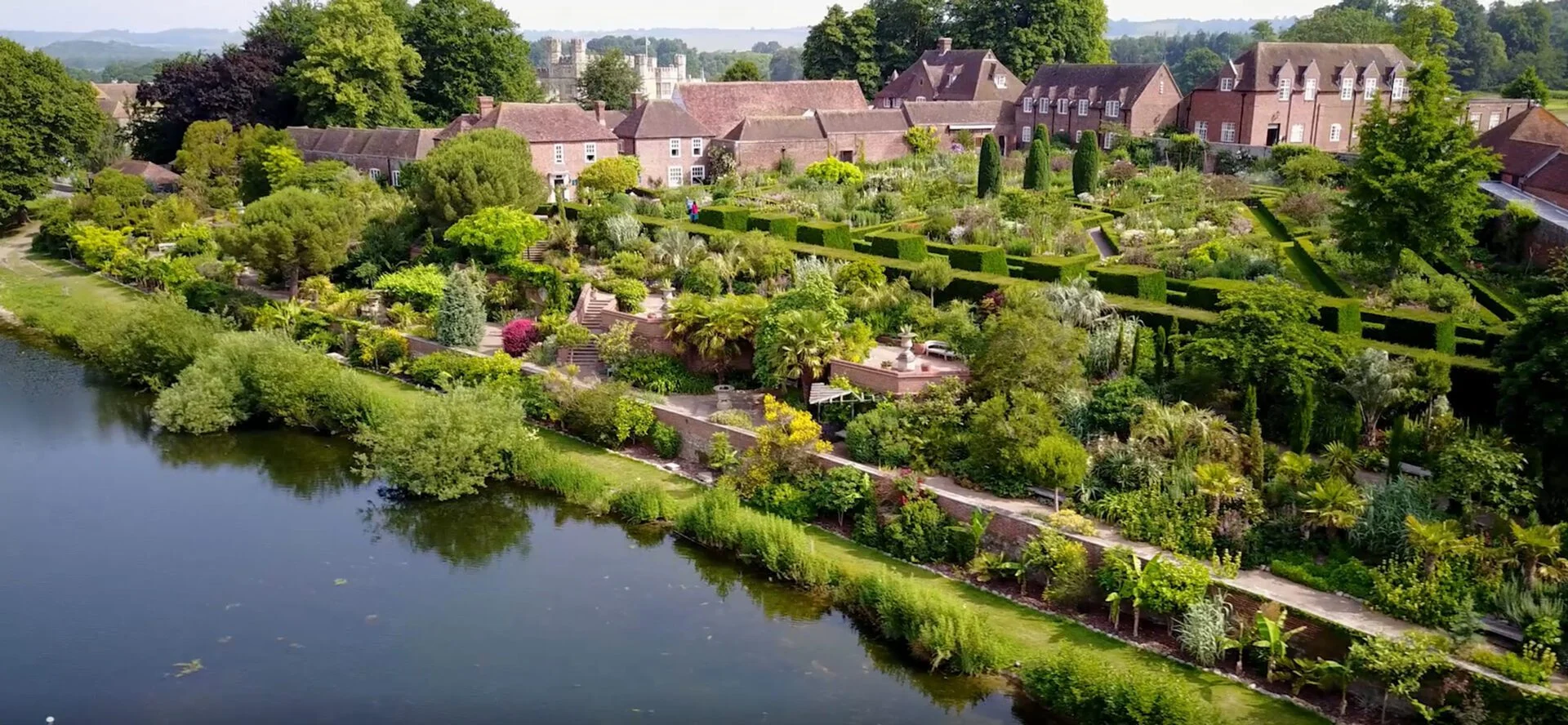
Five hundred acres of Wealden parkland, threaded with waymarked walks and alive with wildlife — great crested grebes and kingfishers on the water in winter, butterflies in the Culpeper Garden in summer, bats in the evenings, black swans and trumpeter swans on the moat year round. The grounds are as serious a reason to visit as the castle, and they reward a longer stay than most visitors give them.
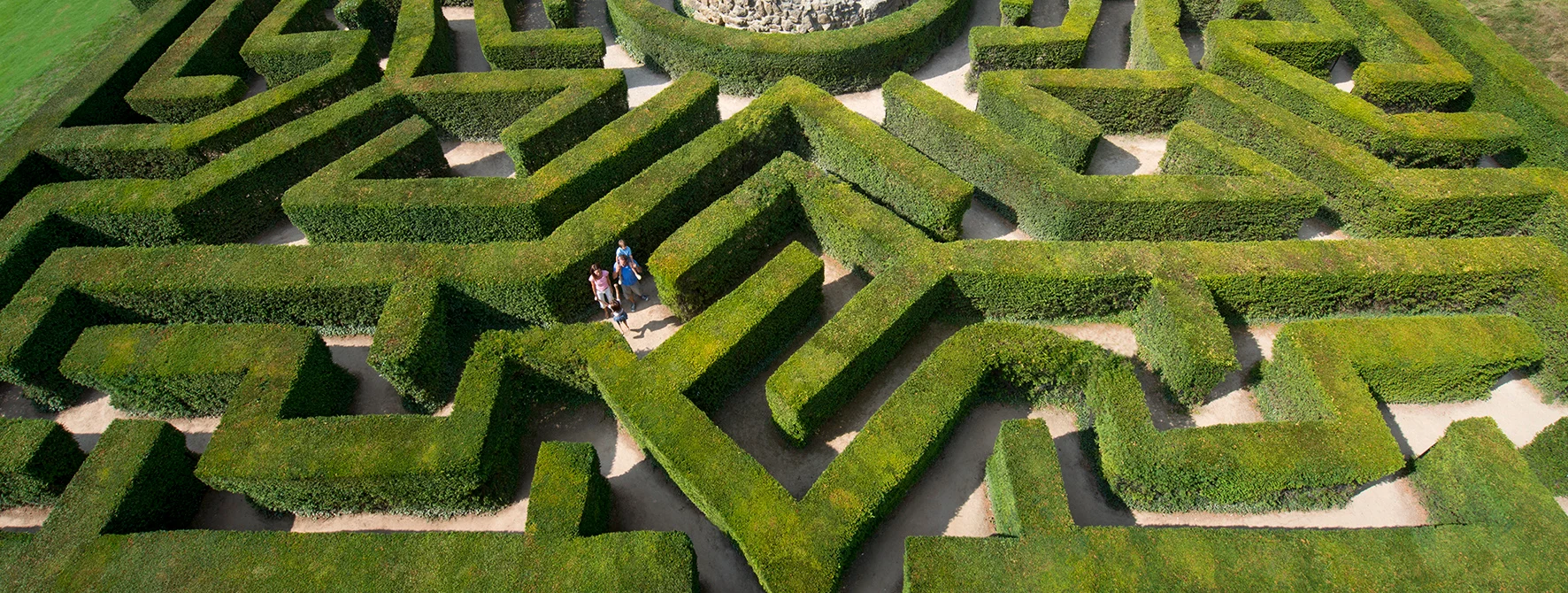
The Culpeper Garden, designed as a cottage garden by Russell Page in the 1980s on the site of the castle’s original kitchen garden, gives climbing roses and herbaceous borders through the summer months. The Lady Baillie Mediterranean Garden Terrace looks out over the Great Water, planted with the Mediterranean species that reflected her preferred aesthetic. The Wood Garden follows the river through spring bluebells and daffodils. And the yew maze, planted in 1988 with two thousand four hundred trees and designed with the general form of a topiary castle, exits through an underground grotto of shells, fossils and mythical creatures with atmospheric lighting — one of the more unusual and memorable denouements a garden maze can offer.
The falconry arena behind the maze hosts daily free-flying demonstrations of hawks, owls and falcons, and the falconry experience — flying the birds yourself, under expert guidance — can be booked separately and is consistently the most praised activity on the estate. Elsie the Castle Train runs from the main entrance to the castle for those for whom the walk is not practical, and the Black Swan Ferry crosses the Great Water to the play areas and maze.
Where to Stay and Eat
Leeds Castle offers several registers of overnight stay, which change the visit considerably by giving you access to the grounds after the day visitors leave.
The Stable Courtyard Bed and Breakfast puts you within the estate walls in rooms that combine period character with modern comfort, breakfast included and access to the castle grounds from early morning. The Maiden’s Tower — the sixteenth-century tower built by Henry VIII for Catherine of Aragon’s ladies-in-waiting — is available as self-catering accommodation for small groups, sleeping in a room where the walls have stood for five hundred years. Knights Glamping, for those whose relationship with canvas involves a four-poster bed and proper linen, occupies luxury tents on the estate. And Lakeside Lodges give waterside self-catering accommodation with views across the Great Water.
For eating during the day, the Fairfax Restaurant serves hot meals, afternoon tea and seasonal menus from locally sourced Kent ingredients; the Maze Café is the lighter option near the gardens. The Park Gate Inn, a short walk from the castle, functions as the estate’s evening pub for those staying overnight. For a more ambitious dinner, Squerryes Winery restaurant, a short drive away near Westerham, offers fine Kent dining alongside one of the county’s most serious English wine estates and can be booked with a ten percent discount for Leeds Castle accommodation guests.
The Practical Details
Leeds Castle is seven miles east of Maidstone, off Junction 8 of the M20 motorway, approximately an hour and a quarter from London by car and equally well reached from the Channel ports, making it a natural first or last stop for a Kent visit. Bearsted railway station is the nearest, with a coach shuttle service available from April to September. The standard admission ticket includes the castle, all gardens and grounds, the maze and grotto, the Dog Collar Museum, falconry displays and the children’s play areas. Annual tickets are available and well regarded by frequent visitors, given the estate’s different character across the seasons.
Allow a full day. Leeds Castle is one of those places where an afternoon reveals the outline and a full day begins to reveal the depth, and the depth is considerable. It is at its most beautiful in autumn, as Lord Conway noted, when the bracken turns and the lake is still, but every season has its character: spring bluebells in the Wood Garden, summer roses in the Culpeper, winter wildfowl on the water. There is no bad time to go, and there is rather more to understand here than any single visit is quite enough to contain.
Leeds Castle Maidstone, Kent ME17 1PL
leeds-castle.com
01622 765400
Open year-round (check website for seasonal hours and event calendar).
About the Author: Lara S

The Finer Map


Get our latest Delivered
Beautiful recipes, inspiration, guides and news that makes you want to live!