Knole, Kent
Knole, Kent
One of the five largest houses in England, a thousand-acre medieval deer park within walking distance of a commuter town, four hundred years in the same family’s hands, and the childhood home of a woman who could not inherit it. The original manuscript of the novel Virginia Woolf wrote in her grief and love is here. The deer graze in the forecourt as though nothing has changed in five centuries. Almost nothing has.
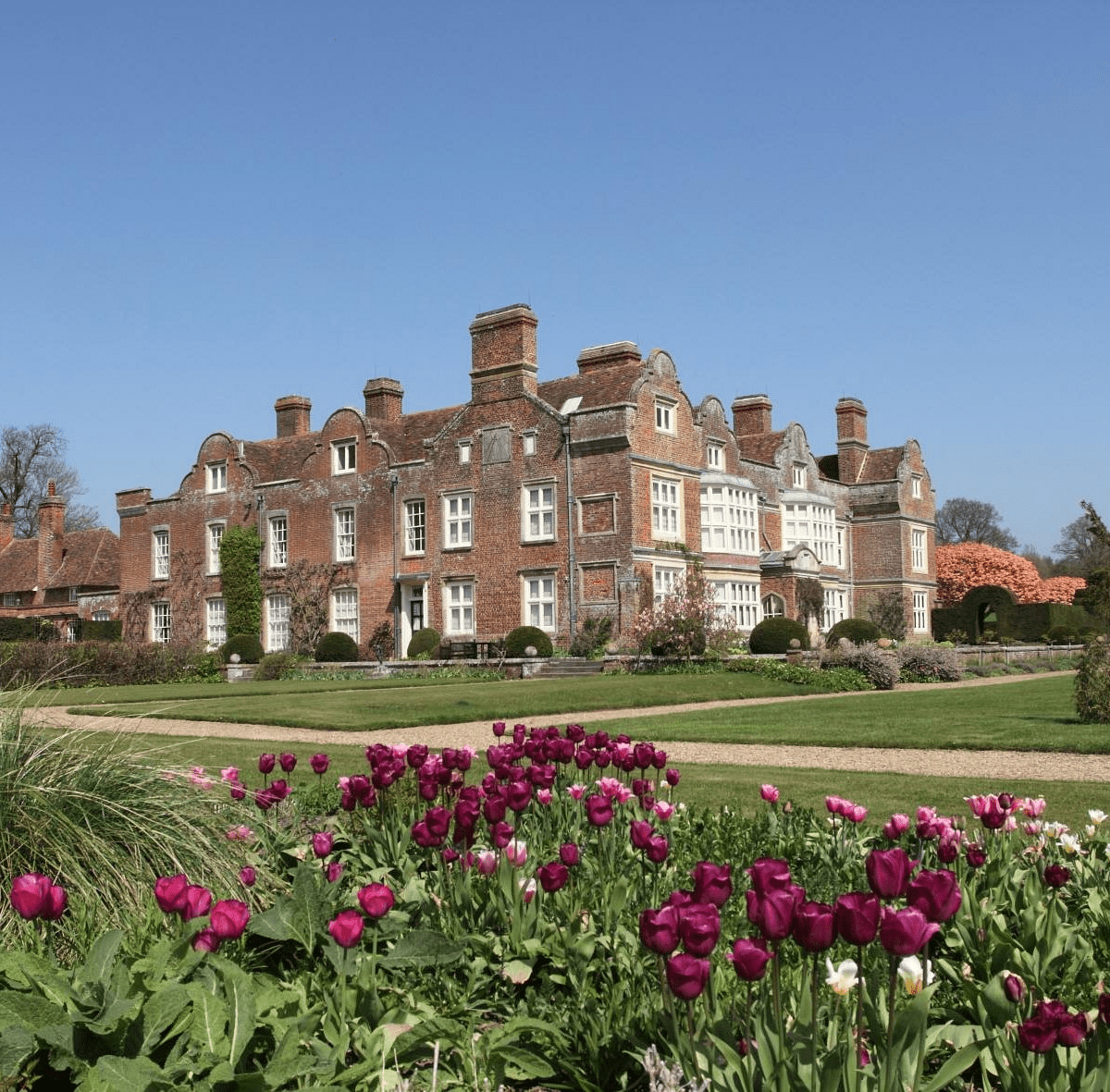
There is a particular problem with very large things, which is that size stops being comprehensible beyond a certain point and simply becomes abstract. Knole has 365 rooms, or so the legend goes — one for each day of the year, along with 52 staircases for the weeks and 7 courtyards for the days. The truth is slightly more complicated, as truths tend to be: the house has approximately 400 rooms, of which fifteen are open to the public, and the legend of the calendar house is almost certainly retrospective, a story the house acquired rather than one it was designed to tell. But the scale is real regardless of whether it maps to the calendar, and it is the first and most overwhelming thing about Knole: the sheer improbable vastness of a house that occupies four acres of footprint, surrounded by a thousand acres of medieval deer park, within walking distance of a Kentish commuter town, as though none of this were in any way unusual.
The second thing, which takes longer to understand but stays longer when it does, is Vita Sackville-West. She was born here, in 1892. She was denied it, by the law of agnatic primogeniture that meant the estate followed the title and the title followed the male line. And everything that came after — the decades of grief, the book she wrote about it, the friendship with Virginia Woolf, the novel Woolf wrote in return, the ruined castle in the Weald she transformed into Sissinghurst and the world-famous garden she made there as a substitute for the great house she was owed — flows from what happened, and failed to happen, at Knole. The original manuscript of Orlando, inscribed in Virginia Woolf’s hand “Vita from Virginia,” is here. It never left.
The House That Archbishops Built
The site has been inhabited since the thirteenth century, the name deriving either from the Old English for a hilltop or from a former owner called Robert de Knole, the records are ambiguous. The house as it now stands began in 1456, when Thomas Bourchier, Archbishop of Canterbury, purchased the estate from the financially ruined descendants of James Fiennes — a soldier who had acquired it and been executed for treason before he could finish building anything — and set about turning it into something worthy of the most powerful churchman in England.
Bourchier worked for thirty years. What he created was less a single building than a series of buildings around a succession of courtyards — Green Court, Stone Court, Water Court, Pheasant Court — in the manner of an Oxford college or a monastic foundation rather than a conventional stately home. The dark Kentish ragstone gives it a sombre, massive quality from the outside, its castellated towers and gatehouse reading more like a small fortified town than a country house, which is approximately what it was. Four successive Archbishops of Canterbury lived here after Bourchier: Morton, who died at Knole in 1500, Dean, Warham, and finally Thomas Cranmer, who enjoyed the house for seven years until Henry VIII, who had been hunting at Knole with Cranmer in 1538 and developed strong feelings about the place, made his wishes clear. Cranmer, being no fool and keenly aware of what happened to people who refused Henry’s requests, presented the house to the King. He lost his estate but kept his head, at least until Henry’s daughter Mary had him burned at the stake fifteen years later, which suggests the wisdom of accommodation had its limits.
Knole remained in royal hands through Edward VI and Elizabeth I, the latter making use of it for her daughter Mary while the protracted divorce from Catherine of Aragon was being managed. In 1566 Elizabeth gave a lease to her cousin Thomas Sackville, and in 1603 he purchased the freehold outright. The Sackville family has been at Knole, in one form or another, ever since.
What the Sackvilles Made
Thomas Sackville, 1st Earl of Dorset, was a man of considerable distinction: a statesman who served both Elizabeth and James I, a poet of quality (his Induction to the Mirror for Magistrates is the finest English verse of the mid-Tudor period), and a playwright whose Gorboduc is the earliest English tragedy in blank verse. He was also, at seventy, an architect with very clear ideas about what he wanted. Between 1603 and his death in 1608 he transformed the medieval Archbishop’s palace into a Jacobean country house of the first rank, working with craftsmen whose names history has not entirely preserved but whose work has endured rather better than their reputations.
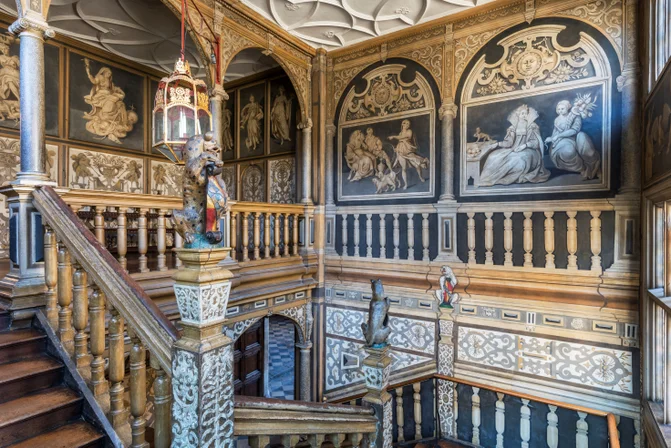
The Great Staircase is the centrepiece of what he made, and it remains one of the finest pieces of Jacobean woodwork in England: a flight of stairs panelled in dark oak, its walls covered in grisaille paintings of an astonishing exuberance — classical figures and architectural fantasies in monochrome that cover every surface between the carved banisters — surmounted by heraldic devices of painted plasterwork that seem to pulse with energy even after four hundred years. At its base, returned to public view after a long exile in an attic, stands a nude marble sculpture of Giannetta Baccelli, a Venetian dancer who captured the heart of the 3rd Duke of Dorset in Paris and came back to Knole with him in the 1780s. When the Duke eventually married a more appropriate wife, Baccelli’s statue was removed to storage, presumably to avoid awkward questions. It is back now, where it belongs, and considerably more interesting than any piece of furniture nearby.
The state rooms that follow are among the most complete sequences of Jacobean and early Stuart interiors in England: the Cartoon Gallery, hung with copies of the Raphael cartoons that Charles I commissioned before the originals went to Hampton Court; the King’s Room, so rich in its furnishings — silver filigree mirrors, a silver toilet set said to have come from France to James II, fabrics so fragile they are kept in permanent low light — that it still faintly reads as a throne room rather than a bedroom; the Spangled Bed, whose name refers to the sequins sewn into its canopy in the seventeenth century, still there; the Brown Gallery, lined with portraits and the exceptional Knole furniture collection, which includes pieces that are among the earliest upholstered chairs and sofas in existence, the deep, low, tasselled forms that gave England the habit of comfortable seating.
The paintings deserve a room of their own and have several. Van Dyck, Gainsborough, Reynolds, Lely — the portrait collection at Knole is one of the finest in private hands, a comprehensive record of four centuries of English aristocratic life that moves from the stiff Jacobean formality of the early Sackville portraits through the swagger of the Restoration to the Georgian ease of Reynolds’s sitters and beyond. The Ballroom chimney piece, carved by Cornelius Cure and considered one of the finest examples of English Renaissance sculpture in the country, stands at the far end under a ceiling that has not been significantly altered since Thomas Sackville died.
In 2014, conservators working on the house discovered something unexpected beneath the floors: oak beams near the fireplaces carved with elaborate marks, scratched and burned into the timber in patterns intended to ward off witches and evil spirits entering through the chimney. They are witch marks, deposited there by servants or craftspeople in the seventeenth century, a form of domestic protection magic that was entirely common in the period and almost entirely invisible to later generations until preservation work starts lifting floorboards. They are not on public display, but knowing they are there changes slightly how you read the dark oak corridors above them.
Vita, and the House She Lost
Victoria Mary Sackville-West was born at Knole on 9 March 1892, the only child of Lionel Sackville-West, who would become the 3rd Baron Sackville, and his cousin Victoria. She grew up in the house with a completeness of attachment that the phrase “childhood home” does not quite cover: she explored every room, learned every corridor, knew the park and its deer and its beeches in every season, and as a young girl delighted in showing visitors around a house she already understood as the family’s great achievement and greatest responsibility. Between 1906 and 1910 she wrote eight full-length novels in the house — none published, all of them attempts to process the place through fiction — alongside ballads and plays, some in French. She was fourteen when she started. She was eighteen, and had written a book and a half already, when she was old enough for a suitable marriage to be arranged.
She understood what that meant. Marriage meant leaving Knole. And she could not inherit it, because Knole followed the title and the title followed the male line — the law of agnatic primogeniture, the rule that property descended through the eldest surviving male, which in the Sackville family’s case meant that when her father died in 1928 the estate would pass not to Vita but to his brother Charles, her uncle, and then to Charles’s son, her cousin Edward (known as Eddy), rather than to the woman who had spent her entire childhood there and loved it with an intensity that nothing else in her long life ever quite matched or replaced. She knew this as a child. She knew it at the private chapel at Knole where she married Harold Nicolson in 1913 and which she was leaving forever, or as near to forever as made no practical difference.
Her father died in 1928. The estate went to her uncle. The title went with it. Vita had already written her book about the place — Knole and the Sackvilles, published in 1922, a history of the house and family that reads, beneath its scholarly surface, as an act of claiming something in words that she was denied in law. The year her father died, Virginia Woolf — who had been Vita’s lover since 1925 and who had visited Knole, walked its state rooms, sat in its park and understood what it meant to the woman she loved — published Orlando.
Orlando is, as Vita’s son Nigel Nicolson described it, the longest and most charming love letter in literature. It follows a character who lives across four centuries of English history and changes sex at the midpoint: a man who becomes a woman and cannot inherit, cannot possess, can only love what the law denies her. The house in the novel is unmistakably Knole. The original manuscript is in the house today, inscribed in Woolf’s hand: Vita from Virginia. It is one of the most extraordinary objects in any English house, and it sits at Knole, where it was always going to end up.
Vita’s cousin Eddy, who inherited what Vita could not, presents the perfect inversion of the irony: by every account he would have vastly preferred not to have inherited it, finding the responsibilities of a great estate entirely uncongenial to his temperament as a critic, novelist and broadcaster. He lived in the Gatehouse Tower between 1926 and 1940, and the exhibition now housed there explores his life as a gay man in the early twentieth century, navigating an identity that required concealment in ways that rhyme, at different angles, with Vita’s own exclusions. The Gatehouse Tower can be climbed — seventy-seven steps — and the views from the top across the park are the closest you will come to understanding the scale of the whole.
Vita herself helped negotiate the transfer of Knole to the National Trust in the early 1940s. The house was gifted in 1946. The Sackville family retained a 200-year lease on private apartments and continues to live at Knole. The current Lord Sackville, the 7th Baron, shares the house with the Trust and with some 80,000 visitors a year, which is either a great burden or a continuing act of the Hussey family motto’s quiet philosophy: I scarcely call these things my own.

The Park and the Deer
The deer park was enclosed in 1456 by Archbishop Bourchier, and it has not fundamentally changed since. A thousand acres of ancient woodland and open grassland within the boundary of Sevenoaks, one of the last medieval deer parks in England still in its original form, grazed by a wild herd of fallow and sika deer whose ancestors were here before the first Sackville arrived.
They are extraordinary to encounter, particularly near the house. The deer graze right up to the outer courtyard — you can walk among them, photograph them from a few feet away, sit among them if you choose and if they permit it — and their complete uninterest in human beings is the clearest sign of a herd that has not known hunting for generations. In April and May the parkland floors are carpeted with bluebells, the ancient beeches coming into leaf above them. In autumn the bracken turns gold and the air carries the smell of damp earth and fallen leaves, and the beeches, which have been here long enough to have inspired Mrs Ann Radcliffe’s passionate description of “shade rising above shade with amazing and magnificent grandeur” when she visited in the early nineteenth century, look approximately as she described them.
The park is free and open year-round. It is, for many visitors, the thing they remember longest: the particular quality of a managed landscape that has had six centuries to find its own character, the deer entirely at home in a place where everything has been, for reasons of inheritance and love and law and accident, the same for a very long time.

What Else To Know
The Brewhouse Café at the visitor entrance serves hot food, cakes and the kind of restorative cup of tea that a substantial visit to a large house earns. A second-hand bookshop by the entrance is well worth the detour. The gift shop carries a good range of books on the Sackvilles, on Vita, and on Orlando — all of which read differently after a morning at Knole than they did before.
The Gatehouse Tower exhibitions are worth booking separately if available, exploring Eddy’s life at Knole with materials from the family archive. The climb to the top of the tower gives views unavailable from anywhere else on the estate.
The Practical Details
Knole is on the south edge of Sevenoaks, off the A225, the entrance just off the town centre. Sevenoaks station is a twenty-minute walk from the house and served from London Charing Cross in around thirty minutes, making this one of the most accessible National Trust properties from London. The house is open on timed tickets in the spring and summer season; the park is free and open year-round from dawn to dusk. National Trust members visit the house free. The deer can be encountered on any visit to the park at any time of year, at any hour, which is the single best practical recommendation this piece can make: come early, or late, or on a winter afternoon when the light is low and the house is quiet and the park belongs entirely to the deer and whoever happened to bring good boots.
A note for those who have read the rest of this Places to Visit collection: Knole is where the Vita story begins, and Sissinghurst is where it continues. The two houses are fourteen miles apart and a lifetime’s creative response to a single act of inheritance law. Both are magnificent. Both are made more completely themselves by the knowledge of the other. The Kent shelf does not get more layered than this.
Knole Sevenoaks, Kent TN15 0RP
nationaltrust.org.uk/knole
01732 462100
Park open year-round, dawn to dusk. House and Gatehouse Tower open seasonal timed entry tickets (check website).
About the Author: Lara S

The Finer Map


Get our latest Delivered
Beautiful recipes, inspiration, guides and news that makes you want to live!