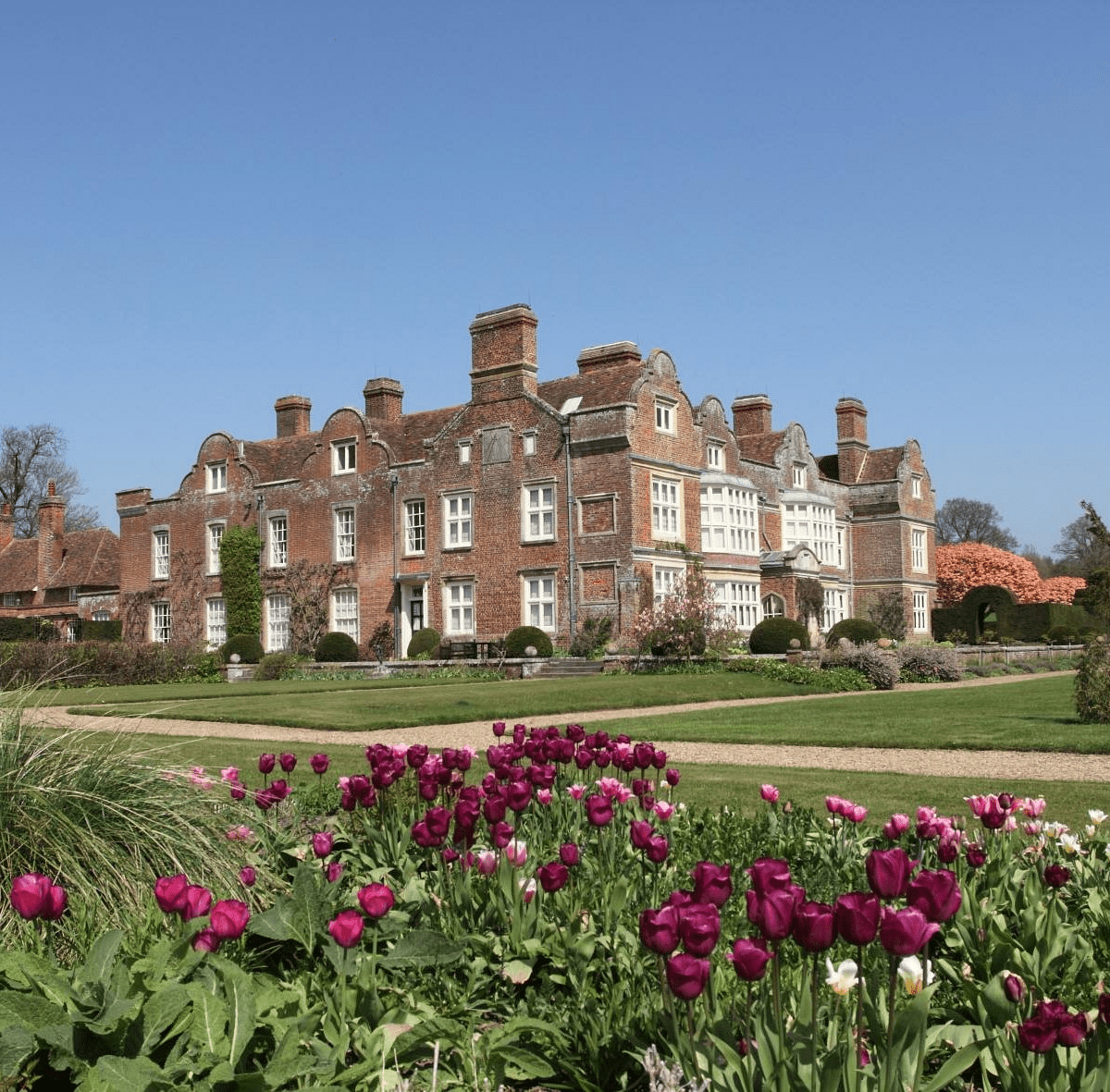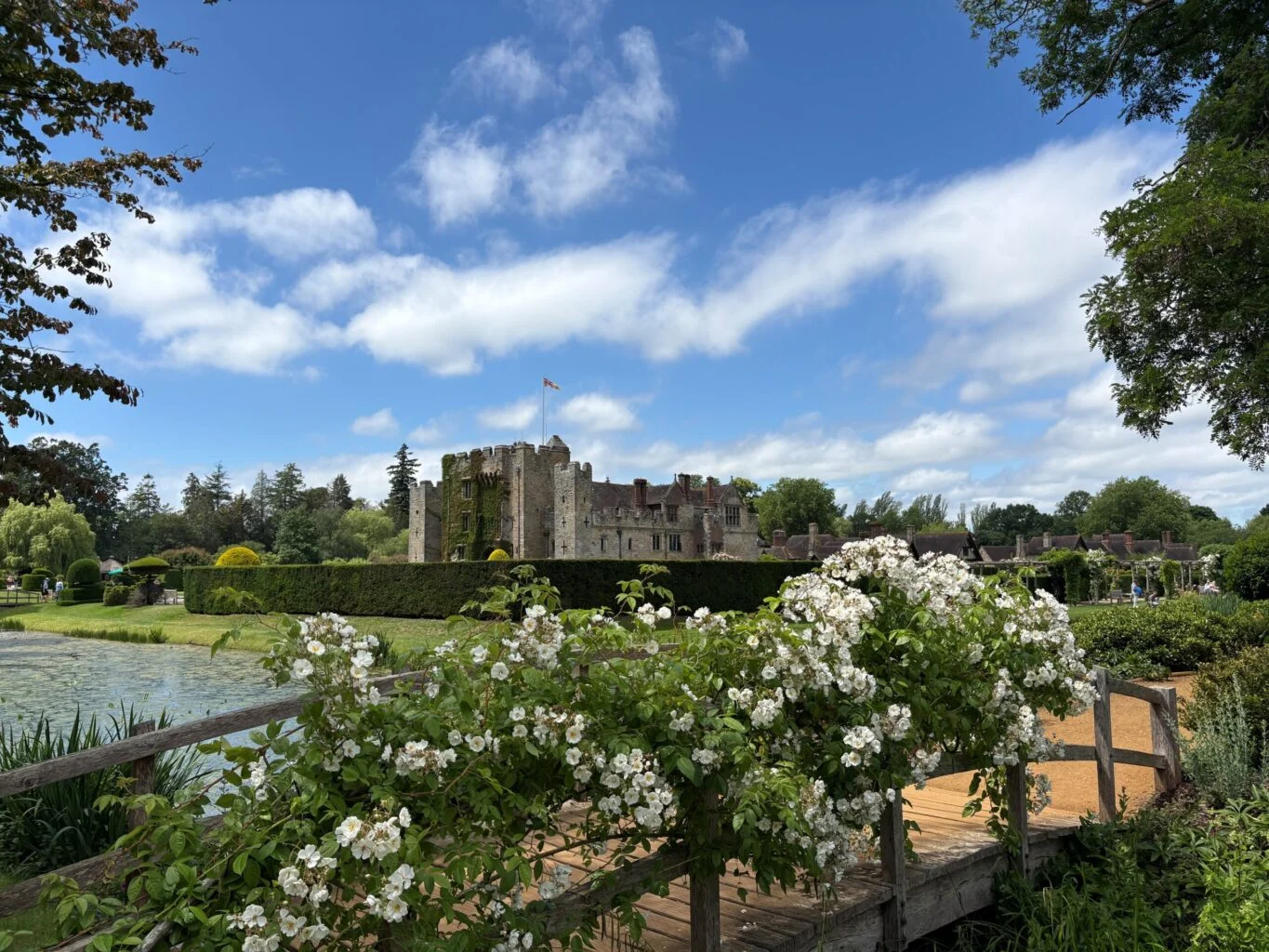
Hever Castle and Gardens
Hever Castle and Gardens, Kent
A double-moated medieval castle in the Kentish Weald, childhood home of Anne Boleyn, scene of a royal courtship that changed the course of English history, and, thanks to one extraordinarily wealthy American who fell in love with it in 1903, one of the finest garden estates in the country. The history alone is worth the drive. The gardens are a bonus worth the price of admission all by themselves.
Some houses carry their history lightly. Hever is not one of them. The moment you cross the drawbridge over the moat, the weight of what happened here settles on you in a way that the most beautifully curated museum display never quite manages, because this is not a recreation of the past but the actual place where it unfolded. The same rooms, the same walls, the same timber and stone that the Boleyn family lived within, that Henry VIII courted a young woman who told him, with a composure that would have terrified lesser men, that she would be his wife or nothing at all. The decision she made in these rooms changed England’s religion, its monarchy and the course of its history. It is a considerable amount to carry for a small double-moated medieval castle in a Kent village, and it carries it with quiet authority.
A Place That Changed England
The castle began, modestly enough, as a fortified country house in 1270, built with a gatehouse and a walled yard by a Kentish landowner. For the next two centuries it passed through several hands without particular distinction, until 1462, when Geoffrey Boleyn, a wealthy London merchant and former Lord Mayor, acquired it and converted the existing structure into a comfortable Tudor dwelling. His grandson Thomas Boleyn inherited in 1505, and it was to this house, on this moat, in this corner of Kent, that Thomas brought his wife Lady Elizabeth Howard and their three children: George, Mary and Anne.
Anne Boleyn, the future Queen of England, lived at Hever through her early childhood until she was sent to the court of Margaret of Austria in 1513 to receive an education appropriate to a young noblewoman. She returned to England in 1522 as a maid of honour to Catherine of Aragon, the first Queen of Henry VIII, and when the King began his determined pursuit of her around 1526, Hever became the place she retreated to, repeatedly, from the dramas and pressures of his court. Henry followed. He wrote her letters, famous letters, passionate and cajoling and increasingly urgent, and it was at Hever, in these rooms, that Anne made clear the terms on which she would accept him: not as his mistress but as his wife.
The consequences of that position are well enough known. Henry’s attempts to have his marriage to Catherine annulled brought him into direct conflict with Rome. The Church refused. Henry created the Church of England. Anne Boleyn became his second queen and the mother of the child who would reign as Elizabeth I, arguably the greatest of all English monarchs. She was Queen for a thousand days before she was executed on Tower Green in May 1536, on charges of adultery and treason that most historians now regard as fabricated. She was twenty-eight, or thereabouts. Her exact birth date remains a matter of scholarly debate.
After the death of Anne’s father Thomas in 1539, the castle came into Henry’s possession. He gave it to his fourth wife, Anne of Cleves, as part of the settlement of their annulled marriage — a fact that must have struck the Boleyn family with particular force. It passed through several English families across the following centuries, declining gradually from a residence of consequence to a gentleman farmer’s house and then to something approaching a ruin, until the morning in 1903 when William Waldorf Astor, then the wealthiest American alive, drove down to Kent and decided to save it.
The Man Who Saved It
William Waldorf Astor had the particular quality of the very rich who love history: he did not merely want to own a piece of it, he wanted to live inside it. Having already acquired Cliveden in Berkshire, he brought to Hever the same combination of money, taste and genuine historical passion, and the result was a restoration that gave the castle back its dignity while indulging Astor’s own considerable appetite for grandeur.
The castle itself was meticulously restored. The Tudor village — now called the Astor Wing — was built alongside it, a picturesque cluster of cottages constructed for family and guests that is today the castle’s luxury accommodation. And the gardens were created almost entirely from nothing: the thirty-eight-acre lake was dug by a thousand workers in a single year, the Italian Garden laid out to house Astor’s extraordinary collection of ancient Greek and Roman statuary, much of which is over two thousand years old. He also planted the yew maze in 1904, now over a century old, and commissioned the Pompeiian Wall and its cascade of fountains. The castle was officially opened to visitors in 1963 by Astor’s grandson Gavin, and has welcomed them ever since. In 1983 the Astor family sold the estate to the Guthrie family’s Broadland Properties, who maintain it to the present day.
Inside the Castle
The castle’s interior works on two registers simultaneously: as a document of Tudor life and as a monument to Edwardian collecting, and the collision between the two is one of the more interesting things about it. Astor was a passionate and knowledgeable collector, and the rooms are hung with what is regarded as one of the finest collections of Tudor portraits after the National Portrait Gallery: Henry VIII in all his imperious bulk, his six wives in varying states of royal composure, courtiers and ministers from an age when portraiture was documentation and power at once.
The Boleyn Apartment is the most personally significant space: four rooms — a Parlour, a Nursery, a Best Bedchamber and a chapel — recently restored to their Tudor appearance following a five-year research project. Architectural historian Dr Simon Thurley established that the apartment is structurally unchanged since the sixteenth century, making it a genuinely rare opportunity: a room where we can say with confidence that Anne Boleyn was here, in this space, under this ceiling. The restoration team recreated the interiors from period inventories and comparable Tudor houses, removing the Victorian oak panelling Astor had installed and returning the rooms to something close to how they would have appeared in the 1520s. The Nursery where Anne slept as a child, the Best Bedchamber where she retreated from Henry’s pursuit — these are not reconstructions but the actual rooms, lightly interpreted.
Among the more remarkable objects in the castle are Anne Boleyn’s own prayer books, bearing her inscriptions and signature, displayed in a case that most visitors pause at longer than they planned to. And one of Henry’s private locks: a padlock the King carried on his travels and had fitted to every door he slept behind, for security. The thought of it — England’s most powerful monarch travelling with his own lock — says something compact and precise about the paranoia that power produces.
The Gardens
If the castle is where you go for history, the gardens are where Hever becomes something else: a place of extraordinary horticultural ambition spread across 125 acres of the Wealden countryside, with the thirty-eight-acre lake at its heart, and the Italian Garden at its grandest extreme.
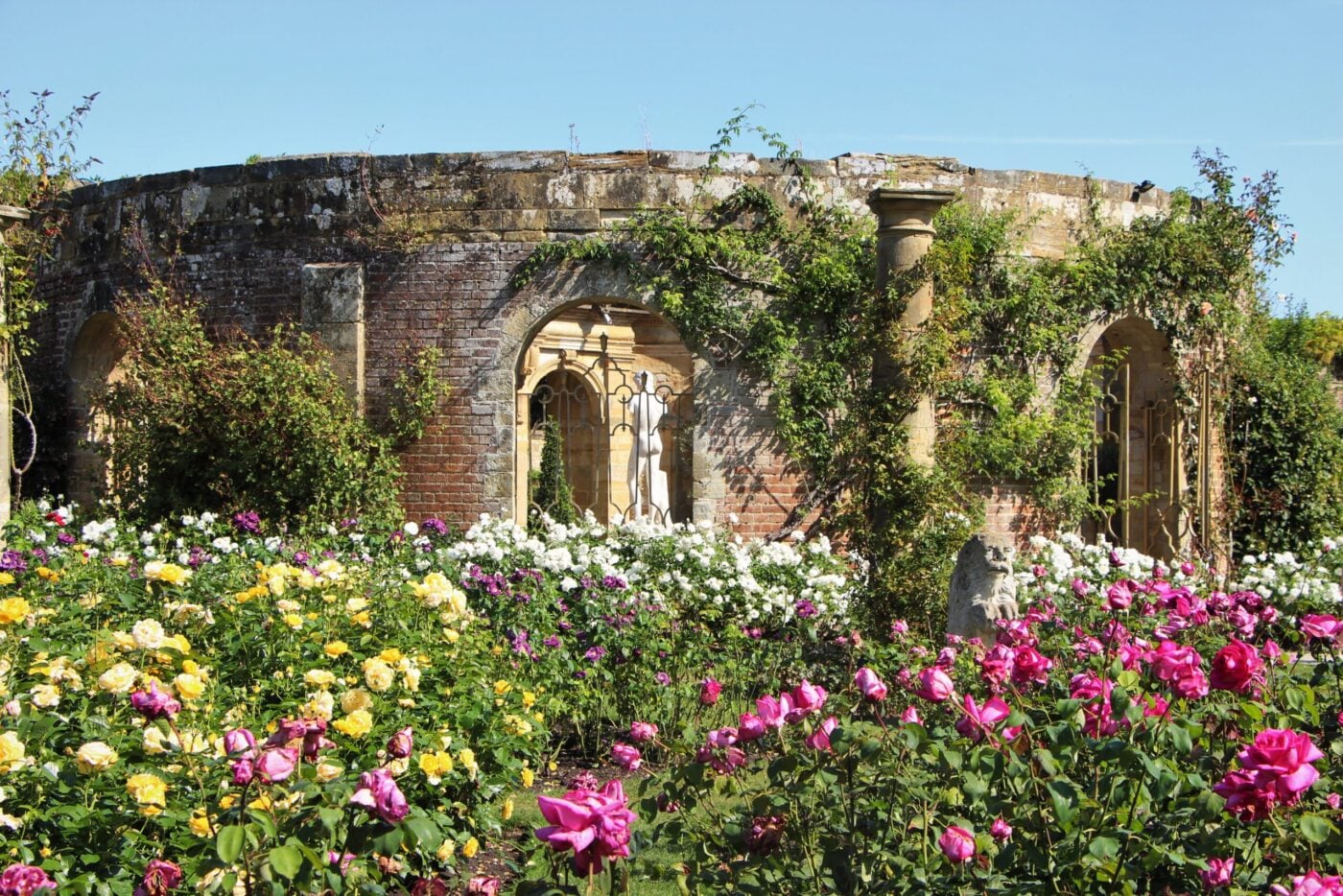
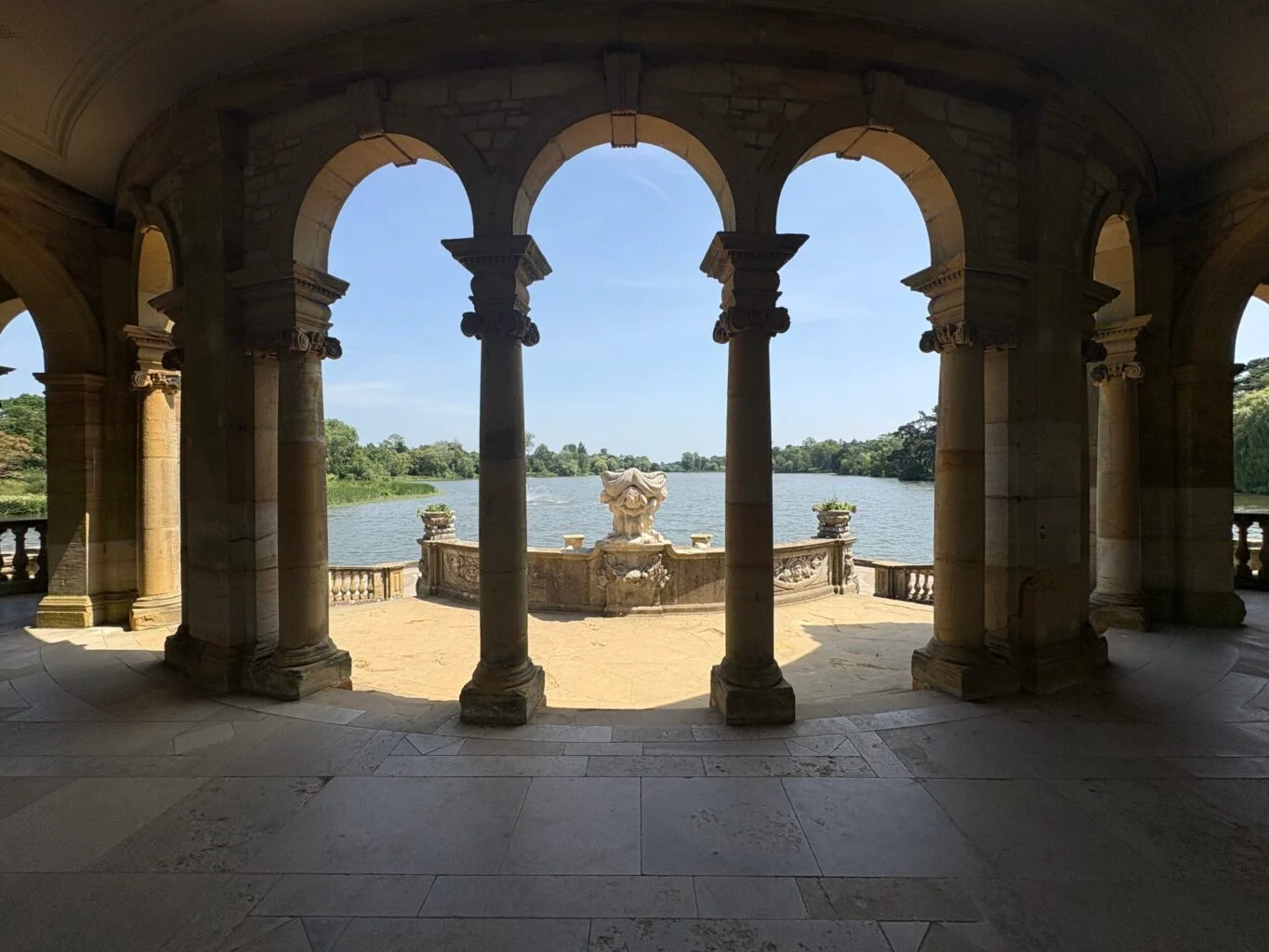
The Italian Garden, Astor’s masterwork, runs along a vast Pompeiian wall lined with niches, each one housing a piece of ancient statuary: Roman emperors, Greek gods, sarcophagi and altar pieces, all acquired by Astor in Italy and shipped to Kent to populate a garden that he conceived as a setting for them rather than an afterthought. The effect is genuinely theatrical: standing at the loggia above the garden and looking down the long axis towards the lake, with the water reflecting the sky and the fountains playing along the wall, it is easy to understand why Astor spent a fortune on it and why it still stops visitors in their tracks today.
Beyond the Italian Garden the grounds open into more English registers: a rose garden with over five thousand bushes whose peak in June fills the air with a scent considerable enough to locate you from a distance, a Tudor Garden planted with herbs and flowers appropriate to the period, a Winter Garden that gives even a January visit its reason, a rhododendron walk that makes late spring a riot of colour along the lakeside path. The Yew Maze, planted by Astor in 1904, is the traditional kind: tall, dense, genuinely disorienting, old enough to have lost any sense of contrivance. The Water Maze on Sixteen Acre Island is the modern complement: step on the wrong paving stone and you get wet, which is either a misfortune or the best thing that happened to you all day, depending on your age and the weather.
The thirty-eight-acre lake wraps the whole estate together, the lakeside walk giving you the castle’s reflection in the water at one end and the Italian Garden’s statuary at the other. Rowing boats are available for hire, which gives you the rather wonderful prospect of a morning on the water in the shadow of a moated Tudor castle, which is not something most days can offer.
Where To Eat
On the estate during the day, the Pavilion Restaurant serves seasonal lunches and afternoon tea from locally sourced ingredients, with the castle and gardens visible from its windows. For something more ambitious, Eden — the castle’s intimate restaurant under the direction of chef George Blogg — is available exclusively to accommodation guests and evening diners, its menu informed by the estate’s own produce and the seasonal availability of the Kent countryside around it. It is the quieter, more considered side of a visit, available once the day visitors have left and the grounds are your own.
A mile from the castle, Falconhurst Farm Shop is highly recommended by those who know the area well. And Squerryes Winery, a short drive away near Westerham, offers a restaurant, deli and vineyard tours of one of Kent’s most serious English wine producers — worth combining with a Hever visit for a full day in the Kentish Weald. The King Henry VIII Inn in the village is the evening standby for those staying on the estate.
Where to Stay
Staying at Hever overnight changes the character of the visit completely, for one reason above all: after the day visitors leave, the gardens and grounds are yours. The castle lit at dusk, the moat reflecting the last of the light, the grounds in silence apart from whatever is moving in the woodland around the lake — this is a version of Hever that the day visitor does not get to see.
The Luxury Bed and Breakfast comprises twenty-six five-star bedrooms across the Astor Wing and the Anne Boleyn Wing, each one with its own character: some with four-poster beds and roll-top baths, others with panelled walls and views over orchards to the castle walls. The Astor Wing has a sitting room with an open fire and deep sofas; the Anne Boleyn Wing is quieter and more intimate. Breakfast is served in an impressive dining room: a Full Hever, smoked salmon and scrambled eggs, or porridge with cream, all made with local ingredients.
For those who want a longer stay, Medley Court is a four-bedroom self-catering house within the estate, five-star gold rated and available for a week or a minimum of two nights on short-lead bookings. The private tour of the castle — Hidden Hever, taking you into rooms not normally open to the public — is available to book during a stay and is, by all accounts, the single most memorable thing you can do here.
The Practical Details
Hever Castle is three miles south-east of Edenbridge, off the B2026 between Sevenoaks and East Grinstead, thirty miles from London. A car is by far the easiest way in, following the brown tourist signs from the M25 at junctions 5 or 6. By train, London Victoria and London Bridge both run services to Edenbridge Town, from which a pre-booked taxi covers the final three miles; Hever station is a mile’s walk from the castle along a country lane.
The main season runs from mid-February to late October, with gardens open from 10.30am and the castle from noon. A Castle and Gardens ticket includes an audio guide; Gardens Only tickets are available for those who want to spend the day outside. Allow three to four hours for a proper visit; those staying overnight can return to the castle until midnight, which is a very particular pleasure. Check the website for the current events calendar: jousting tournaments, the Handmade and Homegrown festival, a Festival Theatre programme rebuilt in 2024, and the Hever in Bloom series in June and July give the estate a rhythm worth planning around.
Hever Castle and Gardens
Hever, Edenbridge, Kent TN8 7NG
hevercastle.co.uk
01732 865224
Open mid-February to late October (see website for winter season and full opening times).
Accommodation bookings: 01732 861800.
About the Author: Lara S

The Finer Map



Get our latest Delivered
Beautiful recipes, inspiration, guides and news that makes you want to live!