Emmetts Garden, Kent. Bluebells, Tulips and Autumn Colour
Emmetts Garden, Kent
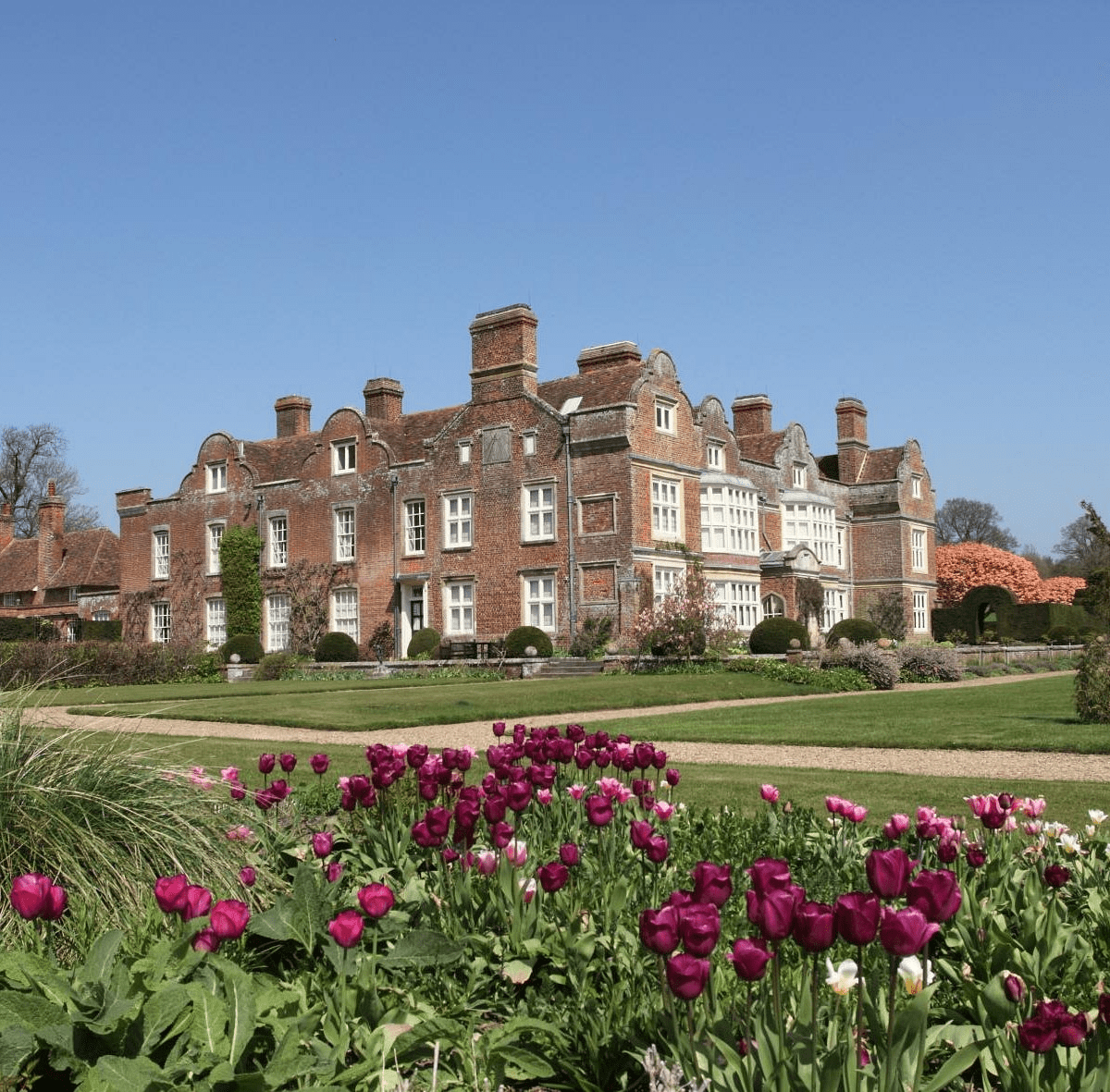
A plantsman’s hillside garden near Sevenoaks, on one of the highest points in Kent, with views over the unspoilt Weald and a seasonal programme that changes more dramatically than almost any other garden in the county. In spring the bluebell woodland turns the hillside blue. In April the tulip meadow opens under cherry blossom. In late spring a handkerchief tree produces its famous hanging white bracts. In autumn the maples turn the slopes to fire. The tallest tree in Kent stands at the top of the ridge. The garden changes with every month you choose to visit it, and there is not a bad one.
Most of the gardens on this Kent shelf have a house at their centre. Emmetts has a view. The house exists — a late Victorian country home visible through the hedges from the rose garden, private and not open to the public, its old stables now the tearoom — but it is not the reason to come. The reason to come is the ridge. Emmetts sits at approximately six hundred feet on a sandstone ridge above the Weald, one of the highest points in the county, and the view from the garden across the unspoilt Wealden countryside to the North Downs in the distance is the founding reason for everything that surrounds it. Frederic Lubbock chose this particular piece of hillside in 1893 and spent the next thirty-four years filling it with plants from around the world, but he chose it first for the position. The position has not changed.
The Plantsman and His Friend
Frederic Lubbock was a banker with a passion for botany of the kind that the Edwardian upper-middle class could sustain: time, money, land and an international network of plant hunters whose expeditions into China and Japan were returning with species that had never been seen in English gardens before. He was also a friend of William Robinson, the Irish-born garden writer and designer whose influence on late Victorian and Edwardian planting was profound.
Robinson’s philosophy was simple and, at the time, radical: plants should be placed in conditions that suited them rather than marshalled into formal arrangements that didn’t. The wild garden, as he called it — plants from around the world set into naturalistic English landscapes, given room to show their true form, grown for the pleasure of the plant itself rather than the geometry of the beds around it — was his argument, made in books and articles and in the gardens of his friends. Emmetts is one of the finest surviving expressions of that philosophy: a hillside garden in which rare trees and shrubs from China, Japan and the Americas are set into the Kent countryside as though they belong there, which, after a hundred and thirty years, they now do.
Lubbock bought rare plants from around the world, many of them collected on expeditions into China that followed the concessions the First Opium War had forced on the Qing empire, opening Chinese territory to European trade and, in due course, to European plant hunters who found there a botanic wealth that had been invisible to the Western world for centuries. The trees in the South Garden at Emmetts — the acers, the magnolias, the rhododendrons, the Chinese species that are now mature specimens rather than the novelties they were when Lubbock planted them — have this history behind them: the slow forced opening of a country, and a banker in Kent who bought the results with gratitude and gave them a hillside to grow in.

The South Garden and Its Spaces
Lubbock laid out the South Garden to display his most extraordinary specimens, and his method was the one Robinson advocated: each tree and shrub given enough space to show its natural form, the planting arranged so that you look past, through and under each specimen to catch a glimpse of others in the distance and the landscape beyond. It is a principle that gives the South Garden its particular quality of depth — the sense that there is always something further to see, another layer of colour or form beyond the one immediately in front of you — which is rarer in garden design than it sounds.
The most famous inhabitant of the South Garden is the handkerchief tree, Davidia involucrata. The Chinese name for this tree translates more accurately as dove tree: in late spring it produces hanging white bracts that drop from the branches in pairs, dangling like white handkerchiefs or, in a gentler light, like the wings of resting doves. It was introduced to Europe in the nineteenth century from the Hubei province of China and became, for a generation of Edwardian gardeners, one of the most prized of the new Chinese imports. Lubbock’s handkerchief tree was blown over and badly damaged in the Great Storm of 1987, which destroyed ninety-five per cent of the surrounding woodland in a single night. The National Trust team that inherited the disaster had it winched upright and continued its care. It is still there, still producing its white bracts in late May, still one of the most extraordinary sights in a garden full of them.
The North Garden
The North Garden — Lubbock called it the Shrub Garden — was planned for the views its northern plateau commanded and for the specific growing conditions its topography created. Water and ponds were not merely decorative but functional, providing bog garden conditions for moisture-loving plants: iris and fern and the plants that need their feet wet. More shaded areas were developed for Japanese planting — acers and magnolias in the conditions they preferred. A rocky bank created the hot, dry conditions for cistus and tree lupins. The design is an education in the relationship between plants and their needs, which is more interesting to walk through than it sounds: a hillside that is, simultaneously, bog and rock and shade and open sky, each zone answering to a different set of botanical requirements.
Charles Boise, who bought the garden after Lubbock’s death in 1927, made one alteration to the North Garden that is difficult to evaluate without sympathy for the man who made it. He filled in the pond. His reasoning was that standing water attracted mosquitoes, and mosquitoes increased his risk of contracting malaria. This was not, in the 1930s, as eccentric as it sounds: malaria had been endemic in the marshy parts of Kent and the Thames estuary for centuries, the last English cases not finally dying out until the mid-twentieth century. Boise’s anxiety was grounded in something real, even if its horticultural cost was considerable. The National Trust has since restored the North Garden with a new pond, reinstating the water that Lubbock had planned and Boise had removed.
Boise’s wife Hazal introduced azaleas, which added a note that was not in Lubbock’s original planting and has since become part of the garden’s spring character. The best decisions in gardens are sometimes made by people who are only passing through.
The Rose Garden
The only formally designed space in Emmetts is the Italianate rose garden, and it was made by Lubbock not for himself but for his wife Catherine, between 1910 and 1920. It lies in front of the house — which was easily accessible to the family for an evening stroll among the scented blooms — and it frames one of the key views from the house out towards the valley and the Weald.
Today the rose garden holds Octavia Hill roses, planted in 2012 to commemorate the hundredth anniversary of the death of one of the National Trust’s three founding members, alongside Rosa ‘English Miss’, Rosa ‘Bonica’ and the fragrant Rosa ‘Katherine Zeimet’. The border was recently replanted with the same varieties chosen for this space by the Lubbocks originally, which means the rose garden now carries both a founding intent and a recent act of careful fidelity to it.
The Tulip Meadow, and the Glass Slides
The meadow at Emmetts has been planted with tulips since at least 1910, and the specific tradition — tulips under the Japanese cherry trees, a Prunus fugenzo variety, in a colour scheme of red, pink and black — has been continuous since the Lubbock era. Its continuation is more precisely documented than most garden traditions, because when the National Trust was researching the garden’s history they found stereoscopic glass slides from around 1910 showing the meadow in exactly the configuration it is still planted in today: the same location, the same colour scheme, the same intention of having tulip and blossom flowering simultaneously in a composition of pink above and colour below. The slides confirmed that this was always the plan. Seven thousand bulbs are planted each year to keep it that way.
The tulip season transitions, as the year warms, into the cornflower meadow, the tulip bulbs replaced by self-seeding cornflowers that bring a wash of azure blue to the same ground in early summer. Each season the meadow changes its crop without changing its location, the hillside below the cherry trees always in colour but never in the same colour twice.
The Bluebells, and Why the Woodland Is Protected
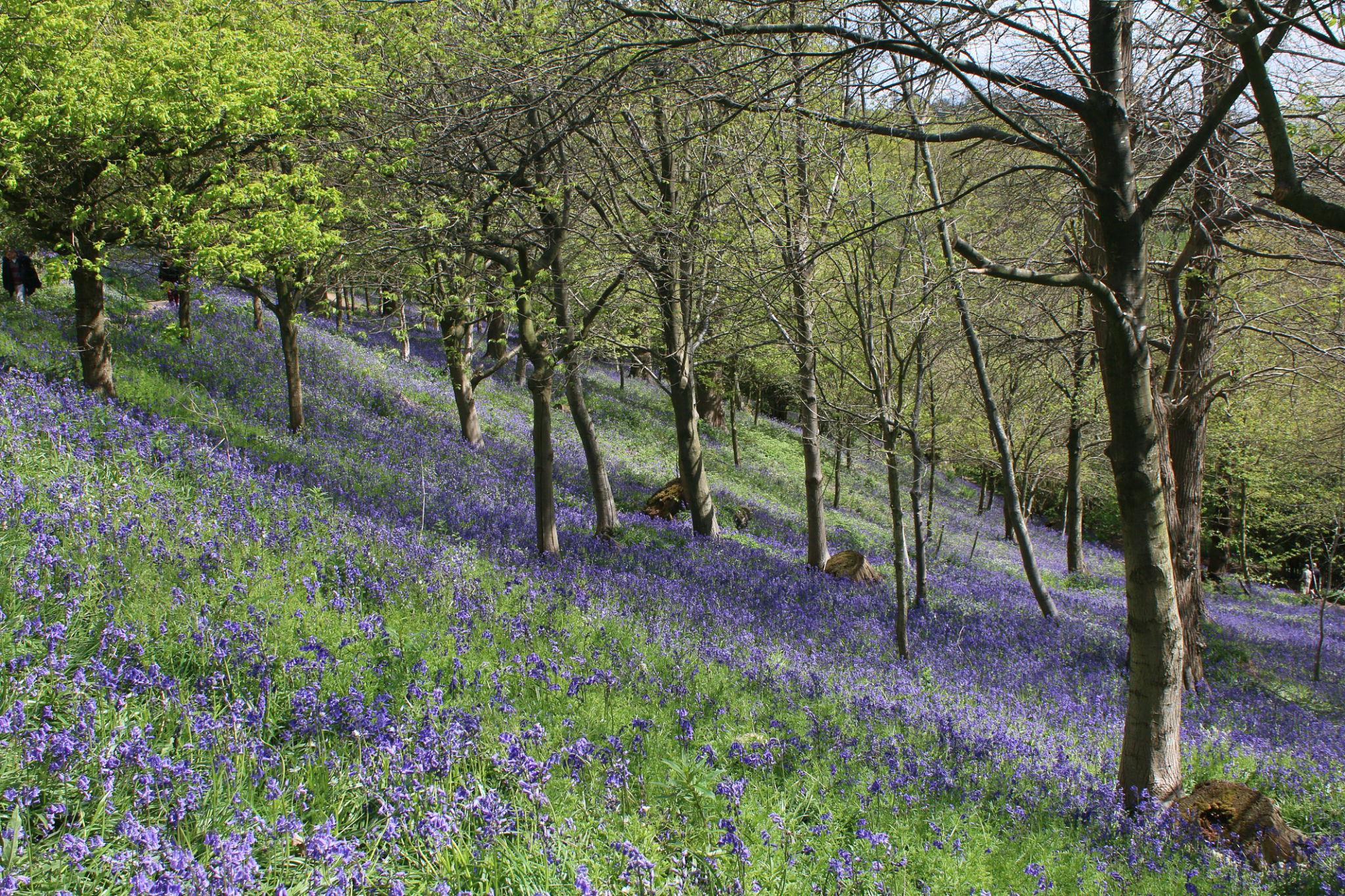
Below the garden proper, the hillside woodland at Emmetts is designated a Site of Special Scientific Interest specifically for its English native bluebells. This is not a casual designation: SSSI status is granted by Natural England to habitats of demonstrable scientific importance, and the bluebell woodland at Emmetts holds the kind of density and quality of native Hyacinthoides non-scripta — the English bluebell, nodding and fragrant and narrowly tubed, quite unlike the Spanish hybrid that has invaded many English woodland floors — that merits legal protection.
In late April and early May the hillside turns blue, the colour spreading under the tree canopy with the particular saturated quality that native bluebells produce in numbers. It is, if you have not seen it before, genuinely startling: a colour the eye doesn’t quite believe. Each damaged bluebell takes between four and six years to regrow, which is why the paths are marked and the instruction to stay on them is more serious at Emmetts than almost anywhere else on this shelf. The population has survived because generations of visitors have respected it, which is a collective act of care worth acknowledging.
The bluebell season is Emmetts at its most popular and its most photogenic. Weekday visits are significantly calmer than weekends, and parking, which is limited, fills quickly on the first warm Saturday of the season. A Tuesday morning in late April, when the colour is at its peak and the hillside is quiet, is one of the finest experiences this collection can recommend.

The Storm and Its Aftermath
On the night of 15 October 1987, the Great Storm swept across the south of England with wind speeds that had not been recorded since 1703. At Emmetts, ninety-five per cent of the surrounding woodland was destroyed in a few hours. The mature trees that had been growing since Lubbock’s planting programme were down. The landscape the garden had been designed in relation to was, overnight, gone.
Alan Comb arrived for his first day of work at Emmetts just after the storm in October 1987. There is no record of what he found or how he felt about beginning a gardening career in the middle of a catastrophe, but the job he began that day has continued for nearly four decades. The National Trust undertook a sympathetic replanting programme in the storm’s aftermath, working with what survived — including the Wellingtonia and the handkerchief tree, which were saved and in the second case winched upright — and replanting the wider woodland with a consciousness of what had been there and what might be needed again. The storm brought more light to the garden as a secondary consequence, which proved beneficial to some of the lower planting; gardening history contains remarkably few disasters that are entirely without benefit.
The Tallest Tree in Kent
At the top of the garden’s ridge stands the Giant Sequoia, Sequoiadendron giganteum — the Wellingtonia, so named in honour of the Duke of Wellington by the botanist John Lindley in 1853, a year after the Duke’s death at Walmer Castle a few miles along the coast, the kind of detail that makes this Kent shelf feel like a connected story rather than a series of separate places. It is one hundred feet tall and thought to be the tallest tree in Kent. It survived the Great Storm of 1987 when almost everything around it did not. From its base on the highest point of the garden the view over the Weald is the widest available from anywhere in the garden, and it is worth walking up to even if climbing further were not the point. The tree is the point.
Autumn
Emmetts in autumn is the garden at its most dramatic and the time most likely to make a photographer stop completely. The acers — the Japanese maples in their many varieties — turn the slopes to the reds and golds and deep crimsons that the species does better than any other in the temperate garden. The wider woodland colours across a longer period, the different species coming into their autumn register at different times and producing a changing palette across October and into November.
The views from the ridge in autumn are, on a clear day with low afternoon light, among the finest available anywhere in the county: the Weald rolling south to the horizon in a landscape almost entirely without visible development, the North Downs rising to the north in their characteristic chalk-white form, and the garden’s own trees in colour in the foreground. It is, if you happen to be carrying a camera, a test of restraint.
The Walks
Two walking routes deserve particular mention. A circular walk links Chartwell and Emmetts Garden, passing through the woodland areas of Toys Hill and Hosey Common, as well as the pretty hamlet of French Street — which means two properties in this Kent collection are connected by a walk of genuine quality, with woodland that is exceptional in its own right as the middle section. Anyone who has read the Chartwell feature earlier in this collection and this one in sequence should walk between them. The experience of the two estates on foot, with the Toys Hill woodland in between, is the kind of day that the whole Kent shelf is designed to make available.
The shorter walk through Ide Hill — the village of that name a mile away, with its green, its historic church and its community shop and café — gives Emmetts a natural extension for those who want more walking than the garden itself provides. It is the kind of village that appears in calendar photographs and then turns out to actually exist when you visit it.
The Old Stables Tea Room
The tearoom at Emmetts occupies the converted stables of the private house, which gives it a character that purpose-built café spaces don’t quite achieve: low beams, the ghost of the original function visible in the structure, the courtyard outside offering the kind of seating that only a former stable yard provides. The National Trust has recently renovated it and the result is the best version of itself: good cake, hot drinks, lunch options and the view, from the terrace, over the garden and the Weald that was always going to be the best feature of any café at this altitude. Dogs are welcome — Emmetts holds a three-pawprint rating from the National Trust — and the combination of the garden, the walk and the tea at the end of it is a complete and deeply satisfying day with very little logistical complexity attached.
The Practical Details
Emmetts Garden is off a minor road north of Ide Hill, one and a half miles south of the A25 near Sundridge, roughly four and a half miles from Sevenoaks. By car from the M25 take Junction 5 and follow the A21 south then the A25 west, following signs for Ide Hill. Roads in the approach are narrow in places and should be driven with care. The nearest railway station is Sevenoaks, from which a taxi takes around fifteen minutes; on Saturdays, Surrey County Council operates a shuttle service from Oxted Station to Chartwell, Quebec House and Emmetts Garden, which must be booked in advance — a genuinely useful option that also provides the Chartwell-Emmetts connection by public transport.
National Trust members visit and park free. Non-members should check current prices on the National Trust website. The garden is on steep ground with slopes and steps in places and is not easy terrain for those with significant mobility limitations; an accessible route is available from the visitor centre, and a map of it is held there for those who need it.
The seasonal programme determines much of what you see. Spring (late April to late May) for bluebells and the tulip meadow and the handkerchief tree’s bracts. Late spring and early summer for the rose garden and the flowering shrubs. Autumn (October into November) for the maples and the wider colour. There is no bad season, but spring is the most dramatic and the busiest; plan weekday visits during the bluebell peak if the option exists.
Emmetts Garden Ide Hill, Sevenoaks, Kent TN14 6BA
nationaltrust.org.uk/emmetts-garden
01732 868381
Open year-round (check website for seasonal hours). National Trust members free. Dogs welcome. Limited parking at peak spring season; weekday visits recommended for bluebells.
About the Author: Lara S

The Finer Map



Get our latest Delivered
Beautiful recipes, inspiration, guides and news that makes you want to live!