Chartwell, Kent
Chartwell House in Kent
Winston Churchill bought a crumbling Victorian house in a Kentish valley without telling his wife, spent more than twice the purchase price fixing it, nearly sold it three times, built his own garden walls by hand, entered a painting anonymously in an amateur art competition and won first prize, considered being buried under the croquet lawn, and said that a day away from Chartwell was a day wasted. If you go looking only for the war leader, you will miss most of what makes this place worth visiting.
There is a version of Churchill so familiar that it has almost become a performance: the cigar, the V-sign, the speeches, the impregnable wartime resolve. It is a true version, as far as it goes, but it is not the whole one, and Chartwell is the place where the rest of it lives. Here, for forty years, he was also a husband whose financial decisions appalled his more prudent wife, a painter who described his canvases as companions rather than achievements, a bricklayer who laid the kitchen garden walls with his own hands for the particular pleasure of physical work, a farmer whose agricultural experiments ranged from moderately enthusiastic to spectacular failure, and a man who simply loved a house and a view with an uncomplicated passion that the rest of his complicated life entirely lacked. The statesman is at the Churchill War Rooms in London. The man is here.
The House He Had To Have
Churchill first saw Chartwell in July 1921, when the house and estate were about to be auctioned and his political career was at one of its recurrent low points — he had lost his parliamentary seat the previous year and his two-year-old daughter Marigold had died in August 1921 at a moment of particular grief. He returned the same month with Clementine, who was initially attracted to the property. He returned again without her. He fell comprehensively in love with the view.
The view is, objectively, the thing. From the back of the house the Weald of Kent rolls away for miles in layers of green, the kind of landscape that looks composed rather than simply existing, as though someone had thought carefully about the middle distance and the horizon and the particular quality of the light on the hills in the afternoon. Churchill said simply, years later, “I bought Chartwell for that view.” He bought it in September 1922, when the house had failed to sell at auction, for £5,000. He did not tell Clementine until the purchase was complete.
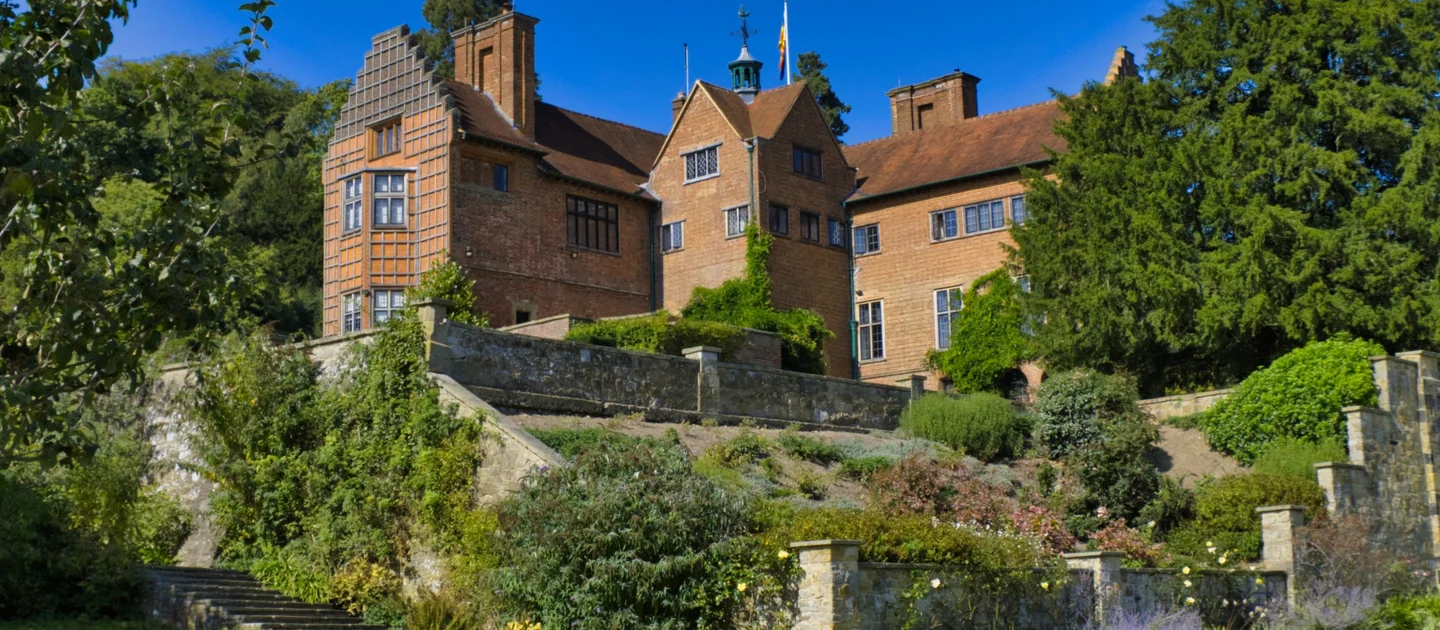
She was, by all accounts, not pleased. She had cooled considerably on the property during subsequent visits, and the house was in a condition that “dilapidated” barely covers — Victorian in its additions, Elizabethan in its older bones, riddled with dry rot and in need of what the sale particulars called “extensive repair.” Churchill called in Philip Tilden, a society architect who had worked for Philip Sassoon at Port Lympne and for Lloyd George, and instructed him to transform it. The renovation took two years and cost considerably more than the purchase price. The initial building works alone came to over £9,000. Clementine called Chartwell “a financial incubus” and worried about it for most of the thirty-odd years they lived there. She was not wrong about the finances, and she never quite loved the house the way he did.
What emerged from Tilden’s work was a house reoriented to make the most of the view rather than the road: the principal rooms at the back, the large windows opening onto the terrace and the valley below, the dining room on a lower level to align with the slope of the garden, Clementine’s bedroom above it with a barrel-vaulted ceiling, the whole front elevation given a quiet, vernacular dignity that the architectural historian John Newman described, rather tartly, as “large and splendid and out of place.” The family moved in in 1924.
The Wilderness Years, At Home
The years between 1929 and 1939 are usually described in terms of Churchill’s political exclusion — the decade when his warnings about Germany went largely unheeded and he spent his time out of government, apparently finished, writing and arguing against the tide. What Chartwell shows is the other side of that decade: the man who came home. He wrote there at ferocious pace, producing the multi-volume history of the First World War and the four-volume life of his great ancestor the Duke of Marlborough — the collected output of those years runs to millions of words and earned the Nobel Prize for Literature in 1953. He painted constantly, the garden studio filling with canvases year on year. He entertained: T.E. Lawrence came, and the painter Walter Sickert, who gave Churchill informal painting lessons, and dozens of politicians and diplomats and journalists who made the journey from London. The Russian Ambassador Ivan Maisky visited in September 1938 and left a diary entry that gives one of the most vivid accounts of the house in its prime: a large, beautifully presented two-storey house, a terrace with a breathtaking view, ponds with goldfish, a pavilion-studio with dozens of Churchill’s own paintings on the walls, and “his pride and joy, a small brick cottage which he was building with his own hands.”
The small brick cottage was the garden wall, and building it was not a hobby in the decorative sense but a genuine physical obsession. Churchill had joined the Amalgamated Union of Building Trade Workers in 1928 as a fully paid-up member, which entitled him to lay bricks at the agreed union rate of fifty bricks an hour. The kitchen garden walls were substantially his own work. So were two garden cottages. He said that bricklaying gave him the satisfaction of physical production that political life, which produces nothing you can hold in your hands, entirely lacked.
He also, during these years, used explosives for landscaping. Churchill had the ponds below the house dug and enlarged using controlled detonations, and the chain of lakes that now reflects the sky below the garden is partly his own earthwork. He kept black swans on the moat, tropical fish in heated tanks in the house, and golden orfe in the lakes. He considered being buried in the garden — under what is now the croquet lawn, if his wishes had been followed. He was not, ultimately: he is buried at Bladon in Oxfordshire, near Blenheim, the house he was born in. But the impulse — to stay at Chartwell even in death — says something about how completely the house had taken hold.
The Financial Catastrophe And The Rescue
Chartwell was always, simultaneously, the thing Churchill loved most in the world and the thing most likely to destroy him financially. The annual running costs in the 1930s ran to what would now be roughly £150,000 to £225,000 a year: staff, maintenance, agricultural experiments, the lakes, the walls, the heated fish tanks. Churchill’s income from journalism and books fluctuated wildly, and the losses he took on Wall Street in the 1929 crash were severe. In 1938, with his share portfolio in ruins and the house about to be advertised for sale again, the industrialist Henry Strakosch agreed to take over his portfolio for three years and pay off significant debts. Churchill withdrew the sale. Strakosch, not unreasonably, never mentioned the arrangement publicly.
During the Second World War the house was considered too exposed — it sat, after all, within clear sight of the Channel — and the ponds were covered and the house left empty, visited occasionally by Churchill on clandestine weekend trips when the pressure of office became unbearable. After the war, with the scale of the financial problem made newly visible, a consortium of Churchill’s friends led by Lord Camrose bought Chartwell and gifted it anonymously to the National Trust, on the condition that Churchill and Clementine could continue to live there for the rest of their lives. Churchill was not told the identity of those who had saved his house. He lived there until shortly before his death in January 1965. Clementine relinquished the house that same year, and Chartwell opened to the public in June 1966 — a date that 2026 marks the sixtieth anniversary of, celebrated at the estate with volunteer-led garden tours and special programming.
Churchill The Painter
The studio is the room most likely to stop you in your tracks, and it is the room most likely to be underprepared for by visitors who came for the war history. The largest single collection of Churchill’s paintings anywhere is housed here: over a hundred canvases in a working studio space kept much as he left it, stacked and hung from floor to ceiling, palette and brushes in their places. He produced more than five hundred paintings across his lifetime — the estimate varies, but the scale does not — and the studio at Chartwell is where most of them were made.
He came to painting relatively late, in 1915, in the aftermath of the Gallipoli disaster, which had ended his time as First Lord of the Admiralty and precipitated one of the worst periods of his political life. He described the effect of the first brushstroke on his mental state with characteristic precision: the canvases fought back, and fighting back was what he needed. He called painting a “joyride” and a “complete distraction” and “a companion.” He took informal lessons from Walter Sickert and from the French Impressionist Paul Maze, and the influence of both is visible in the loose, light-flooded quality of the outdoor canvases, the south of France and the Wealden hills and the garden at Chartwell rendered in a way that is entirely competent and occasionally rather more than that.
In 1925 he entered a painting, Winter Sunshine, Chartwell, anonymously in a London exhibition for amateur painters and won first prize. He was under no illusions about his talent — painting was therapy and escape, never vanity — but the prize was, by his own account, one of the more quietly pleasing things that happened to him in the 1920s. The painting is at Chartwell still.
The House And Its Rooms
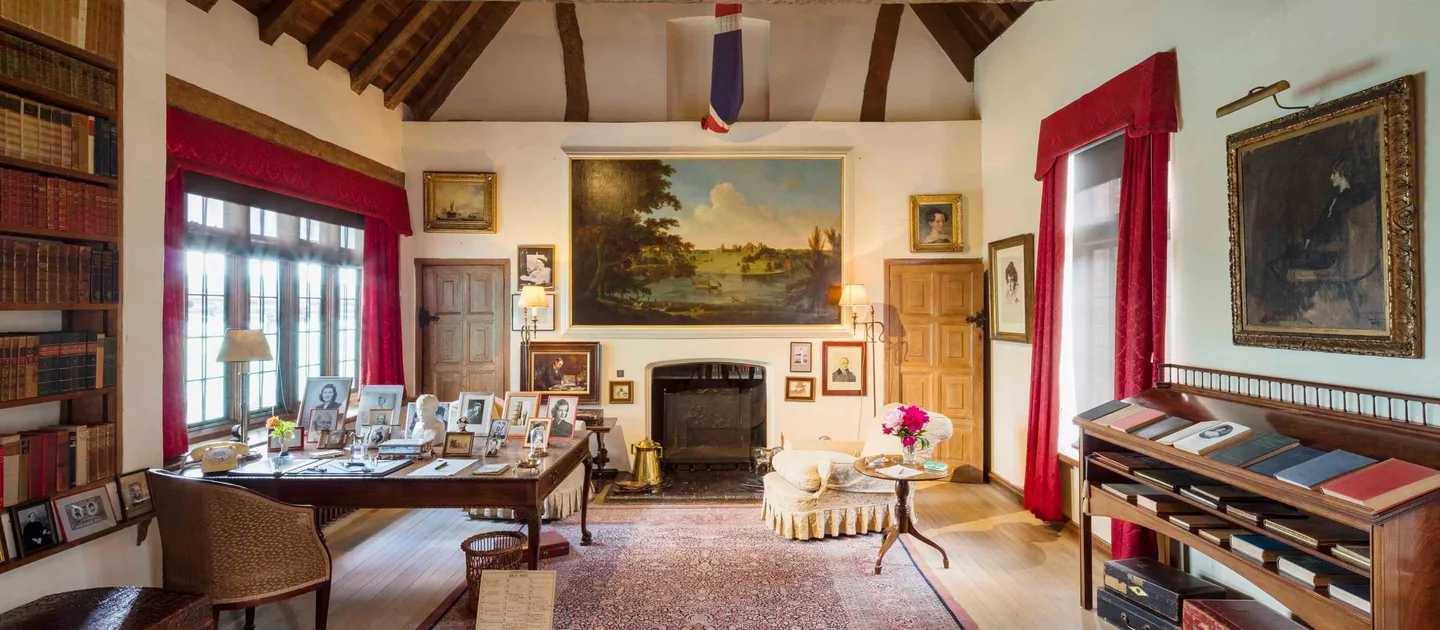
The house is presented as it was in the 1930s, the period when Churchill spent most time here, and it is a family home rather than a stateroom: comfortable, a little crowded with the accumulation of decades, not grand in any conventional sense but entirely itself. The study where he wrote and dictated, the dining room where he presided over dinner and argument, the drawing room where a card table is still set for bezique and the walls hold 898 inscribed books, including a Claude Monet — Charing Cross Bridge, 1902, given to Churchill after the Second World War by Emery Reves — alongside presentation copies from politicians, scholars and friends. The bedroom where he slept and worked, the uniforms on display in the recently restored Uniform Room, the map room with its wartime charts still hanging where he studied troop movements.
The exhibition Churchill: Image and Power, opened in February 2026, explores how one of the most recognisable faces in history was constructed and maintained — how the cigar and the V-sign and the particular quality of the wartime speeches became, over time, both portrait and mask. It is a thoughtful complement to the domestic intimacy of the house rooms, which tend in the opposite direction: stripping away the public figure to reveal the private man behind it.
The Garden And Its Grounds
Lady Churchill’s rose garden was her project rather than his, and it reflects her more disciplined sensibility: formal, well-maintained, a counterpoint to Winston’s more interventionist approach to the landscape. The walled kitchen garden, with its walls substantially laid by Churchill’s own hands, remains a working kitchen garden. The orchard and the wildflower meadow beyond give the grounds a gentle, English-pastoral quality that the formal terrace above the valley belies.
The estate walk takes in the lakes and the wider woodland, and in April and May the bluebell woods below the house are among the finest in this part of Kent — carpets of blue spreading under the canopy, the kind of seasonal thing that makes a garden visit feel like a discovery rather than a tour. The play areas, the treehouse and the “bomb crater” and “Canadian camp” themed for children, give the grounds a family energy that the house’s intimate scale and timed tickets does not.
The statue by the lakeshore, a large bronze by Oscar Nemon of an elderly Churchill and Clementine sitting together on a bench, is worth finding: Nemon was a close friend of the Churchills and also made the statue of Churchill that stands in the Members Lobby of the House of Commons. This one is different in character — intimate, seated, domestic — and it says something about Chartwell rather than Westminster. A man and his wife, by their lake, in the view that made him buy the house.
Where To Eat And How To Visit
The National Trust operates two cafés at Chartwell, the Chartwell Café and the Kitchen Café, serving hot and cold food, afternoon tea and the kind of seasonal menus that make the most of the estate’s kitchen garden produce. The second-hand bookshop at the visitor entrance is as rewarding as such bookshops in National Trust properties invariably are: disproportionately likely to contain something worth reading, and priced accordingly.
The house is open on timed tickets, purchased from the visitor centre, and visitors are strongly advised to book in advance, particularly in the summer months and at weekends, when the relatively modest domestic scale of the rooms makes crowding a genuine impediment to the experience. The gardens and grounds are open from 10am and well worth a full morning or afternoon without entering the house at all, particularly in spring. The studio has slightly different opening times from the main house and should be checked separately on the National Trust website.
Chartwell is two miles south of Westerham, off the B2026. By car, from the M25 Junction 5 or Junction 6, it is a straightforward twenty-minute drive. By public transport it is slightly less straightforward: the nearest station is Oxted or Sevenoaks, from which bus connections are limited, so the National Trust’s own website is the best source for current transport options. Annual tickets are available and represent good value for more than one visit; National Trust members visit and park free.
Chartwell Mapleton Road, Westerham, Kent TN16 1PS
nationaltrust.org.uk/chartwell
01732 868381 House
Open April – October on timed tickets. Gardens and grounds open year-round. National Trust members free. Book timed house tickets in advance. 2026 marks sixty years since Chartwell opened to the public.
About the Author: Lara S

The Finer Map



Get our latest Delivered
Beautiful recipes, inspiration, guides and news that makes you want to live!