Goodnestone Park Gardens
Goodnestone Park Gardens, Kent
A privately owned garden in a quiet Kent village, seven miles from Canterbury, where Jane Austen came to visit and began writing Pride and Prejudice. The family who own it today are descended from the man who forced King John to sign Magna Carta. It is pronounced GUN-stone. It is exactly the kind of place The Finer Edit exists to tell you about.
There are gardens you read about in supplements and travel pieces and then find rather smaller in person than the words implied. And then there are places like Goodnestone: fifteen acres of privately owned garden in a village so quiet you can hear the church bell across the park, owned by the same family for over three hundred years, visited by Jane Austen repeatedly through the 1790s and beyond, tended by a head gardener and three female gardeners who know every corner of it, and open to the public from late March to early October without any of the infrastructure that larger heritage sites carry as ballast. No gift shop selling branded tote bags. No audio guides. No queues. A converted dairy selling cream teas, a plant nursery worth half an hour, and a walled garden with a view to the church tower that, once you have seen it, you will find yourself describing to people who were not there.
This is precisely the kind of place The Finer Edit exists to tell you about. Not because nobody knows it — the Daily Telegraph voted it Britain’s sixth favourite garden, and the Country Life Awards made it a finalist in 2009, so some people are paying attention — but because it remains, despite its quiet reputation, something you have to decide to go to rather than simply arrive at on the way somewhere else. It rewards the decision.
The Name, and the Way In
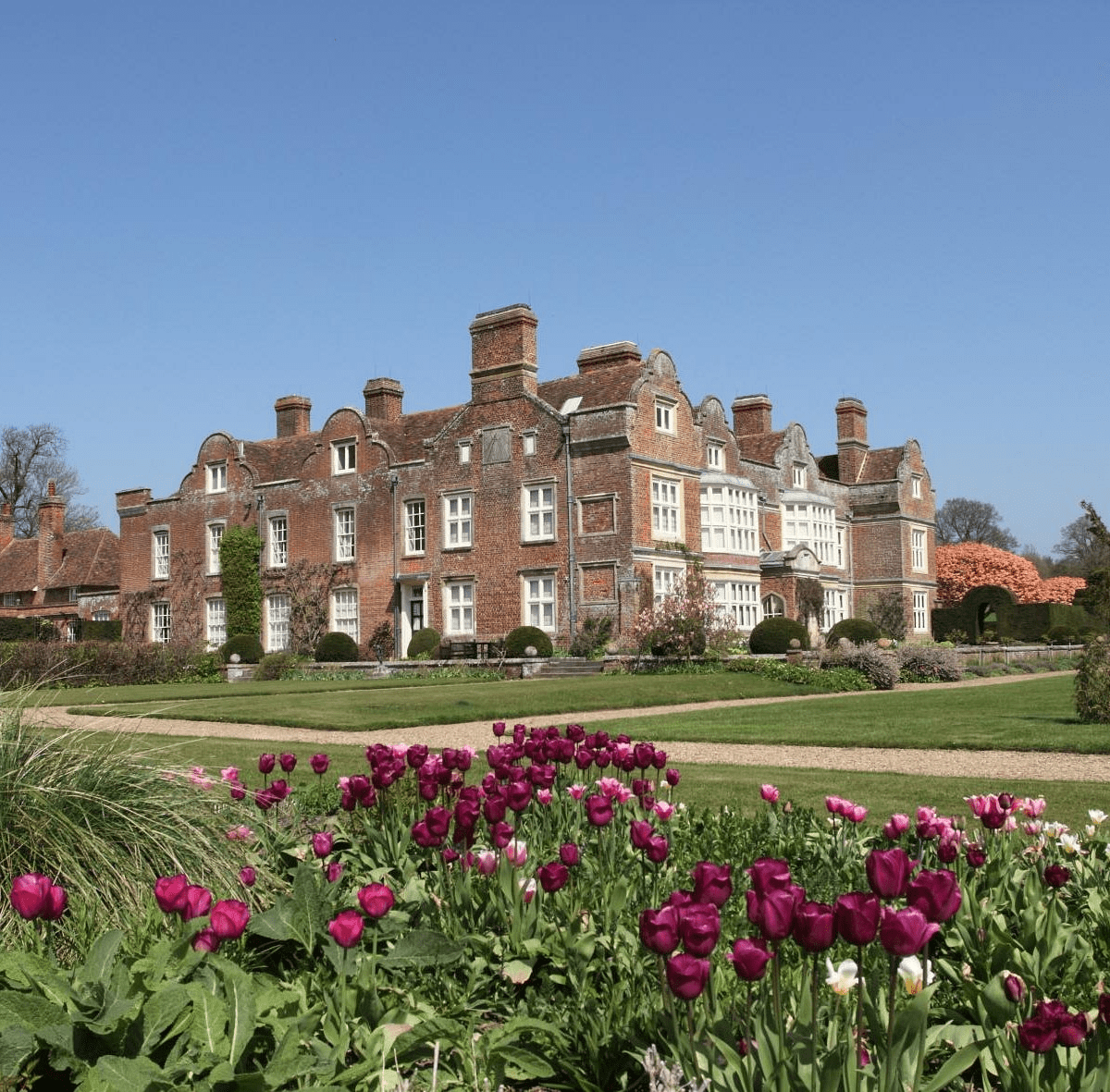
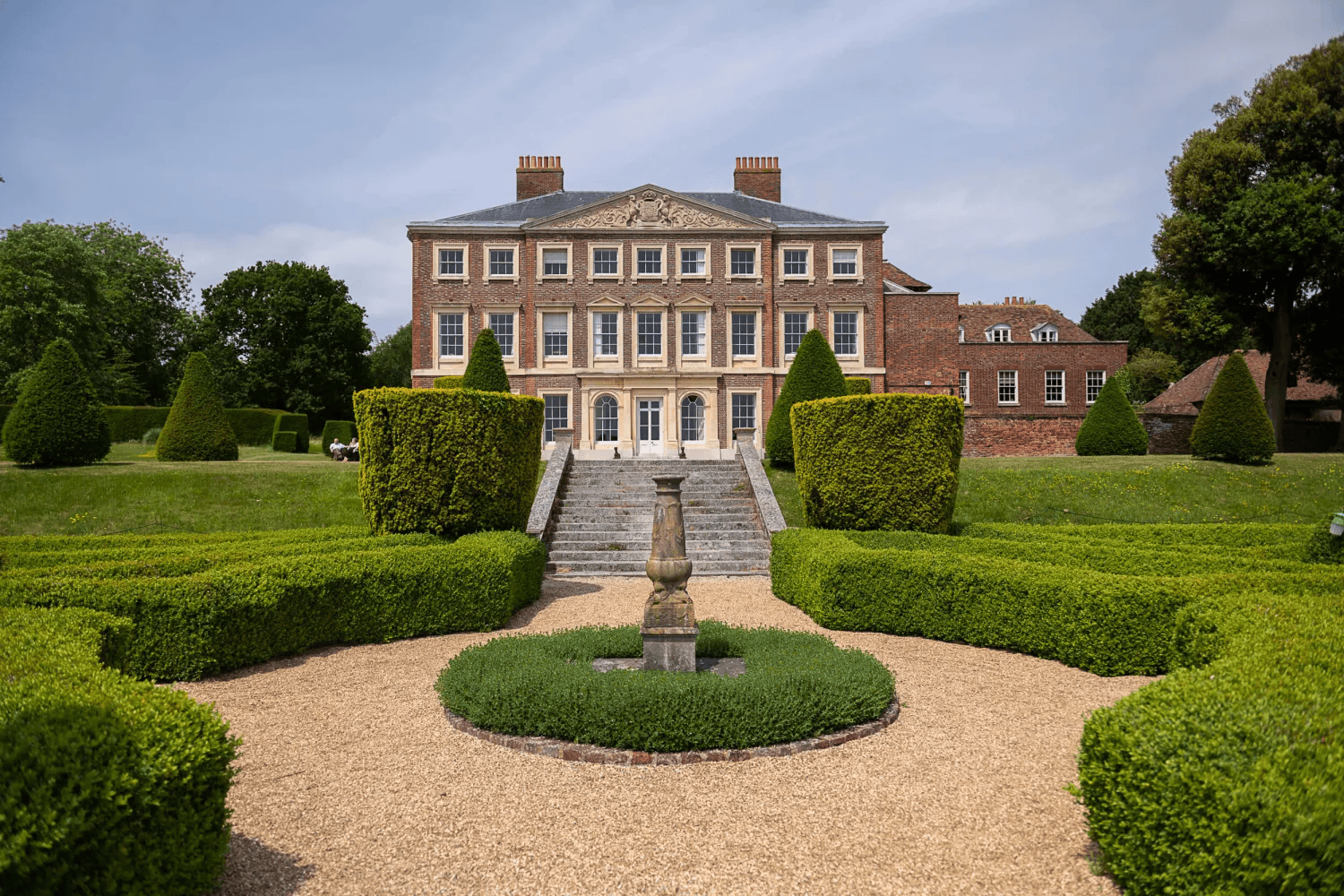
Goodnestone is pronounced GUN-stone, which is important to know before you arrive and a useful piece of local knowledge to carry into the car park without embarrassment. The village it sits in is small enough that the main street ends at the estate gates, and the approach through the village — past the pub, past the flint-and-brick houses, up the slight rise that gives the house its view — is the kind of arrival that has barely changed in three hundred years. The Palladian house, built in 1704 in red and blue brick, sits at the end of it with the composed authority of a building that knows it has been here longer than almost anyone looking at it.
Brook Bridges, the 1st Baronet who built the house, had the year scratched into one of the bricks at the front as he built it, and the date — 1704 — is still visible. He had an extensive formal garden laid out around it shortly after completion, recorded in a bird’s-eye view by the designer William Harris that shows the house surrounded by geometric planting of the formal kind then fashionable. His grandson, the 3rd Baronet, swept all of that away in the 1780s and replaced it with the naturalistic landscape park that was then in fashion instead. These periods of reversal are the rhythm of English garden history: the formal swept away by the natural, the natural softened by the formal, each generation reacting to what the previous one had done and calling it an improvement. What the 3rd Baronet left was the view — the parkland falling away from the house, the church visible through the trees, the Kent countryside doing its quiet thing on all sides — and that view was already there when Jane Austen walked it.

The Family, and the Magna Carta
There is a thread in the ownership of Goodnestone that runs from the garden you are standing in back to 1215, to a meadow beside the Thames, to one of the most significant constitutional moments in English history.
The estate passed, through female inheritance and the complicated genealogies of the English aristocracy, to the FitzWalter family, who hold it today as Lords FitzWalter. The FitzWalter barony is one of England’s oldest surviving peerages, established in 1295, and its founding ancestor is Robert FitzWalter, who was the principal baron in the baronial revolt that forced King John to the negotiating table at Runnymede in June 1215. Robert FitzWalter led the rebel barons at the siege of London that preceded the negotiations, was one of the twenty-five barons appointed to enforce the terms of the charter, and is considered by historians to be among the most significant of the Magna Carta barons. The barony he established, and the family it gave its name to, produced the people who eventually came to own this Kent garden — a connection that stretches the history of Goodnestone from a 1704 Palladian house all the way back to the origins of English constitutional law. It is not a connection most garden visitors expect.
Jane Austen, and the Novel That Began Here
Elizabeth Bridges, daughter of the 3rd Baronet, married Edward Austen in 1791. Edward was Jane’s brother, one of several siblings she adored, and the marriage brought Jane repeatedly to this corner of Kent through the 1790s and into the next decade. Edward and Elizabeth lived at Rowling House, a property on the Goodnestone estate, for the early years of their marriage, and Jane was a regular guest.
Her letters from these visits are among the most vivid she wrote: a description of an evening at Goodnestone in September 1796 — dinner and dancing, a walk home to Rowling under the shade of two umbrellas, the moonlight on the Canterbury road — reads with such particularity that the evening she is describing still feels close. She describes walking the principal walks of the estate, visiting Canterbury and returning by moonlight, watching a funeral procession pass Rowling on a weekday morning, her brothers shooting with mixed success. She is observing. She is always observing.
It was after this stay at Rowling in 1796 that Jane Austen began writing the novel she called First Impressions. It was published fifteen years later, in 1813, under the title Pride and Prejudice. Whether Goodnestone’s landscape, its social rhythms, its particular quality of Kentish country-house life fed directly into the novel’s DNA is impossible to say with certainty, but it seems unlikely that the woman who was absorbing everything in her letters was absorbing nothing for her fiction. The walks she described — up to Rowling after dinner on a summer evening, across the park in the morning — were reinstated in 2014 as the Serpentine Walk, following the route Jane Austen knew, which is the most directly literary piece of garden restoration I know of in this county.
Her niece Fanny, daughter of Edward and Elizabeth, became one of Jane’s most cherished correspondents. Some of the liveliest of Jane’s surviving letters were written to Fanny, who grew up between Goodnestone and the nearby Godmersham Park that Edward later inherited. This corner of Kent shaped them both.
The Garden After the War
Goodnestone in 1945 was not the garden it is now. The house had been requisitioned by the War Office for the duration, and the army had adapted the estate for military use, including laying a concrete surface on the North Drive to accommodate tanks. A garden does not recover quickly from tanks. Margaret FitzWalter, who took up the restoration work with her husband Brook in the years after the war, spent decades rebuilding what had been lost and adding, carefully, to what remained.
The restoration that began in the mid-1960s is the reason the garden looks as it does today: not a historically accurate recreation of any particular period but an honest accumulation of good decisions made over sixty years by people who lived in the house and gardened by preference rather than by obligation. The walled garden was redesigned and replanted from 1960, the woodland garden developed from the 1920s plantings that Emmy FitzWalter had made between the wars, the box parterre added at the millennium, the Golden Arboretum planted in 2001 to mark Lord and Lady FitzWalter’s golden wedding. Each addition has a date and a reason, and together they produce a garden that reads as the work of a family rather than a design statement, which is considerably rarer and considerably more interesting.
The Garden As It Is Today
The heart of it is the walled garden, and specifically the view from within it. Three separate rooms within the walled enclosure open into each other through archways of flint and brick, and from the deepest room the view is framed precisely: roses in the foreground, a rill of water running towards you, the herbaceous borders rising on both sides, and at the end of it all the medieval tower of the village church of St Lawrence, framed by the garden wall’s opening as though the garden and the church had always meant to be seen together. They very probably had. Visitors come and sit in this view, the National Garden Scheme notes, for hours on end. I understand completely why.
Within the walled enclosure the planting is generous and well-judged: roses and wisteria and clematis climbing the walls, a rose garden in one room, a rill garden in another, an alpine garden, an ornamental greenhouse and a kitchen garden whose produce supplies the café. The soil here is slightly alkaline over chalk — characteristic of the North Downs — which gives the walled garden its particular palette of roses and herbaceous planting while making the woodland garden, with its more acidic greensand, the place to plant rhododendrons and azaleas and the other ericaceous plants that give it its spring character.
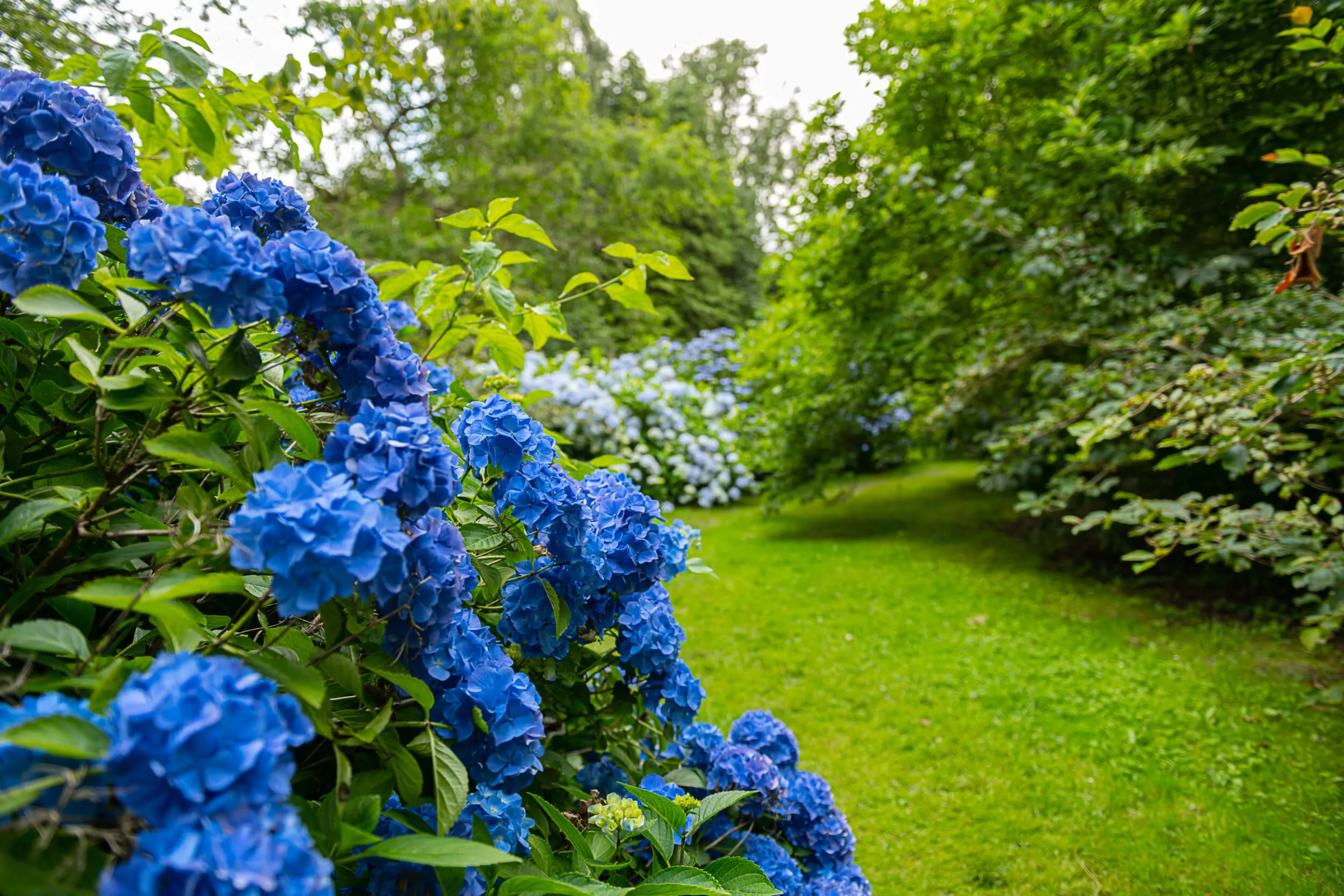
Beyond the walled garden the woodland opens: hydrangeas in blue and white, cornus in its many varieties, a tranquil pool set into the trees, paths that wind through the planting without the insistence of a managed route. The woodland here has been accumulating character since the 1920s, and it shows in the scale of the planting and the particular quality of shade and light that old woodland develops over time.
The arboretum is where the garden’s extraordinary trees live. The ancient Cedar of Lebanon dates from the early eighteenth century and has been here as long as the house it watches over. The largest southern beech in the United Kingdom grows here, its canopy a generous presence in both spring and autumn. Tulip trees, copper beech, a lime avenue that leads through the arboretum and back towards the house — these are trees that a garden grows into over centuries rather than plants for effect, and they give Goodnestone a scale and a depth that its fifteen acres would not suggest.
Art installations are threaded through the garden at various points: metal birds hovering over the borders in suspended flight, larger sculptural pieces in the wider grounds, the old stables adapted as an exhibition space for changing shows. These are neither intrusive nor simply decorative but add a quality of surprise and contemporaneity to a garden that might otherwise feel entirely historical.
The Serpentine Walk, reinstated in 2014 along the route Jane Austen followed on her evening walks, runs through the estate and gives visitors who know the letters a specific pleasure: the sense of walking a path someone walked before you and wrote about so well that you almost feel their company.
Where to Eat, and What Else
The Old Dairy Café, converted from the estate dairy and set around a courtyard, serves brunch, lunch and cream teas made with local ingredients including produce from the kitchen garden. It is genuinely good, which matters: a café in a garden should sustain the mood of the visit rather than interrupt it, and this one does. Bread and pastries are made on site. The menu is seasonal. The courtyard in summer is the right way to end a morning’s walking.
The plant nursery sells garden-grown varieties, and it is the kind of nursery from which it is genuinely difficult to leave empty-handed. The plant shop at the entrance carries garden-related books alongside the obvious, and the Jane Austen titles sit alongside the garden history with the particular logic of a place where the two are inseparable.
Dogs are welcome in the gardens, with the exception of the walled garden, which Lord FitzWalter has extended as a deliberate welcome rather than merely a tolerance. The garden is one of the relatively few on this shelf where a dog makes the visit more rather than less manageable.
The Practical Details
Goodnestone Park is seven miles from Canterbury, near the village of Goodnestone between the A2 and the B2046. The nearest railway station is Aylesham, about two and a half miles away, from which the walk through the lanes to Goodnestone is pleasant if unhurried. By car from Canterbury the journey takes around fifteen minutes on country roads. Postcode for navigation: CT3 1PJ, which is more reliable for reaching the car park than the house’s own address.
The garden is independently owned by the FitzWalter family and is not a National Trust property, which means admission is independent and no National Trust membership applies. Current ticket prices and seasonal hours should be checked on the website before visiting; the garden is open from late March to early October, with Sunday openings from mid-February that bring snowdrop-seekers and the brave-and-cold through the most peaceful weeks of the year. There are no timed tickets, no advance booking requirement, and no particular crowd on most weekday mornings, which is exactly what it feels like to find the right kind of place.
2025 was the 250th anniversary of Jane Austen’s birth, and a year of renewed attention to the places she lived and visited in Kent. Goodnestone was part of that conversation, and its connection to Austen — real, specific, documented in her own letters — was properly celebrated. If the anniversary has passed by the time you read this, the garden has not changed. The view from the walled garden to the church tower is the same one she walked towards on summer evenings. The Serpentine Walk follows the route she took after dinner. The Cedar of Lebanon in the arboretum is the same tree that was old when she was young. The garden earns the visit in any year.
Goodnestone Park Gardens Goodnestone, Canterbury, Kent CT3 1PL
goodnestonepark.co.uk
Open late March to early October; Sunday openings from mid-February (check website for current hours). Not a National Trust property. Dogs welcome in the gardens (not the walled garden).
If You’d Like To Know More About Goodnestone Park Gardens Click Here
About the Author: Lara S

The Finer Map



Get our latest Delivered
Beautiful recipes, inspiration, guides and news that makes you want to live!