Risotto alla Milanese
Risotto alla Milanese
The original risotto: saffron-gold, Parmesan-rich, finished with cold butter off the heat until it flows like a slow wave. A Milanese apprentice allegedly invented it by accident in 1574. It has never needed improving since.
Risotto has a reputation it does not entirely deserve. People approach it with the wariness they usually reserve for soufflés and pastry, as though the slightest inattention will cause it to collapse into something un-salvageable. In my experience, which now runs to a good many Sunday evenings and rather more midweek risottos than I have properly counted, this is not the case. Risotto rewards attention and punishes neglect, which is a different thing from being difficult. It simply asks you to be present for about twenty minutes, which is a reasonable request from a dish that gives back this much.
Risotto alla Milanese is the version I make most often and the one I return to when I want to be reminded of why risotto matters. It is the original: the dish that, in some form, predates all the variations that followed. It is also, in its saffron-gold simplicity, one of the most beautiful things you can put in a bowl.
Where It Came From
Rice arrived in northern Italy via the Arabs during the medieval period, but it was the Po Valley — the flat, water-rich plain of Lombardy and Piedmont, fed by rivers from the Alps — that turned it into a staple crop. By the sixteenth century the marshy fields of the Po were producing short-grain rice in significant quantities, and the particular varieties that flourished there — Arborio, Carnaroli, Vialone Nano — had a quality that distinguished them from rice grown almost anywhere else: an exceptionally high starch content that, when coaxed out through slow cooking in warm stock, produced a creaminess no other grain could match without adding cream. This was not engineering. It was accident and geography and the particular conditions of a specific place, and the result was risotto.
The most famous origin story belongs to risotto alla Milanese specifically, and it is too good not to tell. In 1574, a young apprentice glassmaker was working on the stained glass of Milan’s Duomo, the great cathedral whose construction had been underway for nearly two centuries. He was known among the craftsmen for his habit of using saffron to intensify the gold in his pigments, and his colleagues teased him about it. At a wedding feast held that year, someone — whether the apprentice himself or a mischievous colleague making a point — added saffron to the rice. The result was a rice dish of startling golden colour that the guests found irresistible. Risotto alla Milanese was, if the legend is to be believed, the happy consequence of a joke.
The story is probably embellished. Most food origin stories are. But what it captures accurately is the nature of the dish: something that looks more considered than it is, that arrives at beauty through a relatively simple act. Saffron in the rice. Butter and Parmesan at the end. The technique doing the rest.
The Five Stages
Italian cooks describe risotto through five stages, and learning the names is useful not because the words matter but because each stage has a specific purpose, and knowing the purpose makes you a better cook of the dish.
The soffritto is the beginning: butter and very finely diced onion, cooked with patience over low heat until the onion is completely soft, sweet and translucent. Not golden, not caramelised. Invisible, almost. The soffritto is the flavour foundation of every risotto, and the most common mistake is rushing it. Eight to ten minutes of gentle cooking produces something quite different from three minutes of impatient frying.
The tostatura is the toasting of the rice: dry grains added to the soffritto and stirred over higher heat until each one is coated in butter and slightly translucent at the edge, with a white heart visible at the centre. This seals the outside of the grain so it holds its structure through the long cook ahead, absorbing stock gradually rather than collapsing into paste. You may hear a faint crackling. This is the sound of things going right.
The sfumatura is the deglazing: wine or dry vermouth poured in and stirred until absorbed, its alcohol burning off and leaving only a gentle acidity that counterbalances the richness of the butter and cheese that follow.
The brodo is the main event: warm stock, added one ladleful at a time, each one stirred in and allowed to absorb before the next arrives. This is the stage that takes time, and this is the stage around which risotto’s reputation for difficulty has accumulated, entirely undeservedly. You do not need to stir constantly. You need to stir frequently — every minute or so — and attentively. You need to keep the heat at a steady, lively simmer. You need to keep the stock warm in a separate pan so each ladleful goes in hot rather than cold. Cold stock dropped into a hot risotto arrests the starch release and produces a gluey, uneven result. This is the only real technical requirement, and it is not a demanding one.
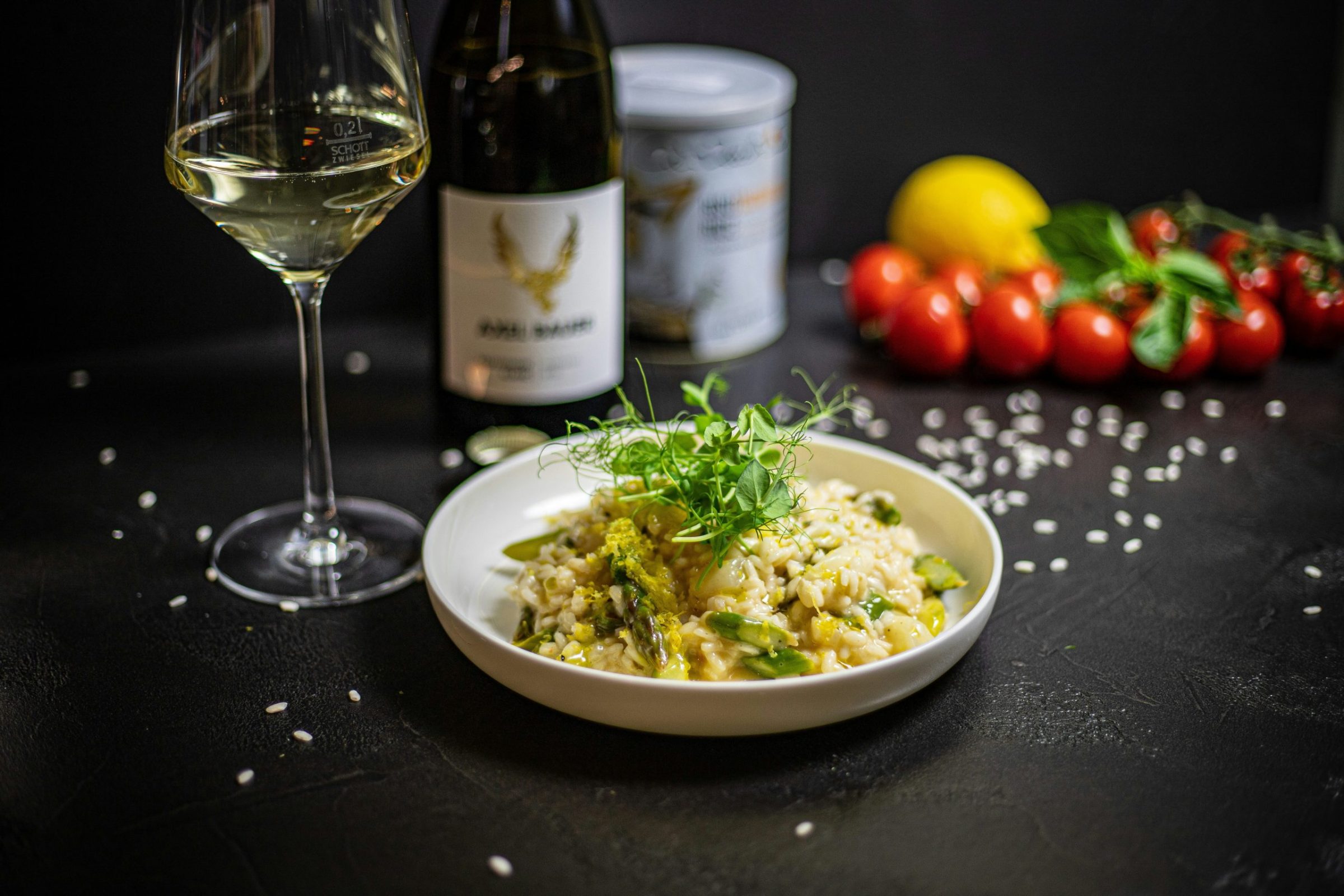
The mantecatura is the finish, and it is where a good risotto becomes a great one. The pan comes off the heat entirely. Cold, cubed butter goes in, along with a generous handful of Parmigiano Reggiano. The whole thing is stirred vigorously for sixty to ninety seconds until the butter emulsifies with the starchy cooking liquid and the cheese melts into something glossy and cohesive. Then the lid goes on and it rests for two minutes, which allows the emulsion to set properly. The result is a risotto that flows when you tilt the pan — all’onda, the Italians call it, like a wave — creamy without cream, rich without heaviness, each grain distinct but bound together into something that behaves more like a sauce than a pile of rice.
Never add cream. The creaminess is entirely the rice’s own work, and adding cream dilutes the flavour and changes the texture in a way that improves nothing. This is one of those culinary instructions I hold firmly enough to repeat.
The Saffron
Saffron is the most expensive spice in the world by weight, which is partly explained by the fact that each thread is the dried stigma of a crocus flower, harvested by hand, and it takes roughly 150,000 flowers to produce a single kilogram. In practical terms for this recipe, you need about half a gram, which is a generous pinch of threads from a good-quality tin, and the cost is measured in pence rather than pounds.
The quality matters. Good saffron, steeped in warm stock for fifteen minutes before it goes in, produces a deep, even gold and a flavour that is distinctly and irreplaceably itself: slightly floral, faintly metallic, warm in a way that is difficult to describe but immediately recognisable. Poor saffron produces pale, insipid rice that tastes of very little. Buy it in threads rather than powder, from a reliable source. Spanish saffron (Azafrán de La Mancha, PDO) and Iranian saffron are both excellent. The little sachets of powder in the supermarket spice aisle are generally not worth the shelf space.
The Method
1. Steep the saffron. Steep the saffron threads in 3 tablespoons of warm stock for at least 15 minutes. The liquid will turn a deep orange-gold. Set aside.
2. The soffritto. Melt 30g of the butter in a wide, heavy-based pan over medium-low heat. Add the onion with a pinch of salt and cook very gently, stirring occasionally, for 8 to 10 minutes until completely soft, sweet and translucent. Not golden, not coloured at all. Patient.
3. Toast the rice. Turn the heat to medium-high. Add the rice to the soffritto and stir continuously for 2 minutes until the grains are coated in butter and become slightly translucent at the edges, with a white dot visible at the centre. You may hear a faint crackle. This is the tostatura, and it is not optional.
4. The sfumatura. Pour in the wine or vermouth and stir until it has been completely absorbed. The sharp smell of alcohol will soften within a minute.
5. Add the stock, ladle by ladle. Add the saffron with its steeping liquid and stir to combine: the rice will turn gold immediately. Begin adding the warm stock one ladleful at a time, stirring frequently and waiting until each addition is almost fully absorbed before adding the next. Keep the heat at a steady, lively simmer. After about 16 to 20 minutes, taste the rice: it is ready when it is tender with a very faint resistance at the very centre and the risotto flows freely in the pan.
6. The mantecatura. Take the pan completely off the heat. Add the cold, cubed butter and the Parmigiano Reggiano and stir vigorously for 60 to 90 seconds until the butter has emulsified and the risotto is glossy, creamy and uniform. Cover the pan and leave to rest for exactly 2 minutes.
7. Serve at once. The risotto should flow when you tilt the pan — all’onda, like a wave. If it has tightened, stir in a final splash of warm stock. Taste and adjust the seasoning. Divide between warm bowls, grind a little white pepper over and serve immediately with more Parmigiano on the table. Risotto does not wait.
The Recipe
Serves 4. About 10 minutes’ preparation and 25 minutes of attentive cooking.
Ingredients
- 300g Carnaroli rice (or Arborio)
- A generous pinch of saffron threads, about 0.5g
- 1.2 litres good chicken or veal stock, kept warm in a separate pan throughout
- 1 white onion or 2 shallots, very finely diced
- 60g unsalted butter: 30g for the soffritto, 30g cold and cubed for the mantecatura
- A splash of dry white wine or dry vermouth
- 80g Parmigiano Reggiano, finely grated, plus more to serve
- Sea salt and white pepper
A Few Things That Are Worth Knowing
On the rice: Carnaroli is the choice of most professional Italian cooks, higher in starch than Arborio, with a firmer texture that holds up better through the long cooking and is more forgiving if you are slightly distracted. Arborio is more widely available in British supermarkets and works very well indeed. Either is correct. What you cannot use is long-grain rice, which lacks the surface starch that makes risotto what it is and will not produce the same result regardless of how carefully you stir it.
On the stirring: you do not need to stir constantly. You need to stir frequently and attentively — every minute or so — keeping the rice moving so the grains rub against each other and release their starch into the stock. Constant stirring produces a slightly gluey result and exhausts the cook. Frequent, relaxed stirring, combined with steady heat and warm stock, produces the same creaminess with considerably less effort and a better texture in the finished dish.
On the stock: this is not the place for a stock cube. The stock is half the flavour of the dish, and a good, clear, properly made chicken or veal stock makes a risotto that a stock cube cannot approach. If you make stock at home with any regularity, this is the recipe to make it for. If you don’t, a good liquid stock from a reliable brand — Waitrose makes a decent one, as do most independent butchers — is far better than a cube dissolved in boiling water.
On the Parmigiano Reggiano: buy a piece and grate it yourself, immediately before it goes in. Pre-grated Parmesan from a bag has lost moisture and does not melt cleanly into the mantecatura, producing a slightly grainy finish rather than the glossy emulsion the dish needs. The difference is noticeable and the extra effort is approximately thirty seconds.
On serving: risotto alla Milanese is traditionally served alongside osso buco — Milanese braised veal shanks — as a contorno rather than a first course. It is magnificent in that context, but it is equally magnificent on its own as a light main course, which is how I most often eat it. A glass of good white Burgundy alongside it is a very fine thing.
On variations: once you have this base and this technique, the risotto world opens considerably. The same method with porcini mushrooms and a dark beef stock produces risotto ai funghi. With peas and mint and a light vegetable stock, a spring risotto. With squid ink and fish stock, something darkly dramatic. With barolo in place of white wine and a red meat stock, risotto al Barolo, which is the Piedmontese alternative to the Milanese and a dish of remarkable depth. The technique is always the same. What changes is what you put into it.
This is my own twist on as classical as possible a recipe as I could find – made many times and always with the saffron steeped for longer than it strictly needs. The history draws on the documented origins of risotto in the Po Valley and the Milanese legend of 1574.
Recipe Card
Recipe Name: Risotto alla Milanese
Recipe Description : A classic Milanese risotto made with saffron, warm stock, Parmigiano Reggiano and cold butter, finished off the heat until glossy, creamy and flowing all’onda.
Serves: Serves 4
Preparation Time: Approximately 10 minutes
Chilling & Resting Time: At least 15 minutes to steep the saffron, plus 2 minutes resting after the mantecatura
Cooking Time: Approximately 25–30 minutes
Total Time: Approximately 40 minutes, with the saffron steeping while the remaining ingredients are prepared
Difficulty: Moderate



Get our latest Delivered
Beautiful recipes, inspiration, guides and news that makes you want to live!