Tarragon Roast Chicken
Tarragon Roast Chicken
A French turn on Simon Hopkinson’s famous bird: herb butter, a hot oven, a glass of something dry in the juices, and almost no fuss.
There is a kind of roast chicken that wants a printed timetable, a probe held in both hands and a small prayer at the oven door. This is not that one. This is the one I keep coming back to, because it asks very little of you and gives back a great deal.
It begins where a good many fine roast chickens begin, with Simon Hopkinson. The recipe in his Roast Chicken and Other Stories is the one most cooks quietly agree on: butter, lemon, herbs, a hot oven and the patience to baste. It has never really been bettered, only borrowed from, and I borrow from it gratefully. What I have changed is small. Tarragon in place of thyme, soft and faintly of aniseed, which tips the whole thing towards a small bistro on a grey Paris afternoon. And, on the days it feels deserved, a splash of dry vermouth let down into the buttery juices at the end, which is hardly any work and tastes as though you tried much harder than you did.
A word on the bird, because it matters more than anything you will do to it afterwards. Buy the best chicken you can reasonably justify, free-range and unhurried in its life, somewhere around 1.8 to 2kg, which feeds four with the makings of a good sandwich left over for Monday. A cheaper bird will roast perfectly well; it simply won’t taste of much, and no amount of butter rescues a chicken that never had a chance. Take it out of the fridge a full hour before it goes in. Cold meat straight from the shelf cooks unevenly and sulks.
The method is mostly the butter and the basting, and the basting is the part people skip and then wonder why the skin is pale. Don’t skip it. Beyond that, the only real skill is knowing when to stop, and the bird will tell you: the juices from the thickest part of the thigh should run clear and gold rather than pink, and a thermometer pushed in there should read 74°C. Then comes the one rule I will not bend. Rest it, properly, for fifteen to twenty minutes with the oven off and the door ajar, while you see to everything else. A bird carved straight from the oven gives its juices to the board. A rested one keeps them for you.
The Recipe
Serves 4. Roughly 20 minutes’ work, around an hour and a half in the oven.
Ingredients
- 1 free-range chicken, about 1.8–2kg
- 75g unsalted butter, softened
- 1 small bunch tarragon, leaves chopped, stalks kept
- 1 lemon
- 1 garlic bulb, halved across the middle
- 1 tsp flaky sea salt, plus more for seasoning
- ½ tsp black pepper
- 100ml dry vermouth or dry white wine (optional, for the juices)
The Method
- Start at room temperature. Take the chicken out of the fridge a full hour before cooking, and heat the oven to 220°C (200°C fan).
- Make the tarragon butter. Soften the butter and beat in most of the chopped tarragon with the finely grated zest of the lemon and the teaspoon of salt.
- Dress the bird. Smear the butter all over the chicken, and under the breast skin too if you can manage it without tearing. Squeeze the lemon over the top, then tuck the spent halves into the cavity with the halved garlic bulb, the tarragon stalks and any leftover leaves. Grind over the pepper and a little more salt.
- A hot start. Roast at 220°C for 15 minutes, to set the skin going.
- Lower, roast and baste. Turn the oven down to 190°C (170°C fan) and roast for about 1 hour to 1 hour 15, basting with the buttery juices every 20 minutes or so. It is done when the thigh juices run clear and gold and a thermometer in the thickest part reads 74°C.
- Rest, and mean it. Turn the oven off, set the door ajar, and rest the bird for 15 to 20 minutes before carving.
- The only sauce you need. Whisk the juices left in the tin. If you like, pour in the vermouth or wine, set the tin over a low flame and let it bubble for a minute. Strain if you prefer it smooth.
To go around it
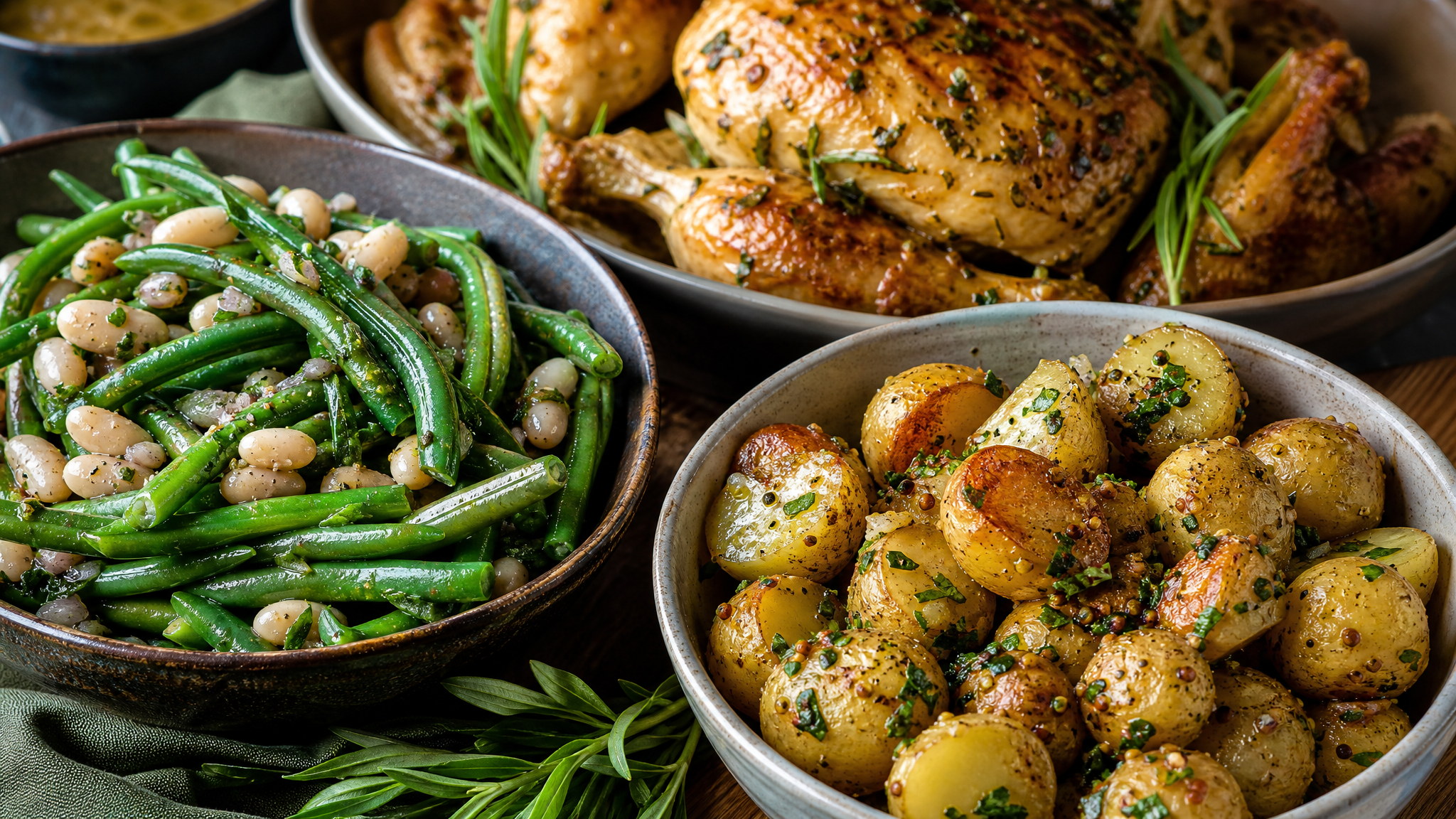
Roast chicken is generous host enough to carry simple company, and I would not gild it. Potatoes are not optional in this house: parboil them, rough up the edges in the colander for the corners that go crisp, and roast them in their own tin in goose fat or a little of the chicken’s, so the bird and the potatoes aren’t competing for the same shelf or the same heat.
For something green, keep it sharp to cut the butter. Fine green beans with nothing on them but salt, or a bowl of peppery watercress dressed at the last moment with a proper mustard vinaigrette, which is the most French thing on the table and takes about ninety seconds to make. Bread, too, for the juices, because to leave them in the tin would be a small tragedy.
To drink, something dry and unshowy. A white Burgundy if the week has been kind to you, a chilled light red if you’d rather, a good cider if you don’t want to think about it at all.
And then there are the leftovers, which are half the reason to roast a whole bird in the first place. But that, I think, is a story for another day.
Adapted, with thanks, from Simon Hopkinson’s roast chicken in Roast Chicken and Other Stories (Ebury Press, 1994). This is a researched and home-cooked recipe, not a paid or gifted feature.
Recipe Card
Recipe Name: Tarragon Roast Chicken
Recipe Description : A French-inspired roast chicken rubbed with lemon and tarragon butter, roasted until golden and finished with buttery pan juices and an optional splash of dry vermouth.
Serves: Serves 4
Preparation Time: Approximately 20 minutes active preparation
Chilling & Resting Time: 1 hour at room temperature before roasting, plus 15–20 minutes resting afterwards
Cooking Time: Approximately 1 hour 15 minutes to 1 hour 30 minutes
Total Time: Approximately 2 hours 30 minutes to 2 hours 50 minutes
Difficulty: Moderate



Get our latest Delivered
Beautiful recipes, inspiration, guides and news that makes you want to live!