Profiteroles with Dark Chocolate Sauce
Profiteroles with Dark Chocolate Sauce
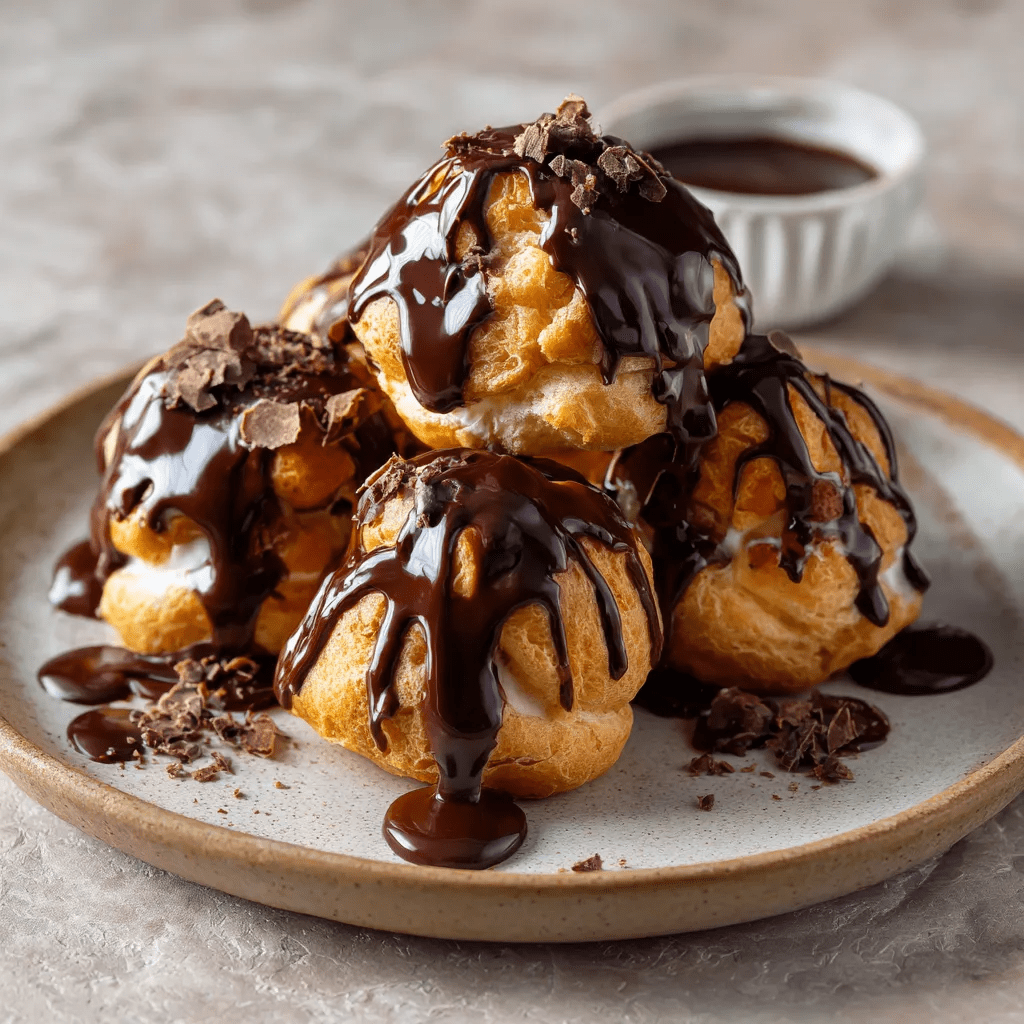
Choux puffs filled with crème pâtissière, piled on a plate, with dark chocolate sauce poured warm at the table in front of everyone. Three components, none of them genuinely difficult, all of them made ahead. The dessert that has ended more French dinner parties than any other, and has yet to produce a disappointing room.
My most vivid memory of this dessert is not eating it but watching the chocolate sauce being poured. I was perhaps eight, at the table at the end of a family dinner that had already lasted longer than I was supposed to stay awake for, and someone carried a white jug of warm dark chocolate sauce to the table and poured it in a slow, glossy arc over a pile of cream-filled choux puffs. The sauce ran between them and pooled beneath them and the whole pile sat there for a moment, gleaming and slightly improbable, before the first spoon went in. I have been making profiteroles ever since, and I have never once poured the sauce in the kitchen before carrying the plate to the table. The pouring is the point. It belongs to the people at the table, not to whoever is in the kitchen.
Profiteroles are the dessert that most consistently underestimates itself. The components sound technical — pâte à choux, crème pâtissière, ganache — and the reality is considerably more manageable than the French vocabulary implies. The choux puffs are made from a paste of water, butter and flour, into which eggs are beaten one at a time until the paste reaches a consistency that holds its shape when piped and collapses into a hollow, golden shell in the oven. The crème pâtissière is a vanilla custard thickened with cornflour, richer and more stable than whipped cream and entirely comfortable being made three days in advance. The chocolate sauce is cream, dark chocolate and a knob of butter, made in ten minutes. None of it requires training. All of it requires attention.
And then you pile them up, pour the sauce, and the room does the rest.
Pâte à Choux, Explained Without Alarm
Choux pastry — pâte à choux — is the dough that makes profiteroles, éclairs, Paris-Brest, gougères and religieuses, and it is made differently from any other pastry in the French repertoire. Where shortcrust and pâte sablée begin with cold fat and minimal liquid, choux begins with boiling liquid into which flour is beaten, producing a cooked dough before a single egg has been added. The cooking of the flour in the hot butter-water is what gives the dough its particular quality: a paste that holds its shape when piped, expands dramatically in the oven, and produces the hollow interior that makes it worth filling.
The name means cabbage pastry, which refers to the resemblance of a correctly baked choux puff to a small, round cabbage — a description so accurate and so charmingly specific that it is worth knowing before you start.
The process has a clear internal logic once you understand what each step is doing. The butter and water are brought to a full boil, which melts the fat completely and heats the liquid to the temperature required to begin cooking the flour. The flour goes in all at once — not in stages, not gradually — because adding it all at once produces an even dough rather than a lumpy one. The dough is then dried over heat for one to two minutes, which removes excess moisture and concentrates the paste so that it can absorb the eggs properly without becoming too slack. Only then do the eggs go in, one at a time, each one beaten in completely before the next arrives.
The drying step is the one most likely to be skipped and the one most important not to. A properly dried panade produces a paste that rises firmly and holds its hollow. An undried panade produces a paste with too much moisture, and the puffs that emerge from the oven are dense and heavy rather than airy.
The “V-Test”
The consistency of the choux paste before it goes into the oven is the single most important variable in the recipe, and the V-test is how you assess it. Lift the wooden spoon through the finished paste and hold it horizontally: the paste should fall slowly in a thick, smooth ribbon that folds back on itself and holds its shape for a moment before settling. It should not drip like water, and it should not stay stuck to the spoon. The slow, deliberate fall of a ribbon that takes two or three seconds to settle is the correct result.
Most choux recipes give a fixed number of eggs, and four large eggs is usually right for this quantity of paste. But eggs vary in size, and the paste may reach the right consistency after three and a half eggs rather than four. This is why the last egg should always be beaten separately and added in stages, checking the paste’s consistency after each addition. The paste that passes the V-test is the right paste, regardless of how many eggs it took to get there.
Crème Pâtissière, the Most Useful “Custard”
Crème pâtissière is the custard that French patisseries put into everything: éclairs, mille-feuille, tarte aux fraises, Danish pastries, and here inside the profiteroles. It is richer and more structured than English custard, thickened with cornflour rather than flour alone, cooked until it bubbles — which is essential, because bubbling cooks out the raw cornflour flavour — and enriched with cold butter at the end to give it a glossy, slightly satin finish.
The cold butter incorporated at the end is the detail that separates a great crème pâtissière from a merely adequate one. It adds a richness that eggs and cornflour alone cannot produce, and it gives the cream a specific quality — smooth, glossy, slightly resistant to the spoon — that makes it feel properly made. Beat it in quickly, off the heat, while the custard is still very hot, and it will emulsify into the cream rather than melting on top.
The cling film pressed directly onto the surface before refrigerating prevents the skin that forms when crème pâtissière cools exposed to air. A skin is the enemy of the smooth cream you need to pipe. Thirty seconds of cling film changes the result materially.
When the crème pâtissière is cold and ready to use, it will have set to a firm consistency. Beat it vigorously before spooning it into the piping bag, which loosens it to a pipeable state without losing its structure.

The Chocolate Sauce
The sauce is dark, glossy and poured warm, and those three qualities are the result of how it is made. Dark chocolate at 70% gives it bitterness and depth. Double cream provides the body and the pourable consistency. The butter — beaten in while the chocolate is still melting — gives the sauce its gloss: without it the sauce is flat; with it, it catches the light and flows with the quality of something made properly. The golden syrup stabilises the emulsion and prevents crystallisation if the sauce cools and is reheated. The pinch of sea salt deepens the chocolate flavour in the way salt always does in a sweet context: not tasting of salt, but tasting more completely of chocolate.
The sauce is made in ten minutes and improves for an hour as it cools slightly and thickens to a pourable consistency. It can be made the day before and reheated gently over warm water, which is the most reliable method for bringing it back to exactly the right temperature without overheating and losing the gloss.
The Theatre of It
Profiteroles poured with chocolate sauce in the kitchen and carried to the table with the sauce already set and cooling into the cream are a different and lesser experience than profiteroles carried dry and then covered in warm, glossy sauce in front of everyone. The sauce pools and runs and fills the spaces between the puffs. The smell of warm dark chocolate arrives at the table a second before the jug does. People stop whatever conversation they were having. Children lean forward. Adults pretend not to.
The sauce belongs at the table, in a white jug, poured by whoever is sitting nearest to it. It is one of the most reliably effective moments a dinner party produces, and it requires nothing beyond a warm jug and the willingness to wait until you are at the table to use it.
The Recipe
Makes approximately 30 profiteroles, serving 8. Three sessions, all made ahead.
Ingredients
For the choux pastry
- 250ml water
- 100g unsalted butter, cubed
- 1 tsp caster sugar
- A pinch of fine sea salt
- 150g plain flour, sifted
- 4 large eggs, at room temperature
- 1 egg beaten with a pinch of salt, for the egg wash
For the crème pâtissière
- 500ml whole milk
- 1 vanilla pod, split and seeds scraped
- 5 egg yolks
- 100g caster sugar
- 40g cornflour
- 30g unsalted butter, cold and cubed
For the dark chocolate sauce
- 200g dark chocolate (70%), finely chopped
- 150ml double cream
- 30g unsalted butter
- 1 tbsp golden syrup
- A pinch of flaky sea salt
Method
- Make the crème pâtissière — up to 3 days ahead. Infuse the milk with the vanilla pod and seeds for 15 minutes over gentle heat. Whisk the yolks, sugar and cornflour together until pale. Pour the hot milk over in a steady stream, whisking. Return to the pan and cook over medium heat, whisking constantly, until the custard thickens, comes to a boil and bubbles for 2 full minutes. Beat in the cold butter until glossy. Press cling film directly onto the surface and refrigerate until completely cold.
- Make the panade. Combine the water, butter, sugar and salt in a saucepan and bring to a full boil. Remove from the heat and add all the flour at once. Beat vigorously until a smooth dough forms and pulls away from the sides. Return to medium heat and stir constantly for 1 to 2 minutes until the dough looks slightly dry and a film forms on the base of the pan.
- Beat in the eggs — the V-test. Transfer to a bowl and cool for 5 minutes. Add the eggs one at a time, beating completely after each. After the final egg, lift the spoon through the paste: it should fall in a slow, thick ribbon that holds for a moment before settling. This is the V-test.
- Pipe, bake and pierce. Heat the oven to 200°C (180°C fan). Pipe or spoon the paste into 3 to 4cm rounds on lined baking sheets, spacing generously. Brush with egg wash. Bake for 22 to 25 minutes until deeply golden and hollow-sounding when tapped. Do not open the oven door in the first 18 minutes. Remove and immediately pierce each puff with a skewer. Cool completely.
- Make the chocolate sauce. Heat the cream until just below boiling. Pour over the chocolate and butter, leave 2 minutes, then stir from the centre until smooth and glossy. Stir in the golden syrup and salt. Reheat gently when needed.
- Fill the profiteroles. Beat the cold crème pâtissière until smooth. Pipe into the base of each puff through a small round nozzle until the puff feels slightly heavy. Alternatively, slice each puff and spoon the cream inside. Pile onto a serving plate or into individual bowls.
- Pour the sauce at the table. Bring the warm chocolate sauce in a jug to the table. Pour it over the profiteroles in front of your guests. The sauce will run between the puffs and pool beneath them. Serve immediately.
A Few Notes Worth Knowing
On the choux not rising: almost always the result of opening the oven door too early. The steam trapped inside the puffs is what expands them; open the door before the shells have set and the steam escapes, the puffs collapse, and they will not recover. Set a timer for 18 minutes and do not touch the door until it rings.
On the piping: a disposable piping bag and a 1cm plain round nozzle is the most reliable method. If you do not have a piping bag, two spoons produce puffs that are slightly less uniform but entirely correct. Uniform profiteroles look more professional; rustic ones look more homemade. Both are eaten with equal enthusiasm.
On the crème pâtissière: it must bubble for the full two minutes to cook out the cornflour. Under-cooked crème pâtissière tastes faintly of raw starch. Two minutes of bubbling at medium heat, whisking constantly, is the correct treatment.
On the golden syrup in the sauce: not for sweetness but for stability. A sauce made without it will crystallise slightly as it cools and become slightly grainy when reheated. The golden syrup keeps it silky across reheating.
On making ahead: the crème pâtissière keeps for three days. The choux puffs keep for twenty-four hours in a tin, or frozen for a month and re-crisped from frozen in a 180°C oven for five minutes. The chocolate sauce keeps for two days. Fill the puffs no more than two hours before serving, at which point the choux begins to soften against the cream. The pouring of the sauce happens at the table, in the last thirty seconds, in front of the people it was made for.
Recipe Card
Recipe Name: Profiteroles with Dark Chocolate Sauce
Recipe Description : Golden choux puffs filled with smooth vanilla crème pâtissière, piled onto a serving plate and finished at the table with a warm, glossy dark chocolate sauce.
Serves: Makes approximately 30 profiteroles, serving 8
Preparation Time: Approximately 45 minutes active preparation
Chilling & Resting Time: At least 2 hours to chill the crème pâtissière and cool the choux puffs completely; the components can be prepared over several days
Cooking Time: Approximately 40–45 minutes
Total Time: Approximately 3½ hours minimum, including chilling and cooling; ideally prepared over two or three sessions
Difficulty: Considered



Get our latest Delivered
Beautiful recipes, inspiration, guides and news that makes you want to live!