Moules Marinières
Moules Marinières
White wine, shallots, garlic, butter and parsley. Live mussels, the widest pan you own, a tight lid, four minutes at the highest heat. The broth that forms in the pot is as good as the mussels themselves, which is why bread is not optional and frites are the correct accompaniment. Fifteen minutes. It does not take longer than this and you should not allow it to.
This is the dish I make when I want to eat something that feels like the sea and cook something that takes no time at all. I first ate moules marinières as a child in France, at a table outside somewhere on the Normandy coast, and the thing I remember most clearly is not the mussels but what happened after: the empty shells used as spoons to scoop out the remaining broth, the frites disappearing into the liquid, the whole exercise becoming slightly informal in the way that only very good food makes it natural to be. Moules marinières is not a dish that encourages restraint. It is a dish that encourages leaning over a bowl with a piece of bread in one hand.
The fifteen-minute argument is the whole editorial case for this recipe, and it is not an approximation. Five minutes to soften the shallots and garlic in butter. One minute for the wine to boil down. Four minutes for the mussels to open. Two minutes for the frites’ second fry while the mussels finish. The whole thing, from cold pan to the table, is genuinely fifteen minutes, and the result is a pot of something so fragrant and so clearly good that it looks like considerably more effort was involved. This is deceptive simplicity of the most satisfying kind.
What Moules Marinières Actually Is
The name means sailor’s mussels, which is either a reference to the simplicity of the preparation — the kind of thing a sailor could cook aboard a boat with minimal equipment — or to the mussels being cooked in the manner of the sea, marinière coming from marin, meaning maritime. Both explanations are plausible and neither is definitively established, which is the usual condition of French culinary etymology.
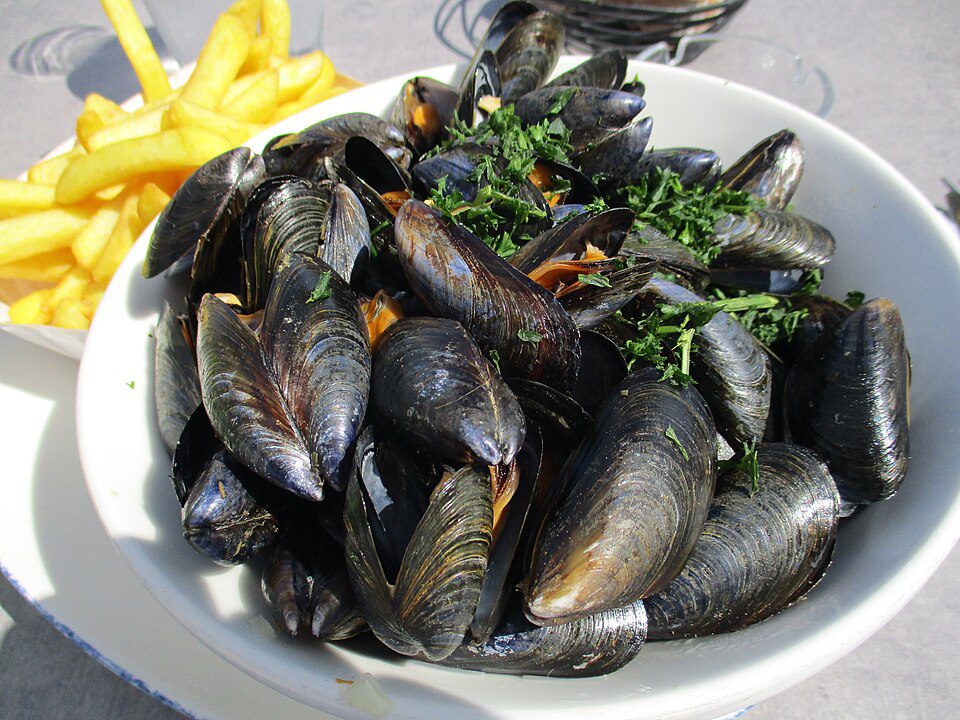
What is established is the dish itself: a classic of Norman and Breton cooking that has spread across the whole of northern France and Belgium to become the definitive way of cooking a live mussel. The version most associated with Belgium — moules-frites, a kilo of mussels with frites alongside — is what made the dish famous internationally, and it is the version I cook: the mussels as they should be, the frites as the companion that makes the meal complete, and the broth between them as the element that quietly ties the whole thing together.
The Mussels
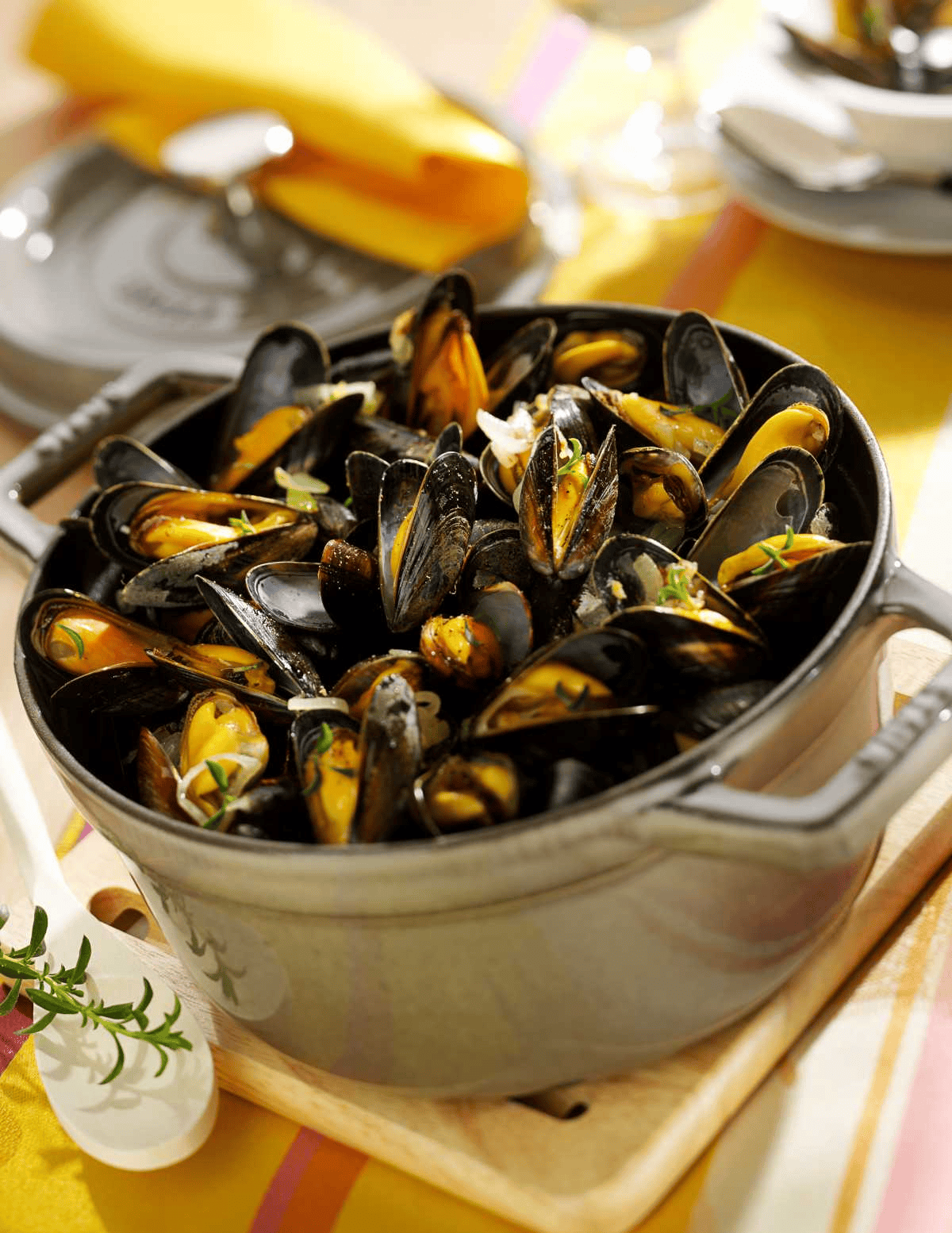
Mussels are available year-round, but they are not the same year-round. From September through April, when the water is cold and the shellfish are feeding actively, the flesh inside the shell is full, plump and sweet. In the warmest summer months — June, July, August — the mussels are in their spawning season and the flesh becomes thin and watery. The shellfish improvement the autumn brings is one of the genuinely pleasant seasonal transitions in cooking, and September mussels cooked in good white wine are, if you have not eaten them recently, rather better than you remember.
The cleaning step is the one that most puts people off mussels at home, and it is considerably less labour than its reputation suggests. Scrub the shells under cold running water with a firm brush or scouring pad, pull away the beard — the fibrous byssus thread between the shells, which is what the mussel used to attach itself to a surface — with a sharp downward tug, and check each one: cracked shells go, open shells that don’t close when firmly tapped go, everything else is ready. The whole process for two kilos of mussels takes about ten minutes. It is not complicated; it is simply preparatory, in the way that any cooking requiring live ingredients requires preparation.
The traditional advice to discard every mussel that has not opened after cooking is correct but occasionally misunderstood. A mussel that has not opened after four minutes of fierce steam has not cooked properly and should be discarded. A mussel that has barely opened — the shell cracked just slightly — is cooked and fine. The test is whether the shell has parted from its fully closed position, not how wide it has opened.
The Pot And The Heat
The width of the pan matters more than any other piece of equipment in this recipe. A narrow, deep pot puts too many mussels on top of each other and the ones at the bottom open and overcook before the heat reaches the ones at the top. The widest pan available — a large casserole, a stockpot, a paella pan if you have one — spreads the mussels in a more even layer and allows the steam to reach everything simultaneously. Cover it with the tightest-fitting lid available.
The heat, when the mussels go in, should be as high as the hob allows. Mussels open by steam, not by sustained gentle heat, and the steam is generated only when the liquid in the pot is boiling fiercely. The four minutes the recipe gives is four minutes of fierce, covered, high-heat cooking. Gentle simmering produces mussels that open unevenly and slowly, which means some are overcooked by the time others have opened. High heat, tight lid, four minutes.
The Broth
The liquid in the pot after the mussels have opened is not a by-product of the cooking but one of its primary achievements. The wine, the shallots, the garlic, the parsley stalks and the butter have been simmering together since before the mussels arrived, and the mussels themselves, in opening, have added their own saline, oceanic liquid to the pot. What you ladle into the bowl alongside the mussels is something genuinely worth eating: salty, winey, buttery, faintly sweet from the shallot, and tasting of the sea in a way that has no simple explanation beyond the fact that this is what happens when you cook live mussels in a good wine.
The knob of butter added at the end enriches and glosses the broth. The parsley leaves added with it stay bright and fragrant because they have not been cooked. Both additions take ten seconds and make the broth noticeably better.
The Frites
Proper frites are double-fried, which sounds like extra work and is, in fact, extra work that produces a fundamentally different result from anything achievable in a single fry. The first fry at 130°C cooks the potato through from the inside — fully, so there is no rawness remaining — without colouring it. The second fry at 190°C crisps and colours the outside in two to three minutes. The result is a frite that is crisp and golden outside and fluffy and yielding inside, the two textures meeting at the skin, which is how the best moules-frites in Belgium are served and how every frites should be.
The first fry can be done up to an hour before the mussels go in, which means the timing works out as follows: do the first fry, set the blanched potatoes aside, soften the shallots, add the wine, tip in the mussels, cover, and do the second fry in the two to three minutes while the mussels are cooking. Both things arrive at the table at exactly the same moment.
If a deep-fat fryer or a large pan of oil feels like too much apparatus on a Tuesday evening, potato batons tossed in oil and roasted at 220°C for thirty minutes with a turn halfway through are very good and require nothing beyond an oven and a tray. They are not proper frites and I would not pretend otherwise, but they are the version that happens in my kitchen when the evening calls for mussels and the occasion does not call for a pan of hot oil. Both are better than arriving at the table without something to dip in the broth.
The Recipe
Serves 2 as a main course. Fifteen minutes.
Ingredients
For the mussels
- 2kg live mussels, scrubbed and debearded
- 40g unsalted butter, plus a generous knob to finish
- 4 shallots, very finely sliced
- 3 garlic cloves, finely sliced
- 1 small bunch flat-leaf parsley, stalks and leaves separated
- 200ml good dry white wine
- Black pepper
For the frites
- 500g Maris Piper potatoes, cut into 1cm batons
- Vegetable or sunflower oil, for deep frying
- Sea salt
The Method
- First fry the frites. Cut the potatoes into 1cm batons, rinse in cold water and dry completely. Heat oil to 130°C in a deep pan. Fry in batches for 5 to 6 minutes until cooked through but not coloured. Drain on kitchen paper. Set aside for up to an hour.
- Clean the mussels. Scrub under cold running water, pull away the beards and discard any with cracked shells or any open ones that don’t close when firmly tapped.
- Soften the shallots. Melt 40g of butter in the largest, widest pan you own over medium heat. Add the shallots, garlic, chopped parsley stalks and a generous grind of black pepper. Cook for 5 minutes until completely soft and translucent. Do not colour them.
- Add the wine. Turn the heat to high. Pour in the wine and let it boil fiercely for 1 minute.
- Add the mussels and cover. Tip in all the mussels at once and cover immediately with a tight-fitting lid. Cook over the highest heat for 3 to 4 minutes, shaking the pan once halfway through. They are done when they have opened.
- Second fry the frites. While the mussels cook, bring the oil to 190°C and fry the blanched potatoes in batches for 2 to 3 minutes until deeply golden. Drain immediately and salt at once.
- Finish and serve. Remove the pan from the heat. Discard any mussels that have not opened. Add the remaining butter and the roughly chopped parsley leaves. Shake the pan. Serve immediately in deep, warmed bowls with the broth ladled over generously, and the frites alongside. Mussels do not wait.
A Few Notes Worth Knowing
On the wine: the wine in the pot should be the wine in the glass. Not cooking wine, not the bottle at the back of the cupboard that nobody finished, but a dry white with enough character to taste of something when it has reduced with shallots and shellfish. A Muscadet de Sèvre-et-Maine is the classic choice and exactly correct. A Picpoul de Pinet is equally good and occasionally cheaper. Any dry white you are happy to drink will produce a good broth.
On the garlic: sliced rather than crushed or minced. Crushed garlic, in a recipe this quick, can turn sharp and slightly harsh in the time available. Thinly sliced garlic softens into the shallots and the wine more gently, giving the broth flavour without bitterness.
On the bread: whatever is best and nearest. The broth requires bread. The bread does not require anything specific beyond being good enough to justify the purpose it is being put to, which is soaking up one of the most flavourful cooking liquids this collection produces.
On quantities: two kilos of mussels feeds two people as a main course. This sounds like a great deal of mussels until you consider that a live mussel in its shell is mostly shell, and the flesh inside represents perhaps a third of the total weight. Scale the recipe directly for more people — the technique and the timing do not change.
On keeping: mussels do not keep after cooking. They should be eaten immediately, and any leftover broth, if there is some, can be used the next day as the base of a fish soup or a quick pasta sauce with more butter and parsley. There are rarely leftovers.
This is my own recipe, made many times and most recently, very happily, in September. Not a paid or gifted feature.
Recipe Card
Recipe Name: Moules Marinières
Recipe Description : Live mussels steamed quickly with white wine, shallots, garlic, butter and parsley, served with crisp double-fried potatoes and bread for the deeply flavoured broth.
Serves: Serves 2 as a main course
Preparation Time: Approximately 10 minutes to clean the mussels and prepare the potatoes and aromatics
Chilling & Resting Time: No chilling required; the potatoes may rest for up to 1 hour between their first and second fry
Cooking Time: Approximately 15–18 minutes, with the second fry completed while the mussels steam
Total Time: Approximately 25 minutes; around 15 minutes at service if the potatoes have completed their first fry in advance
Difficulty: Moderate



Get our latest Delivered
Beautiful recipes, inspiration, guides and news that makes you want to live!