Turin: The Quiet Capital
Italy’s first capital is also its most quietly elegant: a city of arcades and café marble, baroque squares and the Alps at the end of every street. Most travellers hurry past it on the way south. That is rather the point.
There is a particular pleasure in a city that does not perform for you. Italy has no shortage of places that arrive pre-loved, photographed into submission long before you reach them, where the queue for the famous thing has rather become the famous thing. Turin is not one of those. It sits at the top left of the country, propped against the Alps, and it has spent the better part of a century being overlooked by people hurrying south. Their loss is the whole reason to go.
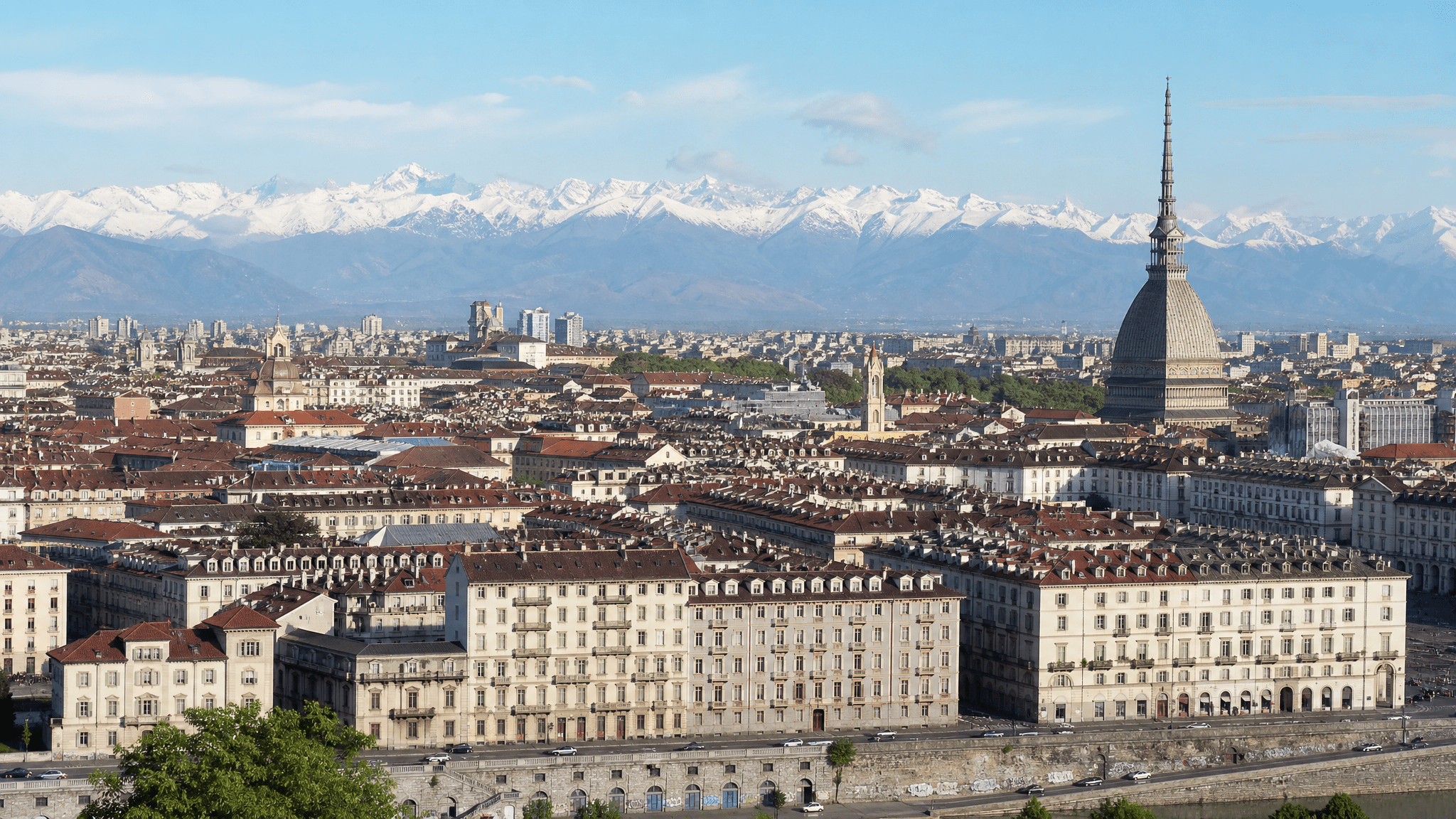
Because Turin is, by some distance, the most elegant Italian city that nobody talks about. It was built to be a capital and it still carries itself like one: long straight boulevards lined with arcades, baroque squares laid out for ceremony, and a café culture so old and so serious that ordering a coffee can feel like a small civic ritual. On a clear morning the mountains appear at the end of the streets, white and close, as though the city had arranged them there for effect.
A capital in retirement
Turin’s poise is not an accident. The House of Savoy made it their capital in 1562, moving the seat of the duchy across the mountains from Chambéry in France, and they spent the next three centuries turning a provincial town into a stage for a dynasty. Architects were summoned, squares were cut, palaces raised. When Italy finally became a single country in 1861, it was Turin that was named its first capital, with a Turinese statesman, Cavour, having done much of the quiet engineering to get there.
The honour did not last. Within four years the capital moved to Florence, and by 1871 to Rome, leaving Turin with all the grand architecture of a capital and almost none of the business of being one. It is said, only half in jest, that Italy was born here and then left home. What the city kept was the manner, and the bones: somewhere around eighteen kilometres of porticoes, the most of any city anywhere, so that you can cross much of the centre in the rain without troubling an umbrella, and a run of squares built on a scale that still makes you stand a little straighter. Piazza San Carlo, all matching baroque façades and bronze horseman, is the one the Turinese call their drawing room. It is easy to see why.
Egypt, by way of Piedmont
The single most surprising thing in Turin has nothing to do with Italy at all. The Museo Egizio is the oldest museum in the world devoted entirely to ancient Egypt, founded in 1824, and its collection is reckoned the most important anywhere outside Cairo. How tens of thousands of pharaonic objects came to rest in the foothills of the Alps is a story of Savoy curiosity and nineteenth-century collecting, and the result is genuinely staggering: more than forty thousand pieces, including the near-intact tomb of an architect named Kha and his wife Merit, discovered with their furniture, their linen and even their food still in place; the rock-cut temple of Ellesiya; the fragile papyrus known as the Turin King List; a serene statue of Ramesses II that has become the museum’s quiet star.
It marked two hundred years in 2024, and it now draws over a million visitors, which is a polite way of saying go early or book ahead. Give it longer than you think you need. It is the kind of place that resets your sense of how old “old” can be.
The spire and the palace
Above the rooftops stands the Mole Antonelliana, the slim, improbable spire the city uses as its signature. It began life in 1863 as a synagogue, but its architect, Alessandro Antonelli, could not seem to stop building upward, and by the time it was finished in 1889 it stood at 167.5 metres, for a long while the tallest brick building in the world. Since 2000 it has housed the National Museum of Cinema, one of the more purely enjoyable museums in Italy, its exhibits spiralling up through the great hollow interior. Best of all is the glass lift that climbs through the centre of the building to a terrace at eighty-five metres in under a minute. On a clear day, the Alps do the rest. I have never quite managed to walk past it without going up.
A few streets away, the Royal Palace anchors what was once the command area of the Savoy, now gathered together as the Musei Reali: the royal apartments, the armoury, the picture gallery, the royal library, and a set of gardens worth an idle hour. Behind it, the cathedral holds the Chapel of the Holy Shroud, a baroque masterpiece by Guarino Guarini whose dome seems to spiral upward into something imagined rather than constructed. It was gutted by fire in 1997 and painstakingly brought back. One honest word, because it saves disappointment: the Shroud itself is almost never on view, shown only at rare public displays years apart. You come for the chapel and the cathedral, not for a glimpse of the cloth.
If you have a third day, the dynasty’s pleasure palaces ring the city, all part of the same UNESCO-listed Savoy estate: the theatrical sweep of Venaria Reale, the rococo hunting lodge at Stupinigi, and Rivoli, an old castle now given over with some wit to contemporary art.

The factory on the hill
For the city’s other face, go south to the Lingotto. The old Fiat factory opened here in 1923, and it was a marvel of its age: raw materials came in at the bottom, cars were assembled floor by floor up an internal ramp, and each finished model was driven out onto a test track on the roof. Le Corbusier admired it. Film lovers know it as the place the Minis tear around in the 1969 “Italian Job”.
Production stopped in 1982, and rather than lose the building, Turin handed it to Renzo Piano, who reimagined it as something new without erasing what it had been. The Pinacoteca Agnelli, a small jewel-box of a gallery, now sits raised above the roofline, and the test track survives, wrapped since 2022 in a rooftop garden of tens of thousands of plants. You can walk the full circuit, the city laid out below and the mountains beyond, where Fiat once put every new car through its paces. It is, when you think about it, the most Turinese thing imaginable: industry turned, without fuss, into something graceful.
How Turin tastes
And then there is the eating and drinking, which is where Turin stops being merely handsome and becomes difficult to leave.
This is a city that takes its café life seriously, in rooms of marble, mirror and dark polished wood that have barely changed in a century or more. The oldest, Caffè Al Bicerin, opened by the sanctuary of the Consolata in 1763, gave its name to the drink you should order at least once: the bicerin, a small glass of espresso, melted chocolate and barely whipped cream, layered so carefully that the three sit in distinct bands. Hemingway, passing through after the First World War, is said to have counted it among the hundred things he would save in the world. He was not wrong. For the full theatre of it, the mirrored and gilded Baratti & Milano, trading since 1858, is hard to beat.
Chocolate, here, is not incidental. When Napoleon’s blockade made cocoa scarce in the early nineteenth century, Turin’s chocolatiers eked out their dwindling supply with the sweet hazelnuts that grow in the Langhe hills to the south, and in doing so invented gianduja. Around 1865, the Caffarel house pressed the hazelnut paste into a small gold-wrapped ingot called the gianduiotto, by most accounts the first individually wrapped chocolate ever sold, and named it after a character from the local carnival. A box of them is the souvenir to carry home.
The city has one more gift to its name. It was here, in 1786, that Antonio Benedetto Carpano first bottled vermouth, and Turin duly became the home of the aperitivo, the names still on the bottles today: Carpano, Cinzano, Martini. Towards six in the evening the cafés begin to fill, a vermouth or a Milano-Torino arrives with a few things to pick at, and the whole city seems to exhale at once. Stay for dinner and Piedmont delivers without trying too hard to impress: plump agnolotti, vitello tonnato, beef braised slow and dark in Barolo, a bonet to finish. The great wine country of Barolo and Barbaresco is barely an hour away, which explains the depth of more than one cellar in town.
The long way round
A few practicalities, because even a beautiful plan needs a train time. Turin is compact and made for walking, the grid and the arcades doing most of the navigating for you, and two to three days is enough to feel you have its measure. Spring and autumn are the loveliest, the light long and the temperature kind. Summer is hot, though the porticoes were built for precisely that, and winter brings the mountains into sharp, clean focus. Tickets and opening hours for the museums are worth a quick check before you go, as they shift with the seasons.
However you come, come gently. Turin is not a city to be marched through behind a raised umbrella and a list. It is a city to be walked slowly, coffee by coffee, square by square, until somewhere around the second afternoon you find yourself wondering, a little indignantly, why nobody told you sooner.
This is a researched feature, written with care from reliable sources rather than a paid or gifted visit. Museum details and opening times were correct at the time of writing; do check ahead before you travel.