Beef Bourguignon
Beef Bourguignon
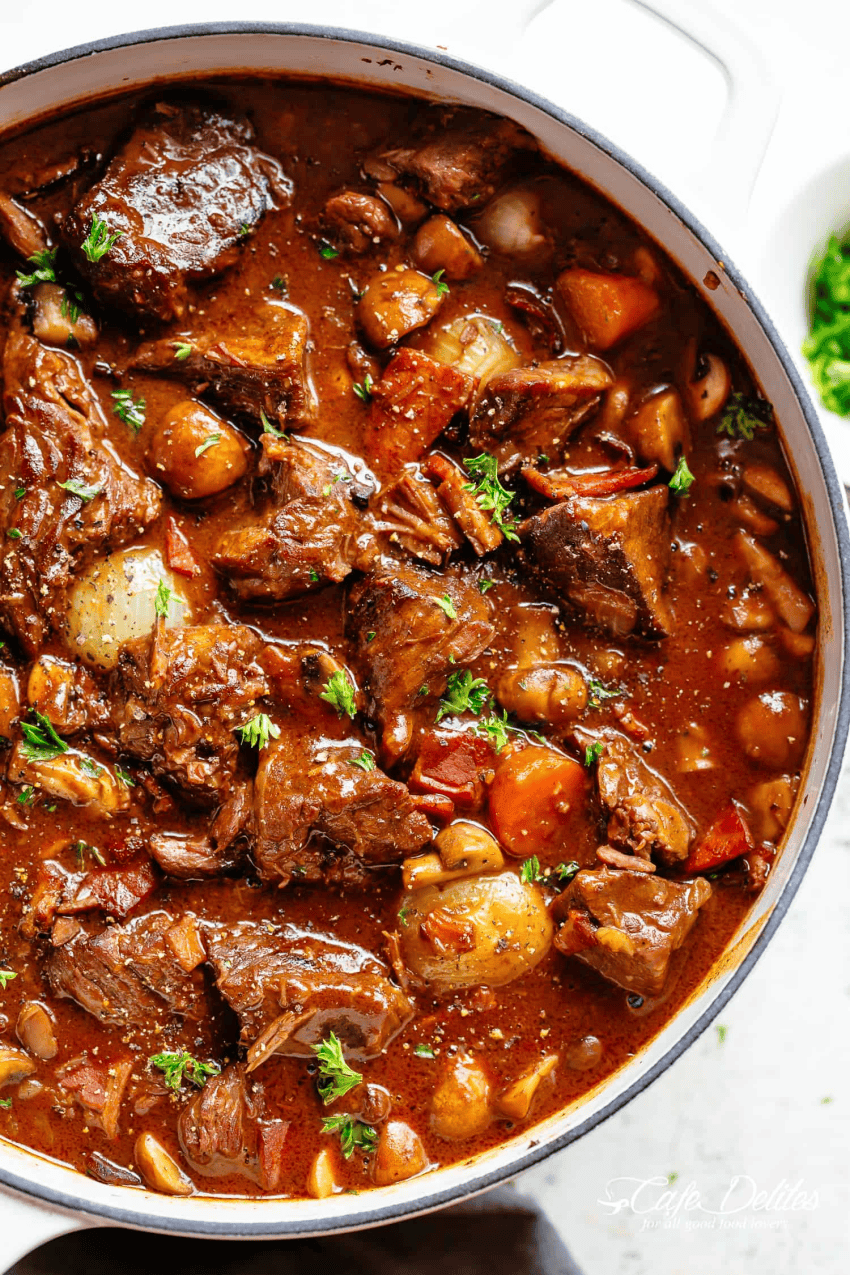
The great Burgundian beef braise: chuck beef in a whole bottle of Pinot Noir, with lardons, pearl onions and mushrooms each cooked separately so every element arrives at the table at its best. The version that makes a dinner party feel like the occasion it is. Better, without exception, the next day.
There are recipes I make because the week calls for them, and then there are recipes I make because the occasion does. Beef bourguignon belongs entirely to the second category. It is what I cook when I want to feed people in a way that communicates something more deliberate than Wednesday — when the table should feel properly laid, the wine should be something worth opening, and the kitchen should smell, from early afternoon onwards, like an investment in the evening ahead.
It is also, and this matters, considerably less difficult than it appears. Bourguignon is a braise, and a braise is nothing more than the patient application of low heat to an inexpensive cut of beef and a bottle of wine, with a few vegetables and aromatics standing by. The technique is patience more than skill: the browning step requires attention; the braising step requires a timer and an oven. The rest is the sauce, which the beef largely makes itself over three hours in the oven. What distinguishes a great bourguignon from a merely competent one is not culinary talent but a commitment to a few specific steps that most shortcut recipes omit, and which make a visible difference to the finished dish.
Where It Comes From
Burgundy is the region of France that gave the world Pinot Noir and Chardonnay of the highest expression, and it also gave the world this dish. The beef that grazes the Charolais hills of Burgundy is among the finest in France, and the wine made from the same hills’ grapes is what braises it. The combination of the two — specific cattle, specific wine, specific region — produces a dish that is genuinely of its place in a way that most French regional cooking is, and which carries the weight of that provenance in every plateful.
The dish found its international audience through Julia Child, whose version in Mastering the Art of French Cooking remains the most thorough treatment the recipe has received in the English language, and whose thirty-minute demonstration on The French Chef in 1963 did more for Burgundian beef than any amount of tourism board activity. Child’s genius was to understand that bourguignon was not a restaurant dish but a home cook’s dish — one that required time but not training, patience but not precision — and to present it as such to an audience that had been taught to fear French cooking. She was right about the difficulty, and her instinct that this was something anyone could make has proved entirely correct.
What she would also be the first to tell you is that it must be made the day before.
The Browning
The browning of the beef is the step that makes or breaks a bourguignon, and it is the step most often compromised by impatience or crowded pans.
Wet beef does not brown. It steams. The Maillard reaction that produces the colour and the flavour compounds requires high, dry heat at the surface of the meat, and moisture — from the beef itself or from overcrowding the pan — drops the temperature and produces grey, pallid meat that contributes almost nothing to the sauce that forms around it. Pat every piece of beef completely dry with kitchen paper before it goes anywhere near the pan. Work in batches small enough that each piece has space around it, with hot oil and high heat. The browning of each batch takes three to four minutes and should not be rushed.
The fond — the dark, sticky residue that builds in the pan as each batch of beef is browned — is the foundation of the sauce. Every gram of it is dissolved by the wine and the stock when the liquid goes in, and its flavour is irreplaceable. A pale bourguignon sauce is almost always the result of a pale browning step, and a pale browning step is almost always the result of crowding or wet beef. The extra five minutes of browning in proper batches is worth more to the finished dish than any other single decision in the recipe.
The Wine
The wine does not need to be expensive, but it needs to be drinkable. A bottle of supermarket Burgundy at twelve pounds will produce a better sauce than cooking wine, and a decent Côtes du Rhône at the same price will work almost as well if Pinot Noir is out of reach. What you want is fruit, body and at least a suggestion of the terroir that gives Burgundy its character. Anything thin, harsh or heavily tannic will concentrate its deficiencies during the braise rather than resolving them.
The reduction of the wine before it goes in is an instruction borrowed from the Burgundian kitchen and one I follow without negotiation. Ten minutes at a rolling boil removes a third of the wine’s volume, concentrating its colour and flavour and burning off the raw alcohol that, if left in, can make the finished sauce taste slightly sharp. The reduction step is not glamorous and is easy to skip, which is precisely why most recipes do and why their sauces are never quite as deep as this one.
The Garnish, and Why It Matters
The three garnish elements — lardons, pearl onions, mushrooms — are what distinguish a proper bourguignon from a beef stew in red wine, and the manner of their cooking is what distinguishes a great bourguignon from a mediocre one.
The lardons are rendered first, in the same pan that will brown the beef, contributing their fat as cooking medium and their smoky, salty flavour as the base note of the entire dish. They are removed before the vegetables go in and returned at the end, so they arrive at the table with some texture rather than having braised to nothing in three hours of oven heat.
The pearl onions are glazed separately, in butter and a pinch of sugar with a small amount of water, covered with a baking paper disc to trap the steam. This technique — pommes glacées, applied to onions — produces onions that are tender all the way through and golden on the outside, their natural sugars caramelised without burning, quite unlike the onions that braise in the main casserole and dissolve into the sauce. Onions cooked separately for the garnish and onions braised into the sauce are different things, and the dish needs both.
The mushrooms are sautéed over very high heat in butter until deeply golden and caramelised — not softened, not sweated, but properly coloured — and added at the end. A mushroom that has braised for three hours is waterlogged and dark and has lost most of what makes a mushroom worth eating. A mushroom sautéed separately at the last moment and added to the finished dish retains its texture, its flavour and its personality. On the day before, the mushrooms are the one element I hold back and add fresh when reheating.
The Sauce
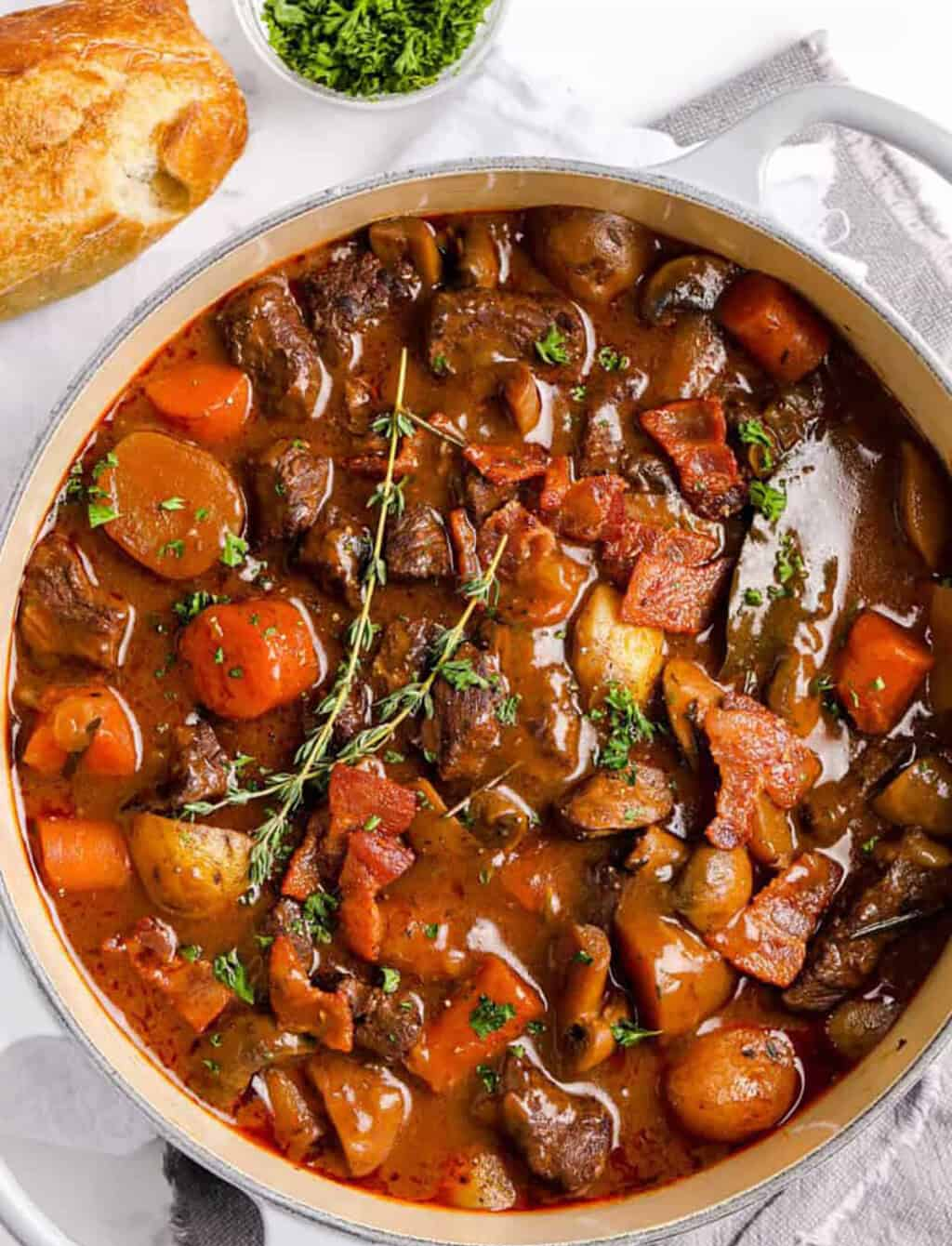
The braising liquid, strained from the vegetables and reduced in a wide pan until it coats a spoon, is where the three hours of oven time announce themselves. By the time it has reduced properly it should be a deep, glossy, mahogany brown with a body that comes from the collagen in the beef and the reduction of the wine and stock. The beurre manié — butter and flour worked together into a paste and whisked in a little at a time — is the classical thickener for the sauce and should be used only if the reduction alone has not produced the right consistency. A sauce thickened by reduction has more flavour than one thickened by flour; use the beurre manié as a correction, not a substitute.
The Recipe
Serves 6. About 45 minutes’ active work, 3 hours’ braising. Make the day before.
Ingredients
For the braise
- 1.5kg beef chuck, cut into 5 to 6cm pieces
- 750ml good Burgundy or Pinot Noir
- 200g lardons or thick-cut smoked bacon, cubed
- 2 tbsp olive oil
- 1 large onion, finely diced
- 2 carrots, finely diced
- 2 celery stalks, finely diced
- 4 garlic cloves, finely sliced
- 2 tbsp tomato paste
- 300ml dark beef stock
- 60ml cognac or Armagnac
- 1 bouquet garni: thyme sprigs, 2 bay leaves, parsley stems
- Sea salt and black pepper
For the garnish
- 200g pearl onions or small shallots, peeled
- 250g chestnut or button mushrooms, halved if large
- 30g unsalted butter
- 1 tsp caster sugar
To finish
- 20g unsalted butter, softened
- 20g plain flour
- A small handful of flat-leaf parsley, chopped
The Method
- Reduce the wine first. Pour the wine into a saucepan and boil over high heat until reduced by one third, about 10 to 12 minutes. Set aside.
- Brown the beef — in batches, with patience. Pat the beef completely dry and season all sides generously. Heat the olive oil in a large, heavy casserole over high heat until smoking. Brown the beef in batches, never crowding the pan, until deeply coloured on all sides. Set each batch aside. Do not rush this step.
- Render the lardons. In the same casserole, fry the lardons over medium heat until the fat has rendered and they are beginning to crisp. Remove with a slotted spoon, leaving the fat.
- Build the base and flambé. Add the onion, carrots and celery to the fat and cook for 8 to 10 minutes until soft and lightly golden. Add the garlic and cook for 2 minutes more. Return all the beef to the casserole. Pour in the cognac, take the pan off the heat and carefully ignite with a long match. Stand back and let the flames die naturally.
- Braise low and long. Stir in the tomato paste. Pour in the reduced wine and the stock. Add the bouquet garni. The liquid should come about two thirds up the beef. Bring to a gentle simmer, cover and transfer to a 160°C (140°C fan) oven. Braise for 2 hours 30 minutes to 3 hours, turning the beef once halfway, until the meat yields without resistance to a fork.
- Cook the garnish separately. While the beef braises, melt half the butter in a frying pan. Add the pearl onions, sugar and a splash of water. Cover with a disc of baking paper and cook over medium heat for 15 to 20 minutes until tender and golden. Remove and set aside. In the same pan over high heat, add the remaining butter and sauté the mushrooms until deeply caramelised. Set aside.
- Strain, reduce and finish the sauce. Lift out the beef and set aside. Discard the bouquet garni. Strain the braising liquid through a fine sieve into a wide saucepan, pressing the vegetables. Boil until glossy, deeply coloured and coating a spoon. If it needs further body, work the softened butter and flour into a paste and whisk in a little at a time.
- Bring everything together. Return the beef, lardons, glazed onions and mushrooms to the sauce. Simmer gently for 10 minutes. Taste and adjust the seasoning. Scatter with parsley and serve from the pot.
A Few Notes Worth Knowing
On the beef cut: chuck is the correct choice — it has the collagen and fat that a three-hour braise requires. A leaner cut will become dry and stringy rather than tender. If your butcher will cut it, ask for large, even pieces rather than pre-diced stewing beef, which is often cut too small and will disintegrate before the sauce has had time to develop.
On the marinade question: some versions of this recipe marinate the beef overnight in the wine with the aromatic vegetables before braising. Julia Child considered it optional but beneficial for older, tougher beef. For modern chuck of good quality, I find the long braise accomplishes what the marinade was designed to do, and the reduction of the wine before braising makes the point somewhat moot. If you have an extra day and want to try the marinated version, it will be very good.
On the next day: remove the dish from the fridge an hour before reheating to take the chill off. Reheat gently on the hob, covered, adding a splash of stock or water if the sauce has thickened too much in the fridge. Sauté the mushrooms fresh and add them when everything is hot. Taste the seasoning again before serving — flavours concentrate during refrigeration.
On what to serve alongside: mashed potato is the canonical choice and the right one. The sauce is considerable and it needs something to absorb it. Plain boiled or steamed new potatoes work for a lighter version. Egg noodles tossed in butter are the Central European alternative and a perfectly good one. Crusty bread on the table regardless, because the sauce that remains in the pot is not a thing to leave behind.
On the wine to drink alongside: the same wine you cooked with, or something from the same appellation. Burgundy with bourguignon is not a cliché but a logical conclusion — the same wine in the glass as in the dish produces a harmony that no amount of clever pairing can improve on. A Côtes de Nuits-Villages or a Gevrey-Chambertin village wine is the attainable version; a premier cru is the occasion version.
This is my own recipe, the version I make when the occasion warrants it and the afternoon is available. It draws on the Burgundian tradition and the thorough treatment of the dish by Julia Child in Mastering the Art of French Cooking, to which any serious cook owes a debt.
Recipe Card
Recipe Name: Beef Bourguignon
Recipe Description : A classic Burgundian braise of tender chuck beef cooked slowly in Pinot Noir, finished with lardons, glazed pearl onions, caramelised mushrooms and a rich, glossy sauce.
Serves: Serves 6
Preparation Time: Approximately 45 minutes active preparation
Chilling & Resting Time: Refrigerate overnight before reheating for the best flavour; remove from the fridge approximately 1 hour before reheating
Cooking Time: Approximately 3 hours 15 minutes to 3 hours 45 minutes
Total Time: Approximately 4 to 4½ hours on the first day, plus overnight resting and gentle reheating before serving
Difficulty: Considered


Get our latest Delivered
Beautiful recipes, inspiration, guides and news that makes you want to live!