Gratin Dauphinois
Gratin Dauphinois
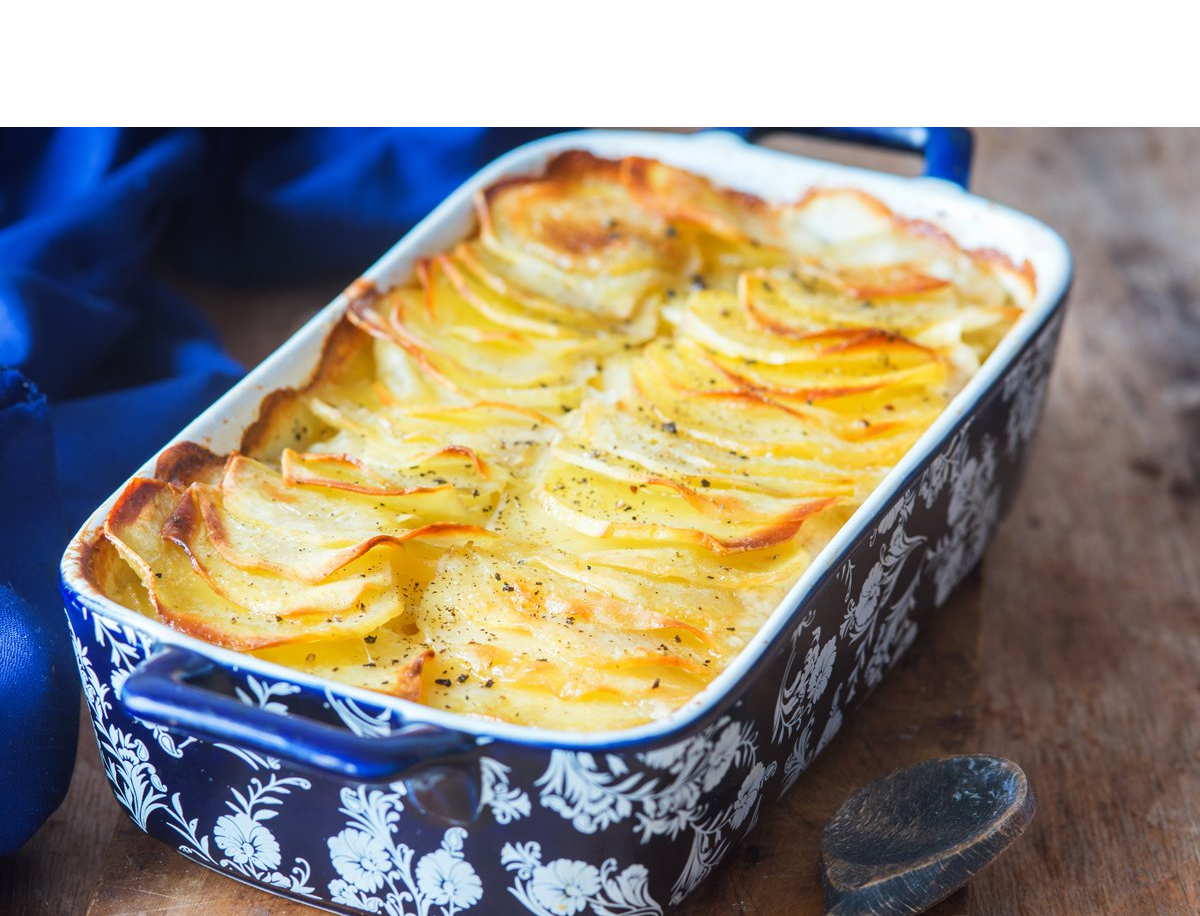
Thinly sliced Maris Piper potatoes baked slowly in cream infused with garlic and nutmeg, with a Gruyère crust on top that the purists of Grenoble would disallow and everyone else will be grateful for. Low oven, long bake, fifteen minutes’ rest. The side dish that makes everything it sits beside feel more serious than it otherwise would.
I should tell you immediately that the version I make is not the strictly proper one. The gratin dauphinois of the Dauphiné — the alpine region of south-east France that gives the dish its name, centred on Grenoble and bordered by the Alps — is made with cream and potatoes only. No cheese. The cream, absorbed into the potatoes over a long, slow bake, is the whole point. It is, in this purist form, a dish of complete elegance, and the chefs and home cooks of the Dauphiné are protective of it in the way that the people of Bordeaux are protective of their wine classifications: the rules are the rules, and everything else is something else.
What I make is something else. I add Gruyère to the top, because the combination of the golden, slightly uneven crust of melted cheese over the cream-soaked potatoes beneath it is, in my view, worth the regional disapproval. The gratin savoyard, made with cheese in the layers, is the technically different dish the Savoyard Alps would recognise. What I am making sits somewhere between the two: the dauphinois base — infused cream, no cheese in the layers — with a Gruyère top that I will defend without apology. This is the version I come back to every time, and it has never once left the table with anything remaining.
Where It Comes From
The Dauphiné was a province of France before the Revolution, centred on the city of Grenoble, its territory running from the Rhône valley up into the high Alps. It is a cold region for much of the year, and the food reflects this: substantial, cream-rich, built around the cattle and the potatoes and the dairy products of the mountains. The gratin dauphinois — potatoes baked in cream with a little garlic and nutmeg, in a dish rubbed with butter — is the dish of this landscape, and it has been since at least the eighteenth century.
The earliest written record of the dish dates to 1788, when the Duke of Clermont-Tonnerre served it at an official dinner in Gap. The recipe was described with the precision of someone who had eaten it many times and considered the particulars important: the potatoes sliced thinly, the cream poured over generously, the baking long and slow. The absence of cheese was not an omission but a principle. The cream does not need cheese to be rich, the argument goes, and adding it changes the character of the dish from something subtle to something more emphatic. This is a reasonable position and I have a great deal of sympathy for it on the days I am not adding Gruyère.
The Potatoes
The potato question in a gratin dauphinois is more contested than you might expect, and the answer depends on what you want the finished dish to do.
Waxy potatoes — Charlotte, Ratte, Jersey Royal — hold their shape through the long bake and produce a gratin with distinct, identifiable slices that cut cleanly and look elegant on the plate. Floury potatoes — Maris Piper, King Edward — break down more at the edges, absorb the cream more completely, and produce a gratin that is more yielding, more unified, where the potato and the cream have become something together rather than remaining separately themselves.
I use Maris Piper. The yielding quality, the absorption, the way the potato and the cream become inseparable after ninety minutes in a low oven — this is what I want from a gratin dauphinois, and Maris Piper produces it reliably. The slices should be between two and three millimetres thick, which is thin enough to cook through in the time available and thick enough to retain some structure rather than dissolving entirely. A mandoline is the right tool — not because a knife cannot produce the right thickness, but because the mandoline produces the right thickness every time, which matters more than any individual slice.
The Cream And The Garlic
Infusing the cream with garlic before it goes anywhere near the potatoes is not the only method, but it is the one I prefer for the depth it produces. The garlic simmered gently in a mixture of double cream and milk for ten minutes gives up its flavour gradually and completely, and when you strain it out and pour the infused cream over the potatoes, the garlic is present throughout the dish rather than concentrated in the spots where the raw slices sit. The cream becomes the carrier of the flavour, which is where it should be.
The milk is not an apology for the cream but a considered dilution. Pure double cream, in the quantities required to cover 1.2 kilograms of potatoes, produces a gratin of considerable richness — magnificent alongside something relatively lean, slightly overwhelming alongside a dish that is itself very rich. The milk brings the cream to a point of generosity rather than excess, and it makes the gratin useful alongside a wider range of the mains in this collection.
The nutmeg is not optional. A gratin dauphinois without nutmeg is a gratin dauphinois that tastes slightly unfinished, missing the warm, faintly spiced note that holds the cream and the potato together and gives the dish its characteristic depth. A good grating of fresh nutmeg over the seasoned cream, tasted and adjusted, is the step that makes the flavour complete.
The Starch And Why Not To Rinse
Most recipes for potato gratins instruct you to rinse the potato slices in cold water after cutting, to remove the surface starch. The reasoning is that the starch can make the cream cloudy and the finished gratin slightly gluey. The counter-argument, which I find more persuasive, is that the starch released by unrinsed potato slices thickens the cream as it cooks and binds the layers of the gratin into a coherent whole rather than a pile of slices in cream. A properly rested gratin made with unrinsed potatoes can be cut into portions that hold together. The same gratin made with rinsed potatoes is more likely to slide apart on the spoon.
Do not rinse the potatoes. Season each layer as you go. Press everything down firmly before the cream goes in. These three instructions produce a gratin that behaves on the plate.
Low Oven, Long Bake
A gratin dauphinois is not a dish that can be hurried, and attempting to hurry it produces one of two outcomes: potatoes that are overcooked at the edges and raw in the centre, or cream that has split and curdled from too much heat. The correct oven temperature is 160°C, and the correct baking time is one hour covered with foil, followed by thirty to forty minutes uncovered with the Gruyère on top. The covering prevents the cream from reducing too quickly before the potatoes have cooked through. The uncovering gives the cheese time to melt, bubble, and turn the particular uneven golden brown that is the most visually convincing thing about the dish.
The skewer test is more reliable than any timing: the gratin is done when a skewer or the tip of a sharp knife passes through the centre with no resistance at all. Not a little resistance. None. Potatoes that have not fully yielded to the cream will firm up again as the gratin cools and produce a texture that is unpleasant rather than the silky giving quality the dish should have. Take it out only when the skewer says it is done.
The Rest And The Next Day
Fifteen minutes’ rest before serving is the instruction most consistently ignored and the one whose consequences are most consistently regretted. A gratin removed from the oven and served immediately is a gratin that collapses on the spoon, its cream running across the plate rather than remaining absorbed into the potato. A gratin rested for fifteen minutes has firmed to the point where it can be lifted in clean portions, each one holding its layers together rather than surrendering them at the first contact with a serving spoon. The rest is not optional.
The next day is better still. A gratin cooled, covered and refrigerated overnight sets to a sliceable solidity that can be portioned with a knife, laid in a baking dish and reheated at 180°C for twenty minutes until warmed through and slightly crisped at the edges. The flavour deepens overnight and the texture on reheating is the best the dish achieves. If you are making this for a dinner party, make it the day before and reheat it. Your guests will not know, and the gratin will be better for the deception.

The Recipe
Serves 6 as a generous side. About 20 minutes’ active work and 1 hour 40 minutes’ baking.
Ingredients
- 1.2kg Maris Piper potatoes, peeled
- 350ml double cream
- 150ml whole milk
- 4 garlic cloves, thinly sliced
- A good grating of fresh nutmeg
- 30g unsalted butter, for the dish
- 80g Gruyère, finely grated
- Sea salt and white pepper
The Method
- Infuse the cream with garlic. Pour the cream and milk into a saucepan with the garlic. Bring to a very gentle simmer and cook for 10 minutes until the cream smells deeply of garlic. Season generously with salt, pepper and a good grating of nutmeg. Taste — the cream should be well seasoned and fragrant. Strain through a fine sieve, discard the garlic, and set aside.
- Prepare the dish. Heat the oven to 160°C (140°C fan). Butter a gratin dish approximately 30 x 20cm generously on the base and sides.
- Slice and layer the potatoes. Slice the potatoes 2 to 3mm thin on a mandoline or with a sharp knife. Do not rinse them. Layer in the buttered dish in overlapping rows, seasoning lightly between each layer. Press down firmly when all the potatoes are in.
- Pour the cream. Pour the garlic cream over the potatoes evenly. It should come to just below the top layer. Press the potatoes down once more with the back of a spoon. Cover tightly with foil.
- Bake low and long. Bake covered for 1 hour. Remove the foil, scatter the Gruyère evenly over the surface and return to the oven uncovered for 30 to 40 minutes until the top is deep golden brown and a skewer inserted into the centre meets no resistance.
- Rest before serving. Leave to rest uncovered for at least 15 minutes. Serve directly from the dish.
A Few Key Notes Worth Knowing
On the dish size: a dish that is too small produces a gratin that is very thick and takes considerably longer to cook through. A dish that is too large spreads the potatoes thinly and dries the gratin before the cream has had time to absorb. 30 x 20cm for 1.2kg of potatoes produces a gratin of approximately 4 to 5cm depth, which is correct.
On the Gruyère: finely grated rather than coarsely, which produces a more even, more molten crust rather than islands of melted cheese separated by bare potato. Comté is an excellent alternative and arguably better — nuttier, more complex, from the same mountain region as the dish itself.
On what it goes with: everything that appears under a rich sauce in this collection — the beef bourguignon, the roast lamb, the coq au vin — wants a gratin dauphinois alongside it. It is also excellent with a simple green salad and nothing else, in which case it ceases to be a side dish and becomes the meal, which is a perfectly reasonable outcome for a Tuesday.
On the purist version: if you would like to make the strictly proper dauphinois without the Gruyère, omit it entirely. Bake uncovered for the final thirty minutes to form a cream crust on the top layer of potato. It is quieter, more subtle, and I commend it to you unreservedly on the days when you are feeling principled.
This recipe was made many times and improved at every iteration towards more garlic and a better crust. The history draws on the documented origins of the dish in the Dauphiné region of France.
Recipe Card
Recipe Name: Gratin Dauphinois
Recipe Description : Thinly sliced Maris Piper potatoes baked slowly in garlic-infused cream with nutmeg, finished beneath a bubbling golden crust of Gruyère.
Serves: Serves 6 as a generous side dish
Preparation Time: Approximately 20 minutes active preparation
Chilling & Resting Time: At least 15 minutes resting after baking; refrigerating overnight before reheating is recommended for the cleanest texture
Cooking Time: Approximately 1 hour 40 minutes to 1 hour 50 minutes
Total Time: Approximately 2 hours 15 minutes to 2 hours 25 minutes, including resting
Difficulty: Moderate



Get our latest Delivered
Beautiful recipes, inspiration, guides and news that makes you want to live!