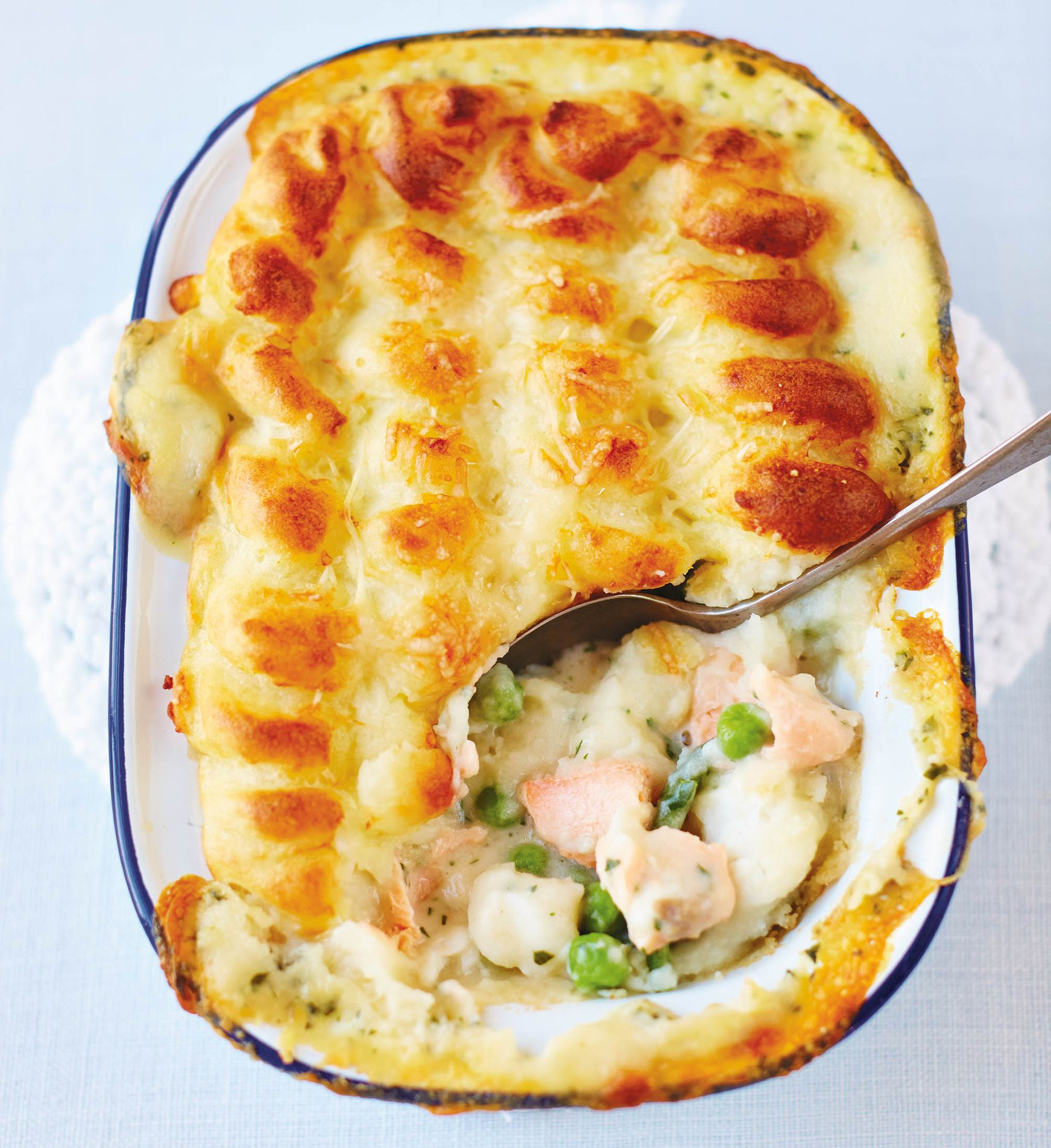
A Good Fish Pie
A Good Fish Pie
The classic trio — white fish, smoked haddock and prawns — in a sauce built from the poaching milk, under a butter-and-cream mash. The kind of pie you make when the week has been long and the table needs something generous.
I want to be straightforward about the name before we begin. This is not a sophisticated fish pie. It is not a fish pie with saffron cream, or a fish pie with champagne, or a fish pie finished with a Parmesan and herb crust that makes it suitable for a dinner party at which you might be judged. It is a good fish pie, and I have called it exactly that because I think “good” is actually a higher standard than “impressive,” and because this particular version has been made in my kitchen more times than any other recipe in the collection.
It feeds six generously and it freezes without complaint. It is what you make when someone is recovering, or when the weather has turned, or when you want to feed people in a way that makes them feel unambiguously looked after without requiring anything of the afternoon beyond a reasonable period of attentiveness in the kitchen. It is also one of those recipes where knowing one key piece of technique separates a fish pie that is merely good from one that is genuinely great, and since that technique is simple enough to be done without thinking once you have done it once, it seems worth spelling out in full.
The Poaching Milk
The technique is this: you poach the fish gently in seasoned milk before you do anything else, and then you use that milk as the base of the roux sauce. That is the whole secret, and it changes the character of the dish completely.
The logic is simple enough. Milk poached with fish and a bay leaf and peppercorns and half an onion becomes, in the six or eight minutes the fish needs to cook through, an infused, sweet, lightly smoky liquid that tastes of everything the finished pie should taste of. When you make your roux with butter and flour and whisk this milk into it instead of plain milk, the sauce starts from a position of genuine flavour rather than cream-coloured neutrality. The smoked haddock is the most generous contributor: by the time you have poached it alongside the white fish, the milk has taken on a soft, smoky depth that scents the whole sauce without announcing itself at every mouthful.
The other reason for poaching the fish first is control. Fish releases liquid as it cooks, and if you put raw fish directly into a cream sauce and bake the whole thing, the sauce thins as the fish gives off its moisture and the pie becomes wet rather than creamy. Poaching first removes most of that excess liquid before the fish ever meets the sauce. The pie holds together. The filling is rich without being loose. The mash sits on top rather than sinking into it.
Three further things about the poaching: it should be gentle, not bubbling. The fish should be barely cooked — opaque through but still yielding — when you lift it out, because it will continue in the oven and you do not want it already overdone before the pie has even assembled itself. And the prawns do not get poached at all. They go in raw with the flaked fish, cooking through in the oven with enough residual heat to firm up without toughening. A prawn that has been poached twice is a prawn that has had quite enough and is not giving its best.
The Fish
The classic trio for a reason: white fish for substance and sweetness, smoked haddock for depth and colour, prawns for texture and the sea. Cod is the natural first choice for the white fish, though haddock or pollock work equally well, and sustainable sourcing is worth your attention here — the Marine Conservation Society’s Good Fish Guide is the most reliable current reference for what to buy and what to avoid, and it is worth a quick check before you order.
The smoked haddock is the one where quality matters most and where the most common mistake is made. The bright yellow kind, that dyed neon colour the supermarkets favour, is dyed to look smoked rather than being genuinely cold-smoked, and the flavour it contributes to the finished pie is flat by comparison. The pale, natural cream colour of properly cold-smoked undyed smoked haddock is what you want. It costs a little more and it is considerably worth it.
The Mash
A fish pie mash has one job: to sit on top, stay there, and turn golden in the oven. It should be thick enough to hold its shape when spread, rich enough to be worth eating in its own right, and light enough not to be a burden over the filling beneath it. Maris Piper or King Edward, riced rather than mashed where possible for the smoothest result, butter before cream, and an egg yolk beaten in at the end to encourage the surface to colour properly. No cheese here — the filling has enough going on, and this is a classic version that earns its restraint.
The cooling step before you put the mash on is the detail that most recipes mention and most people skip. Do not skip it. A warm filling steams the mash from below as you spread it, turning the top layer soft and the whole thing damp. The filling wants to be at room temperature or cooler before the mash goes on. This does require some planning: the filling can be made the day before and the pie assembled on the day, which is actually the more sensible approach if you are feeding people for Sunday lunch, and it bakes from cold perfectly well with an extra ten minutes in the oven.

The Recipe
Serves 6. About 40 minutes’ active work, plus cooling time. Better still if made the day before.
Ingredients
For the filling
- 400g skinless cod or haddock fillet, in one piece
- 300g undyed smoked haddock fillet, skinless
- 200g raw king prawns, peeled and deveined
- 700ml whole milk
- 2 bay leaves
- 6 black peppercorns
- 1 onion, halved
- 50g unsalted butter
- 50g plain flour
- 3 tbsp double cream
- 1 tbsp Dijon mustard
- 1 small bunch flat-leaf parsley, finely chopped
- 1 lemon, zested and juiced
- Sea salt and white pepper
For the mash
- 1.2kg Maris Piper or King Edward potatoes, peeled and cut into chunks
- 100g unsalted butter
- 100ml double cream
- 1 egg yolk
- Sea salt and white pepper
The Method
- Poach the fish. Put the cod and smoked haddock in a wide pan. Pour over the milk and add the bay leaves, peppercorns and onion. Bring to a very gentle simmer over medium-low heat and poach for 6 to 8 minutes, until the fish is just opaque and barely cooked through. Lift the fish out carefully with a slotted spoon and set aside to cool. Strain the poaching milk into a jug and keep it. Do not discard it under any circumstances.
- Make the sauce. Melt the butter in a saucepan over medium heat. Add the flour and stir to make a paste. Cook for 2 minutes, stirring constantly, until it smells faintly nutty. Add the strained poaching milk a ladleful at a time, whisking after each addition until smooth before adding the next. Bring to a gentle simmer and cook for 3 to 4 minutes until the sauce is thick enough to coat the back of a spoon generously. Stir in the cream, mustard, lemon zest and a good squeeze of lemon juice. Taste carefully before adding salt — the smoked haddock will have seasoned the milk — then add white pepper and stir through the parsley.
- Assemble the filling. Flake the poached fish into large pieces, discarding any bones, and fold it gently into the sauce along with the raw prawns. Pour into a large deep baking dish and leave to cool completely. Do not skip this step.
- Make the mash. Boil the potatoes in well-salted water until completely tender, about 20 minutes. Drain thoroughly and leave to steam dry in the colander for 2 minutes. Pass through a ricer or mash until completely smooth. Beat in the butter until glossy, then the cream. Season generously with salt and white pepper. Beat in the egg yolk last.
Top and bake. Heat the oven to 200°C (180°C fan). Spoon the mash over the cooled filling and spread to the edges so the fish is completely sealed in. Score the surface with a fork to create ridges — they catch and brown in the oven. Bake for 30 to 35 minutes until the top is deeply golden and the filling is bubbling enthusiastically at the edges. Leave to rest for 5 minutes before serving.
A Few Notes Worth Knowing
On the fish: buy the best you can, and buy fresh rather than frozen where it is available. A frozen prawn is fine and frequently better than a “fresh” prawn that has been sitting. A frozen piece of white fish poached from frozen will release significantly more water than a fresh one and should be fully thawed and patted dry first.
On the cooling: I know it is already noted in the method, and I mention it again because it is the step most likely to be hurried and the one whose consequences are most visible in the finished pie. A pie assembled while the filling is warm produces a mash top that is damp before it has been near the oven. Twenty minutes at room temperature is the minimum. An hour is better. Overnight in the fridge is better still.
On hard-boiled eggs: the addition of quartered hard-boiled eggs to a fish pie is a very English tradition and a very good one, adding a richness and a textural variation that the filling benefits from. I have not included them in this recipe because the brief was for the classic version, but if you would like to add them — two or three eggs, hard-boiled, peeled and quartered, folded in with the fish — please do. They belong here.
On what to serve alongside: peas. Buttered peas, or petits pois if you have them, served in a bowl alongside so people can take as much or as little as they like. Their sweetness against the smoky filling is one of those combinations that requires no invention on your part because someone figured it out long before you were cooking. Some people want bread as well, for the sauce, and they are right.
On the wine: a good Chablis, or any dry white with enough backbone to stand alongside the smoked fish. If the occasion is casual enough to want something more forgiving, a dry English sparkling has a lightness that works surprisingly well and keeps the plate’s register consistent with the pie. A decent Sauvignon Blanc is the fallback that never quite disappoints.
Recipe Card
Recipe Name: A Good Fish Pie
Recipe Description : A generous British fish pie of cod, smoked haddock and prawns in a creamy sauce made from the seasoned poaching milk, topped with rich butter-and-cream mash.
Serves: Serves 6
Preparation Time: Approximately 40 minutes active preparation
Chilling & Resting Time: At least 20 minutes to cool the filling, plus 5 minutes resting after baking; making the filling a day ahead is recommended
Cooking Time: Approximately 1 hour 10 minutes to 1 hour 20 minutes
Total Time: Approximately 2 hours minimum, including cooling; ideally prepared over two sessions
Difficulty: Moderate



Get our latest Delivered
Beautiful recipes, inspiration, guides and news that makes you want to live!