San Sebastián: Biarritz’s Belle Époque Sister
An hour over the French border, the Spanish court built its own Biarritz on a perfect shell-shaped bay, then quietly out-cooked the world. San Sebastián has more Michelin stars per head than almost anywhere on earth, a Belle Époque skyline to rival anything on the Atlantic, and a nightly ritual of bar-hopping that locals still call a sport. If you loved Biarritz, this is where you go next.
There is a sentence in the history of this city that I find more useful than any guidebook description, because it tells you everything in one line: when the Spanish monarchy went looking for a royal summer retreat in the nineteenth century, they built it here *following the French example of nearby Biarritz*. San Sebastián was not an accident, and it was not a slow organic bloom the way some resorts are. It was a deliberate answer to a question Biarritz had already posed, just a few miles down the coast, across a border that has never quite managed to separate the two as firmly as the maps suggest.
What the Spanish built in response, though, has long since stopped being an answer to anything. It is its own extraordinary place, and in one respect it has eclipsed its French cousin entirely: this is now one of the great eating cities of the world, with a density of culinary talent that has very few rivals anywhere on earth.
A Royal Bay, Built to Order
The story begins in 1845, when the young Queen Isabel II came to San Sebastián for the therapeutic salt-water baths her doctors had prescribed. The fashion she set proved durable. From the 1880s, her daughter-in-law Queen María Cristina, regent during her son’s minority, made the town her summer residence every year until 1929, decamping with her entire court to the Basque coast for months at a time and declaring San Sebastián the summer capital of Europe.
What followed was a building boom on a scale that has left the modern city looking, in its centre, almost entirely Belle Époque: a new town laid out from 1864 in an orthogonal, neoclassical Parisian style by the architects Jose Goicoa and Ramon Cortazar, its arcades modelled on the Rue de Rivoli, its bridges inspired by the Pont Alexandre III. The railway arrived the same year, and aristocrats, diplomats and the merely fashionable followed it in numbers. The Miramar Palace went up on its clifftop above the bay in 1893 for the Queen’s own use. The Grand Casino, now the city hall, hosted the parties of Europe’s bourgeoisie until gambling was outlawed in 1924 — during the First World War its rooms were reportedly thick with political refugees and spies, Mata Hari supposedly among them, the city having become a discreet meeting point for a continent at war around it. The Hotel María Cristina opened on the river in 1912, designed by Charles Mewes, the same architect responsible for the Ritz in both Paris and Madrid, and named for the Queen who came to open it in person.
The Belle Époque ended formally with the Spanish Civil War, the casino’s grand façade still bearing bullet holes from the fighting that swept through the city in 1936. But almost everything else survived: the arcaded squares, the cathedral, the wedding-cake hotels along the bay, and a layout so consistently elegant that walking through the centre still feels, as more than one visitor has put it, like wandering through a neighbourhood of Paris that happened to wash up on the Spanish coast.
The Most Beautiful Bay in Europe
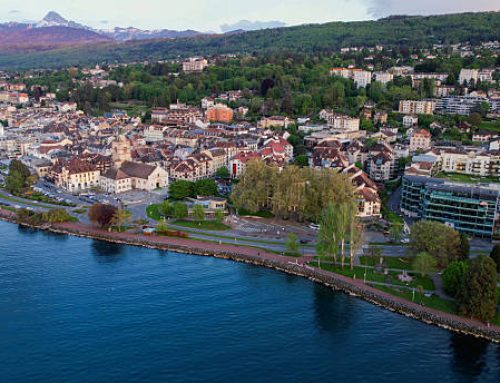
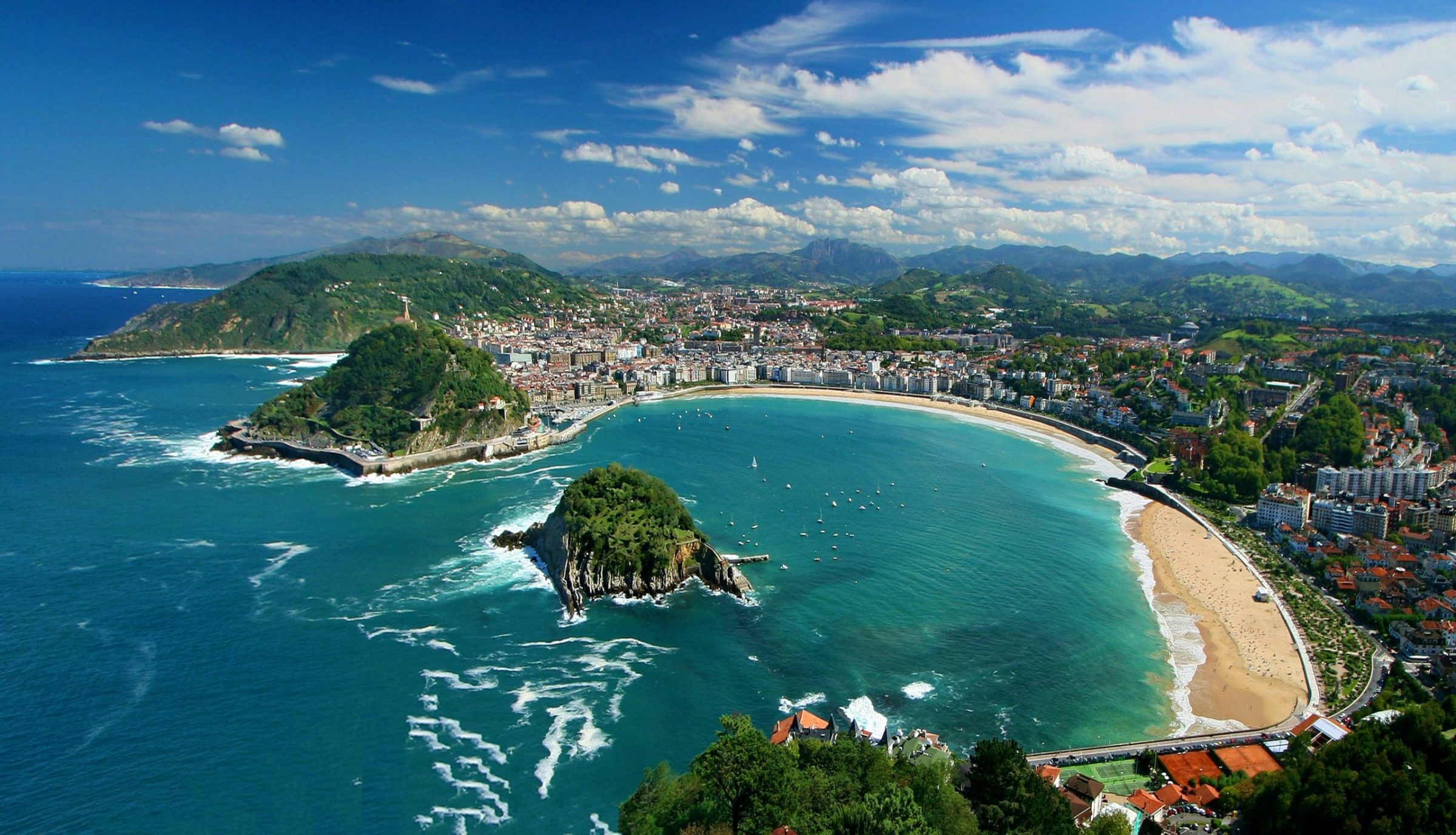
La Concha is the reason any of this happened in the first place, and it remains the first and best argument for coming. The bay curves in a near-perfect shell — La Concha means “the shell” — for more than a kilometre and a half of fine golden sand, framed at each end by green hills and, at its mouth, by the small wooded island of Santa Clara. The promenade that runs its full length, with its ornate white balustrade now a symbol of the city in its own right, was built for exactly the kind of unhurried, see-and-be-seen stroll that filled it in 1900 and still does today.
Walk the bay from east to west and the city tells its own story without needing a guide. You begin near the old town and the city hall, pass beneath the Belle Époque hotels of the Área Romántica, and reach Ondarreta beach beneath the cliff where the Miramar Palace still stands in its gardens, open to the public and giving the same view over the water that once belonged to a queen. Beyond Ondarreta the headland rises into Monte Igeldo, reachable by a century-old funicular, where a slightly faded but much-loved amusement park has occupied the summit since 1912 and the views back over the whole sweep of the bay are the best in the city. At the bay’s eastern tip, where it gives way to the open Atlantic, Zurriola beach faces the sea directly rather than the sheltered curve of La Concha, drawing a year-round community of surfers and giving the Gros neighbourhood behind it a younger, saltier energy than the formal grandeur of the centre.
The Old Town, the Parte Vieja, sits at the bay’s eastern corner, a tight grid of narrow streets that has hardly changed its footprint since the medieval walls came down in 1863. By day it holds the city’s oldest buildings, the Gothic severity of the Church of San Vicente, the baroque Basilica of Santa María del Coro, the excellent San Telmo Museoa in a sixteenth-century former convent. By night it becomes something else entirely, which brings us to the real reason most people come to San Sebastián at all.
A City Built Around the Table
San Sebastián holds the unusual distinction of having the second-highest concentration of Michelin stars per capita of any city in the world, beaten only by Kyoto. At the top sit the names that built modern Basque cuisine: Arzak, still run by the family that helped invent New Basque Cooking in the 1970s; Akelarre, where Pedro Subijana has held three stars on a clifftop above the Bay of Biscay for decades; Mugaritz, just outside the city, where Andoni Luis Aduriz treats a meal as something closer to a question than a service. Booking any of the three wants to happen months ahead, and a Michelin-starred lunch, rather than dinner, is generally the better-value way in.
But the truer, livelier expression of this city’s relationship with food happens lower down and later at night, in the pintxos bars of the Parte Vieja, in a ritual the locals call the txikiteo. The rule is simple and almost nobody who hasn’t done it quite believes how well it works: one bar, one dish, one small glass, then move on. You are not settling in. You are assembling an entire evening’s meal one perfect bite at a time, standing at a zinc counter with a glass of txakoli, the local lightly sparkling white poured theatrically from a height, in your hand.
A handful of names come up again and again, from locals and obsessive visitors alike, and they are worth knowing by name rather than simply “go and find a pintxos bar.” Ganbara, on San Jerónimo, is the place for product worship: its counter piled with wild seasonal mushrooms, the dish to order a plate of ceps grilled simply and finished with a cured egg yolk, a favourite of the late Anthony Bourdain for exactly the reason it remains everyone else’s favourite too. La Cuchara de San Telmo and its sister bar Borda Berri, both a few steps apart on Fermín Calbetón, represent the more modern, chef-driven wing of the scene, with nothing on display on the counter and everything cooked to order from a chalkboard: the suckling pig and the beef cheek at La Cuchara, the extraordinary “false risotto” of orzo and smoky Idiazábal cheese at Borda Berri, are the dishes people fly back for. Bar Txepetxa, tucked into the Old Town, has spent decades doing remarkable things with the humble anchovy alone. And La Viña, on the same street as La Cepa and its magnificent hanging hams, is where the burnt Basque cheesecake — the dense, caramelised, intentionally scorched tart now copied on dessert menus across the world — was invented, and remains, by some distance, the place to eat it.
The whole evening costs less than a single course at most cities’ fine-dining tables, which is perhaps the most San Sebastián fact of all: this is a city that built one of the world’s great culinary reputations standing up, at a bar, for the price of a round of drinks.
Where to Stay
For the full Belle Époque experience, nothing else competes with the Hotel María Cristina, which has occupied its spot beside the Urumea River since 1912 and has hosted everyone from Woody Allen to Elizabeth Taylor during the San Sebastián Film Festival each September. It is grand in the proper sense rather than the gilded one, and its location, a few minutes’ walk from both the Old Town and the bay, makes it the obvious first choice for a first visit.
For something quieter and more intimate, Villa Soro occupies a restored nineteenth-century private villa near Zurriola beach in the Gros neighbourhood, twenty-five rooms wrapped in genuine, unperformed comfort rather than showy luxury, a short walk from the surf and the old town alike. And for a more contemporary register, the Nobu Hotel sits directly on La Concha Bay itself, its Belle Époque shell reworked inside into something sleek and understated, with a rooftop terrace looking out over Santa Clara Island that is worth the visit even without staying the night.
For the classic seafront position at a gentler price than the María Cristina, the Hotel de Londres y de Inglaterra has stood directly on the promenade since the early 1900s, once a favourite of visiting film critics during the festival, its terrace giving uninterrupted views across the whole bay.
The Practical Details
San Sebastián is roughly seventy minutes from Biarritz by road, which makes it a natural pairing for any trip already planned around the French Basque coast, or a destination in its own right reached via Bilbao, where direct flights from London take around two hours, followed by a further hour and a quarter along the coast. June through September brings the best of the beach weather and the busiest crowds; May and October are the sweet spot, warm enough for the bay and quiet enough that the pintxos bars aren’t fighting off coach parties.
Three days is a sensible minimum: a day for the bay and the Old Town, a day given over properly to the pintxos crawl, and a third for whichever direction takes your fancy, whether that is a Michelin lunch, the funicular up Monte Igeldo, or simply doing the whole bay walk again, more slowly this time, the way the Belle Époque visitors who built this city always intended you to.