The Fordwich Arms
A Michelin-starred pub in England’s smallest town, beside the River Stour, two miles from Canterbury and a long way from anywhere ordinary. One of the finest restaurants in Kent. Possibly one of the finest in the country.
There are places you hear about before you visit and places that arrive without warning, and the Fordwich Arms has always been both at once. If you know, you know: a riverside pub in a medieval town of barely three hundred souls, where a young chef arrived in 2017 and within ten months had earned a Michelin star, a 10/10 from Grace Dent in The Guardian and a reputation that has been quietly compounding ever since. If you don’t know, the approach tells you almost nothing. A country road, a river, a Tudor town hall on one side, a pub that looks from the outside like exactly the kind of place you’d stop for a quiet pint on a Sunday afternoon. Then you go in, and you understand.
The Smallest Town in England
Fordwich earns its own paragraph, because understanding it is part of understanding the restaurant it contains.
It is officially the smallest town in England, and has been a town, in one form or another, since 675 AD. Its population at the last count was 372. It covers less than two square kilometres of riverbank, water meadow and old timber buildings. And it was, for a significant portion of the medieval period, one of the most important ports in the country.
The River Stour was once navigable as far inland as Fordwich, making it the natural landing point for goods arriving from France and from the sea, and the town grew into the principal port of its larger and more famous neighbour, Canterbury, just two miles upstream. When the great Cathedral was damaged by fire in 1174 and reconstruction began in the Gothic style, it was through Fordwich that the Caen stone came: unloaded from boats on the Stour and carted to Canterbury by road. The town’s Tudor town hall, built in 1544, still stands opposite the Fordwich Arms on the riverbank. It is the smallest working town hall in England, and it contains a ducking stool that was once used for rather more than decoration.
The river silted up. The port became less useful. The town lost its borough status in 1886 and spent nearly a century as a parish of Canterbury, before successfully reclaiming its town status in 1974 under the Local Government Act, on the strength of its historic chartered rights rather than its population. It now has a mayor, a town council, and a Michelin-starred restaurant. Not bad for three hundred and seventy-two people.

Daniel and Natasha Smith
The Fordwich Arms had been a village pub for a generation when Sue and Shaun Donnelly retired in November 2017 after twenty-four years at the helm. They were, by every account, the heart of the community: beloved, embedded, essentially irreplaceable. When Daniel and Natasha Smith took over at twenty-six years old, the locals were not entirely welcoming. Dan has spoken openly about the difficulty of following people so deeply rooted in the village. “They were big boots to fill,” he has said, “and there were a lot of people against our vision for the pub from day one.”
The vision, as it turned out, was rather good.
Dan Smith had spent five years at The Clove Club in Shoreditch, one of London’s most serious and celebrated restaurants, where he was part of the team that earned it a Michelin star. Before that he had worked across several of Jason Atherton’s restaurants, acquiring a technical precision and a philosophy of cooking that places ingredient quality and flavour balance above everything else. In 2016, a year before Fordwich, he was named The Observer’s Young Chef of the Year. He was not an unknown quantity.
Natasha, who runs the front of house and the business alongside Dan, had been one of the head pastry chefs for a luxury London catering operation. Together they brought something the Fordwich Arms had not had before: the rigour and ambition of a serious London restaurant, applied to the setting of a riverside Kent pub, with Kentish farms and suppliers providing the raw materials. The combination was, on reflection, obvious. In practice, it produced something exceptional.
Ten months after opening, in October 2018, the Michelin Guide awarded the Fordwich Arms a star. Three AA Rosettes followed in January 2019, the guide noting cooking that demonstrates “the selection and sympathetic treatment of the highest quality ingredients” with timing, seasoning and flavour combinations that are “consistently excellent.” Dan was named La Liste’s Young Talent of the Year in 2021. The restaurant has appeared in every significant list it has been eligible for, and it has retained its star without interruption. The Bridge Arms in nearby Bridge, which the Smiths also took over during lockdown and reopened in 2021, earned its own Michelin star the same year — making Dan and Natasha the only couple in the country to hold two starred pubs simultaneously.
What The Critics Said
The critical reception to the Fordwich Arms is worth quoting, because it is unusually consistent and unusually enthusiastic for a restaurant this young, in a location this unexpected.
Grace Dent, reviewing for The Guardian not long after the opening, awarded a perfect 10 out of 10 and described the food as making you “want to move house.” It is the kind of review that changes a restaurant’s trajectory, and it did.
Kathryn Flett in The Telegraph called it “pukka, bells-and-whistles, ambitious modern British.” Tom Parker Bowles in the Mail on Sunday, noting the local resistance to the pub’s transformation, argued it was worth it for the delicious new menu. Giles Coren in The Times described it as “a wonderfully situated local restaurant” and called his meal “the crowning jewel of my winter.” These are not faint endorsements.
The Room
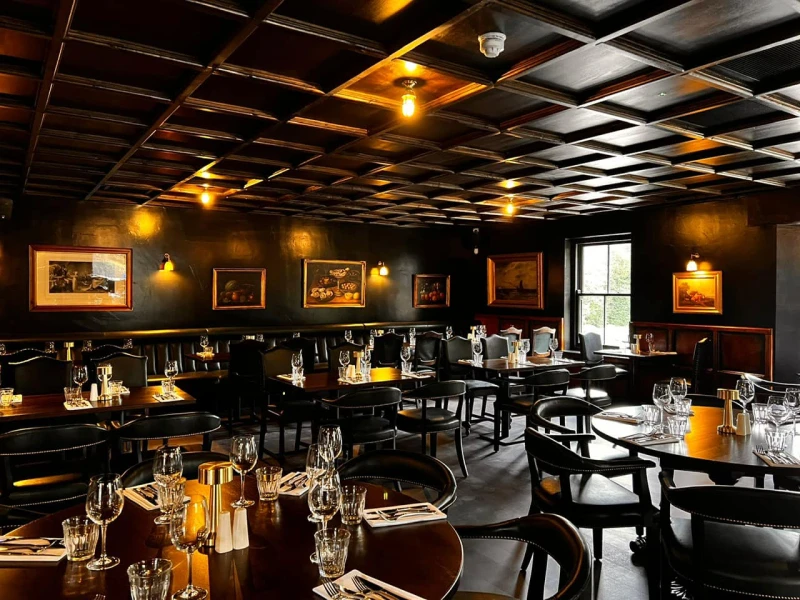
The building has been a tavern in some form for over nine hundred years. The 1930s bar survives and is used: a proper pub bar with real drinks, not a staging area. Beyond it, an oak-panelled dining room with three open fires is where the serious eating happens. It seats around fifty-five, which keeps the experience intimate. The furniture is comfortable, the light is warm, and the view from the riverside tables, looking out over the Stour where the Canterbury stone once arrived by boat, is the kind that makes a meal feel like an occasion without anyone having to announce that it is.
In summer the terrace opens over the river, and it becomes, on a good evening, one of the most idyllic places to eat in England. The combination of a perfect Kent evening, the sound of the Stour, the Tudor town hall opposite, and whatever Dan Smith has sent out that week is, by any honest assessment, rather hard to improve on.

The Food
The cooking at the Fordwich Arms is described by Michelin as “modern British cuisine,” and by the restaurant itself as seasonal, provenance-led and built on the best of Kentish produce. Both descriptions are accurate and both slightly understate what is actually being produced.
The menus change with the season and the supply, which is how a kitchen with this commitment to provenance must work. What appears across the sample menus on the website at time of writing suggests a kitchen cooking with real confidence and real wit: a chicken liver parfait served with Sauternes, beetroot and warm doughnuts, which is a dish that sounds slightly improbable and almost certainly tastes magnificent; hay-smoked confit chalk stream trout with gooseberry, cucumber and smoked butter; a hand-dived Orkney scallop roasted and served with pickled kohlrabi and garlic butter; Hereford beef with Roscoff onion, pickled walnut and morel, the sourcing named on the menu as a matter of principle rather than fashion.
The tasting menu adds native lobster — served with turnip, nettle and lobster butter sauce — and the kitchen’s own version of a Snickers bar for dessert, which is either an act of mischief or an act of confidence and is probably both. The Sunday menu runs to a full roast with Hereford beef or Gloucester Old Spot pork or Blackface lamb saddle, served with the full complement of trimmings: roast potatoes, Yorkshire pudding, glazed carrot, hispi cabbage, tenderstem broccoli, cauliflower cheese. Sharing options include a kilogram of dry-aged rib of Hereford beef, which is the kind of thing that should only be ordered when you have the afternoon arranged for it.
The set menu, available Tuesday through Friday lunch, runs to three courses at £45 per head — a pricing point that, in the context of a Michelin-starred kitchen, represents very good value and speaks to a restaurant that wants to be used rather than merely admired.

The Wine List
The wine list at the Fordwich Arms is not the wine list of a country pub. It is the wine list of a restaurant run by people who care very seriously about what goes in the glass, and it is long, ranging from excellent by-the-glass options at accessible prices to bottles that require a significant commitment and deserve one. Kent is well represented: the Fordwich Arms Reserve, a Gusbourne sparkling wine made in partnership with the restaurant, is the house special and appears throughout the list. Simpsons and Gusbourne feature across multiple entries. Nyetimber, Rathfinny, Chapel Down and Tillingham complete a southern English section that makes a compelling case for the country’s increasingly serious wine industry.
The rest of the list ranges widely and intelligently, from Burgundy (including a 2015 Bâtard-Montrachet for the committed) to natural wines from the Jura, California and Austria, with skin-contact options and a sweet wine section that takes Sauternes and Tokaji alongside Kentish ice cider from Biddenden. It is the kind of list that rewards spending time with it before you order, and the kind that suggests someone on the team genuinely loves wine rather than simply managing a cellar.
The Practical Details
The Fordwich Arms is on King Street in Fordwich, approximately two miles northeast of Canterbury. The nearest station is Sturry, roughly half a mile away, from which Canterbury is a short hop; Canterbury itself has regular high-speed services to London St Pancras in approximately fifty-five to sixty minutes.
Food service runs Tuesday to Saturday for lunch and dinner, and Sunday for lunch only; the pub itself is open wider hours. The tasting menu is available to all group sizes; the à la carte is available to parties of five or fewer, with a reduced version for groups of six to nine. The set menu runs Tuesday through Friday lunch, excluding December and bank holidays. Booking is strongly recommended and should be made well in advance for weekends and evenings. Dietary requirements can be accommodated with forty-eight hours’ notice.
A cancellation policy of £40 per person applies within forty-eight hours, which is standard for a kitchen operating at this level and worth noting before you book.
Fordwich itself rewards the walk from the car park or from the Sturry direction: the Tudor town hall, the Stour, the medieval church of St Mary the Virgin and the sheer improbability of the place are all worth a few minutes before or after the meal. The signposted Stour Valley Walk runs two miles from Fordwich to Canterbury, which makes for a very fine way to work up an appetite or walk off a tasting menu, depending on which direction you choose.
The Fordwich Arms King Street, Fordwich, Canterbury, Kent CT2 0DB
fordwicharms.co.uk
reservations@fordwicharms.co.uk
01227 286690
Booking strongly recommended. Cancellations within 48 hours subject to a £40 per person charge.
This is a researched feature, written from verified sources, published reviews and menu information. Michelin star held continuously since October 2018. Three AA Rosettes.
Menus, prices and opening hours are subject to change; please check the website before travelling.